

Odoo vs Xero is not a like-for-like choice: Xero is accounting software with a flat monthly fee, while Odoo is an ERP priced per user that runs sales, stock, purchasing and accounting in one database. If your stock fits inside Xero, Xero is cheaper and simpler. Once you are paying for an inventory app on top, Odoo usually costs less to run, and the gap widens every year. Before you change anything, the free ERP Readiness Scorecard tells you whether you are ready for a move at all.
Part of The Gantry's automation guides. Updated October 2026.
One thing first: I implement Odoo, so weigh my view accordingly. Xero has real wins below.
Odoo vs Xero: what each one actually is
Xero is cloud accounting. It does invoices, bills, bank reconciliation, GST and reporting well, and simply. For deep inventory, payroll, CRM or job costing you add apps from the Xero App Store, each with its own login, price and data.
Odoo is a suite of business apps on one database: CRM, sales, purchasing, inventory, accounting, manufacturing and more. A sales order reserves stock, the delivery moves it, the invoice posts to the ledger, and nobody re-keys anything. The price is a real implementation project.
So the real question is whether your business still fits in accounting software plus a few apps.
Odoo vs Xero pricing in Singapore (October 2026)
Xero Singapore, per organisation per month, prices in SGD including GST (xero.com/sg pricing):
Starter: S$39, rising to S$42 from 1 November 2026. 20 invoices and 5 bills a month.
Standard: S$70, rising to S$77. Unlimited invoices and bills, no multi-currency.
Premium: S$95, rising to S$99. Adds multi-currency, which most importers need.
Xero does not charge per user, which is its biggest structural advantage. The 1 November increases are on Xero's pricing update page.
Odoo, checked from Singapore on 6 October 2026, bills in US dollars (odoo.com/pricing):
Standard: all apps on Odoo Online, US$16.90 per user per month billed yearly (US$13.50 in the first year), or US$21.10 billed monthly.
Custom: adds Studio, multi-company, the external API and Odoo.sh or on-premise hosting, US$32.00 per user per month yearly (US$25.50 in the first year), or US$40.00 monthly.
At S$1.28 to the US dollar (mid-market, 6 October 2026), Standard is about S$21.63 per user per month after year one. Implementation is extra, as broken down in what Odoo actually costs in 2026.
Singapore specifics: GST F5, InvoiceNow and payroll
GST F5. Xero prepares the F5 and submits it directly to IRAS in one click. Odoo's Singapore localisation includes a tax report laid out in the F5 boxes (I checked the Odoo 19 source), but I have not seen direct submission to IRAS in standard Odoo, so plan on filing the figures in myTax Portal. Point to Xero.
InvoiceNow. IRAS is phasing in the GST InvoiceNow Requirement/gst-invoicenow-requirement): new voluntary registrants already, then existing GST-registered businesses from 1 April 2028 to 1 April 2031 depending on annual supplies. Xero (Singapore) Pte. Ltd. is on IMDA's InvoiceNow-Ready Solution Provider list (updated 1 October 2026). Odoo S.A. is not on it. Odoo generates the Singapore PINT e-invoice format, but its built-in Peppol service does not cover Singapore, so you connect through an accredited provider (several Odoo partners are listed). Check your own date with the free InvoiceNow Deadline Checker, and see when InvoiceNow applies to you.
Payroll. Neither runs Singapore payroll on its own. Xero connects to partner apps such as Talenox; Odoo's Singapore documentation offers an Employment Hero connector. Budget for a payroll app either way.
Odoo or Xero for inventory?
Xero's own inventory is included in every plan and handles up to 4,000 tracked items, valued at average cost. It has no multiple warehouses, batch or serial numbers, landed cost or reordering rules. For one storeroom and a few hundred SKUs, that is enough, and free.
Odoo Inventory gives you multiple warehouses, FIFO or average costing, lots, serials and expiry dates, landed cost, reordering rules and barcode picking, all posting straight to the ledger.
If you need any of that while staying on Xero, you add an inventory app. That is the moment the comparison changes.
What "Xero plus add-ons" really costs
A typical Xero stack for a trader with real stock, at list prices:
Xero Premium: S$99 a month (from 1 November 2026).
Inventory app, e.g. Cin7 Core Standard: US$349 a month, 5 users, 6,000 sales orders a year, prices excluding tax (cin7.com/pricing). That is S$446.72 at S$1.28.
Payroll, e.g. Talenox Payroll: S$4.36 per full-time employee a month including GST, minimum S$21.80 (talenox.com.sg/pricing).
CRM: left out of the sums below because prices vary too much to quote fairly. Add your own.
Worked example: 3-year cost for a 12-person trading company
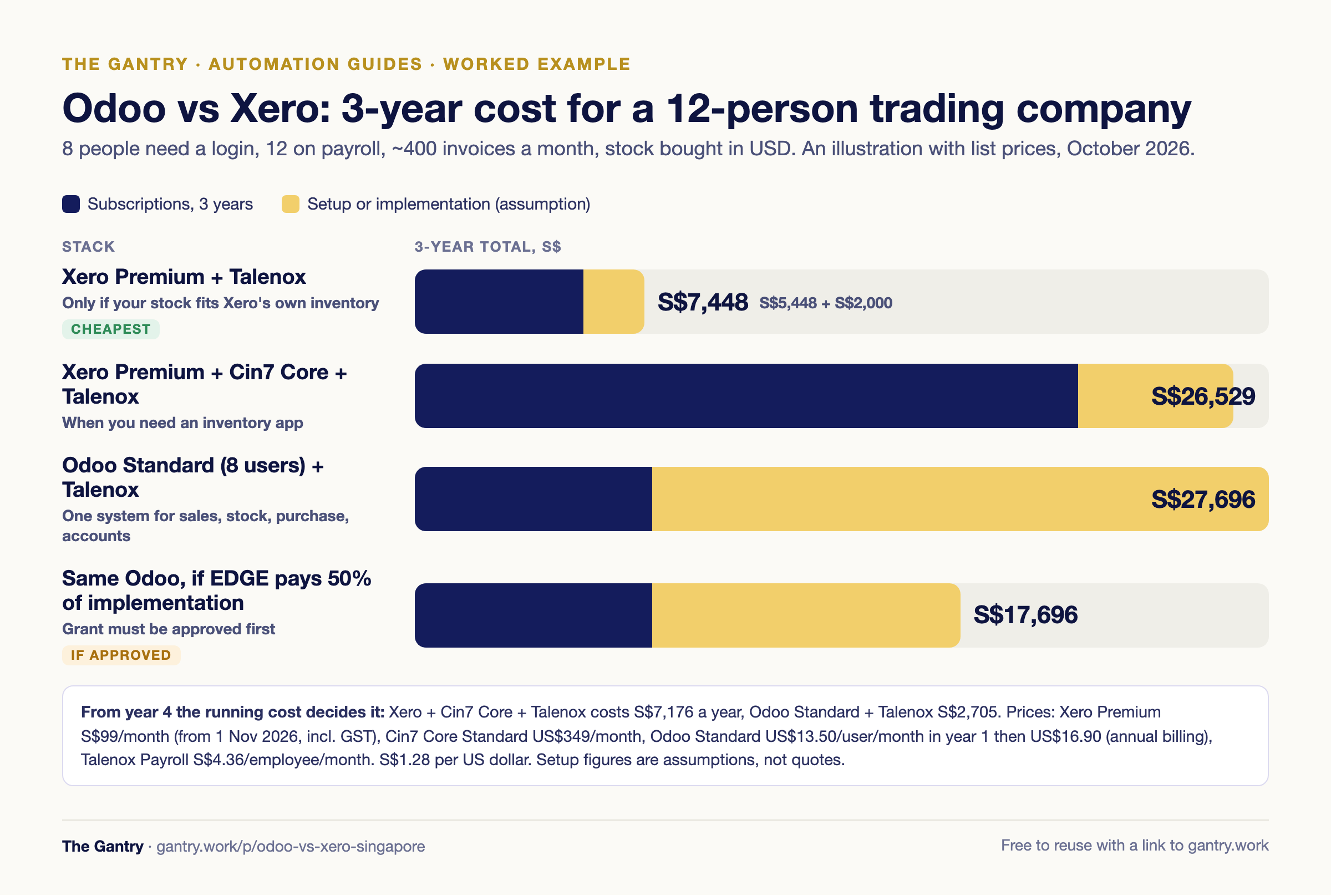
An illustration, not a quote. A typical 12-person trading company: about 400 invoices a month, one Tuas warehouse, purchases in US dollars. Eight people need a login (owner, two sales, one purchasing, two warehouse, two finance); all 12 are on payroll. List prices as above, S$1.28 per US dollar, Odoo billed yearly.
Stack A: Xero Premium + Xero's own inventory + Talenox
Xero: S$99 × 12 = S$1,188 a year
Talenox: S$4.36 × 12 staff × 12 months = S$627.84 a year
3 years: (S$1,188 + S$627.84) × 3 = S$5,447.52
Plus S$2,000 setup (my assumption) = S$7,447.52
Stack B: Xero Premium + Cin7 Core Standard + Talenox
Cin7 Core: US$349 × 12 × 1.28 = S$5,360.64 a year
Per year: S$1,188 + S$5,360.64 + S$627.84 = S$7,176.48
3 years: S$21,529.44
Plus S$5,000 setup (assumption) = S$26,529.44
Stack C: Odoo Standard, 8 users + Talenox
Year 1: US$13.50 × 8 × 12 × 1.28 = S$1,658.88
Years 2 and 3: US$16.90 × 8 × 12 × 1.28 = S$2,076.67 each
Odoo over 3 years: S$5,812.22, plus Talenox S$1,883.52 = S$7,695.74
Plus S$20,000 implementation (assumption, within the range in my cost guide) = S$27,695.74
Over three years, B and C come out almost level, with Odoo about S$1,166 dearer. After that the running cost decides it: S$7,176.48 a year for B against S$2,704.51 for C, a gap of S$4,471.97 a year. Odoo pulls ahead early in year 4. If the EDGE grant is approved for half of the implementation, C drops to S$17,695.74 and is ahead by the end of year 2.
And Stack A, at S$7,447.52, beats everything. If Xero's own inventory covers you, stay.
The per-user break-even. Xero Premium plus Cin7 Core Standard is S$545.72 a month. Odoo Standard is S$21.63 per user after year one, so on subscriptions alone Odoo stays cheaper up to about 25 users (545.72 ÷ 21.63 = 25.2), though Cin7 Core Standard itself stops at 5 users. Against Xero Premium alone, S$99 buys fewer than 5 Odoo users. The inventory app is what flips it.
Two caveats. On the Custom plan, Odoo for 8 users costs S$10,997.76 over 3 years instead of S$5,812.22. And Xero's prices include GST while the US dollar prices exclude tax, so a GST-registered buyer's real Xero cost is a little lower.
Also weighing AutoCount, the local favourite for stock-heavy traders? See AutoCount vs Xero vs Odoo for the inventory tests and SGD prices side by side.
When to keep Xero
Your stock fits Xero's inventory: one location, average cost, under 4,000 items, no batches.
Most of your team never touches the system, so a flat fee beats per-user pricing.
Your accountant runs your books in Xero and the month-end works. Do not underrate that.
You cannot spare two key people for a three-month project right now.
Plenty of 20-person service companies should never leave Xero.
When to move to Odoo
You are already paying for an inventory app and re-keying orders between systems.
You run more than one warehouse, import with freight and duty, or need lot and expiry tracking.
Orders, deliveries and invoices live in different places and nobody trusts the stock figure.
You keep adding apps, each with its own sync to babysit.
If that is you, read how to switch ERP systems without the drama before you sign anything.
The middle path: Xero for accounting, Odoo for operations
Some companies keep Xero for the books and run sales, purchasing and stock in Odoo through an integration. It keeps the accountant happy. The pitfalls:
You pay for both. Xero plus Odoo users plus the connector.
Standard is not enough. Odoo's external API is only on the Custom plan, so most connectors push you to US$32 per user.
Stock valuation splits. Decide which system owns cost of goods sold and inventory value, or the two will never reconcile.
Mapping drifts. Tax codes, customers and items must match on both sides, and someone has to watch the sync errors.
Fine as a one-year bridge. As a permanent design it usually costs more than either option alone.
The EDGE grant changes the arithmetic
Since 30 September 2026, the EDGE grant has replaced PSG, EDG and MRA. Integrated enterprise systems can get up to 50% support for SMEs, within a S$30,000 sub-cap per company per year, and the solution needs at least 3 core functions, for example sales, inventory and accounting. It is not Odoo-specific, and nothing is certain until approved. More in EDGE grant for ERP in Singapore.
Odoo vs Xero: my recommendation
If Xero's own inventory covers you, keep Xero. If you already pay for an inventory app, or soon will, Odoo is usually cheaper from year 4 and simpler every day, and EDGE can pull that forward. If you are under 10 people with simple stock, you probably need neither change yet.
Stuck between the two? Bring your current setup (users, invoices a month, stock items, the apps you bolt on) to a free 20-minute systems review. I will tell you honestly which one fits, or whether you need either yet.
Stuck on a step? Tell me where you're stuck and you'll get the fix, or a free 20-minute review if it's worth one.
Frequently asked questions
Is Odoo better than Xero? For accounting alone, no: Xero is simpler and files GST directly with IRAS. For a business that also runs stock, purchasing and sales in one place, Odoo is.
Can Odoo replace Xero? Yes. Odoo Accounting handles invoicing, bills, bank reconciliation and a GST report in the F5 boxes. Switch at the start of a financial year or quarter.
Is there an Odoo Xero integration? Odoo does not ship one. Third-party connectors exist, and most need the Custom plan because Standard has no external API.
Odoo or Xero for inventory? Xero for simple stock in one location. Odoo once you need multiple warehouses, landed costs, lots or reordering rules.
Is Xero or Odoo InvoiceNow-ready? Xero is on IMDA's InvoiceNow-Ready Solution Provider list. Odoo is used for InvoiceNow through accredited partners and providers, not natively.
Does Xero do payroll in Singapore? Not by itself. It connects to payroll apps such as Talenox, HReasily and SimplePay.
Related guides
What Odoo actually costs in 2026 · Odoo Community vs Enterprise · Is QuickBooks an ERP? · From spreadsheets to ERP · The best cloud ERP for SMEs in 2026
Want this handled properly? I do a free 20-minute systems review. No pitch, just your questions answered.
I'm Sayed. I work closely with business owners to automate their operations and build workflows that actually make sense. I write The Gantry about ERP and automation for SMEs.