

“So… how much will Odoo cost us?” It’s the first question in almost every discovery call I run, and the honest answer is more useful than the one on most pricing pages. Here it is up front:
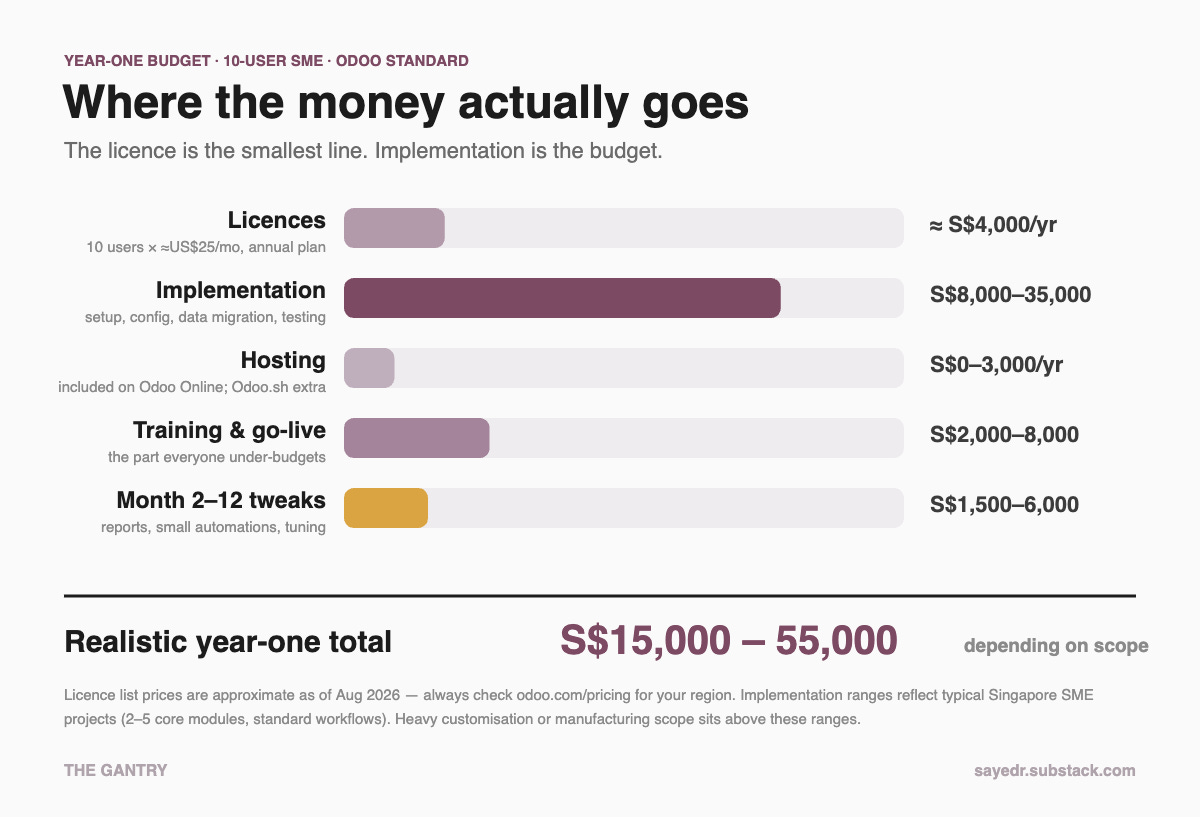
Short answer: For a 10-user company on Odoo Standard billed yearly, licences are US$1,620 in year one and US$2,028 a year after that. The bigger cost is implementation: S$8,000 to S$35,000 one-off for 2 to 5 core modules, giving a realistic all-in year one of S$14,000 to S$54,000 depending on scope.
Key facts
Checked from Singapore on 7 October 2026, Standard is US$16.90 per user per month billed yearly, discounted to US$13.50 for the first 12 months.
Custom is US$32.00 per user per month billed yearly (US$25.50 for the first 12 months) and adds Odoo Studio, multi-company and the external API.
Monthly billing is US$21.10 on Standard and US$40.00 on Custom; Odoo showed US dollars, with no SGD price, to a Singapore connection.
Worked example: a 10-user trading company on Sales, Purchasing, Inventory and Accounting lands around S$20,000–30,000 in year one.
Only internal users need licences, but HR employee records with no linked user also count as paying users.
Implementation is not included; the subscription covers Odoo Online hosting, daily backups, weekday email support, upgrades and eLearning.
Figures checked 7 October 2026, against Odoo's pricing page and FAQ.
The licence is the cheap part. Odoo’s paid plans list at roughly US$17 per user per month on the annual Standard plan, with a lower first-year rate (always confirm current pricing for your region at odoo.com/pricing — it changes). For a 10-person company on Standard, that is US$2,028 a year at list price (US$1,620 in the first year), roughly S$2,600. The real budget is the implementation: for a typical Singapore SME going live with 2–5 core modules, expect S$8,000–35,000 one-off, plus training and a buffer for the tweaks you’ll want in months two to twelve. A realistic all-in year-one number for a 10-user company is S$14,000–54,000 depending on scope.
That range is wide, so the rest of this post breaks down exactly what moves you toward the bottom or the top of it.
The whole picture in 50 seconds
The short version: per-user licences are the small line, the implementation is the budget, and year two is priced at list, not at the first-year discount. The plans, the worked example and the line items nobody budgets are below.
What you’re actually buying
Odoo’s pricing looks simple — three plans — but the differences matter:
One App Free: one app, unlimited users, genuinely free. Great for trying the CRM or Website builder; not a company system.
Standard: every app, hosted on Odoo Online. This is where most SMEs should start. No custom code allowed — which is a feature, not a limitation (more below).
Custom: adds Odoo Studio, multi-company, external API access, and Odoo.sh hosting eligibility. You need this tier the moment you want custom development or serious integrations.
There’s also Odoo Community — the open-source edition, free forever, self-hosted. It’s real and it works, but you give up accounting localisations, payroll, Studio, and hosted convenience, and you take on server responsibility. For most non-technical SMEs the paid Standard plan is cheaper than “free” once you price in the DevOps. I walk through that choice in Odoo Community vs Enterprise: the decision tree I use with clients.
Deciding on a system for your own business? In a free 20-minute systems review, you walk me through how sales, stock and accounts run today, and I tell you honestly which system fits, or whether you need one yet. No pitch. Book a free 20-minute review
Did Odoo raise its prices in 2026?
Yes for the Custom plan, no for Standard. Odoo raised its published Custom prices in the US in January 2026, from US$46.70 to US$61.00 per user per month billed yearly (about 31% more), and in euro markets in September 2026, where Germany went from €37.40 to €44.90. The Standard plan and the free One App plan did not change. Odoo sets prices country by country, so check Odoo's pricing page from your own location.
From Singapore in September 2026, per user per month billed yearly, it shows:
Standard: US$16.90, discounted to US$13.50 for the first 12 months.
Custom: US$32.00, discounted to US$25.50 for the first 12 months.
Light User: US$5.90, a cheaper licence for staff with limited use; check what it includes before you rely on it.
What that means for your budget:
Budget for year two, not year one. The first-year discount applies to the users you order at the start. From month 13 you pay list price, and existing customers usually see new prices at renewal.
Only pay for Custom if you need it. Custom adds Odoo Studio, multi-company and the external API. You need it if you run more than one company in one database, or if another system, such as a Make or n8n automation, has to read and write your Odoo data.
Monthly billing costs more. Paying monthly instead of yearly adds roughly a quarter to the licence bill.
How much does Odoo cost per user?
List pricing moves around and differs by region, but the shape has been stable for years: roughly US$17/user/month on Standard (annual billing) and US$32 on Custom, with first-year discounts to about US$13.50 and US$25.50. Two things people miss:
Only internal users need licences. Your customers on the portal, suppliers receiving RFQs, job applicants — all free. A 30-person company where only 12 people actually create records needs 12 licences, not 30. One catch: Odoo now also counts employee records in the HR apps that have no user login, so check that before you budget.
Every app is included. Unlike per-module pricing (looking at you, most mid-market ERPs), adding Inventory or HR later costs nothing extra in licences.
What actually drives implementation cost
When I scope a project, five questions decide whether you’re at S$8,000 or S$35,000:
How many workflows go live at once? Sales + invoicing is one thing. Sales + purchasing + inventory + accounting + a POS is another. Each module multiplies testing and training, not just configuration.
How dirty is your data? Migrating a clean customer list takes an afternoon. Migrating five years of half-duplicated contacts, open invoices, and stock balances from three different spreadsheets is often the single biggest line in the quote.
How standard are your processes? If you can adapt to Odoo’s default flow, you save real money. Every “but we’ve always done it this way” that becomes custom development adds cost now and upgrade friction forever.
Integrations. Connecting a webshop, a logistics provider, or PEPPOL e-invoicing each adds scoped work.
Who does the change management? If your team expects to be trained module by module with hand-holding through month one, budget for it. It’s worth every dollar — untrained users are how ERP projects fail — but it must be in the plan.
A worked example: 10-user trading company
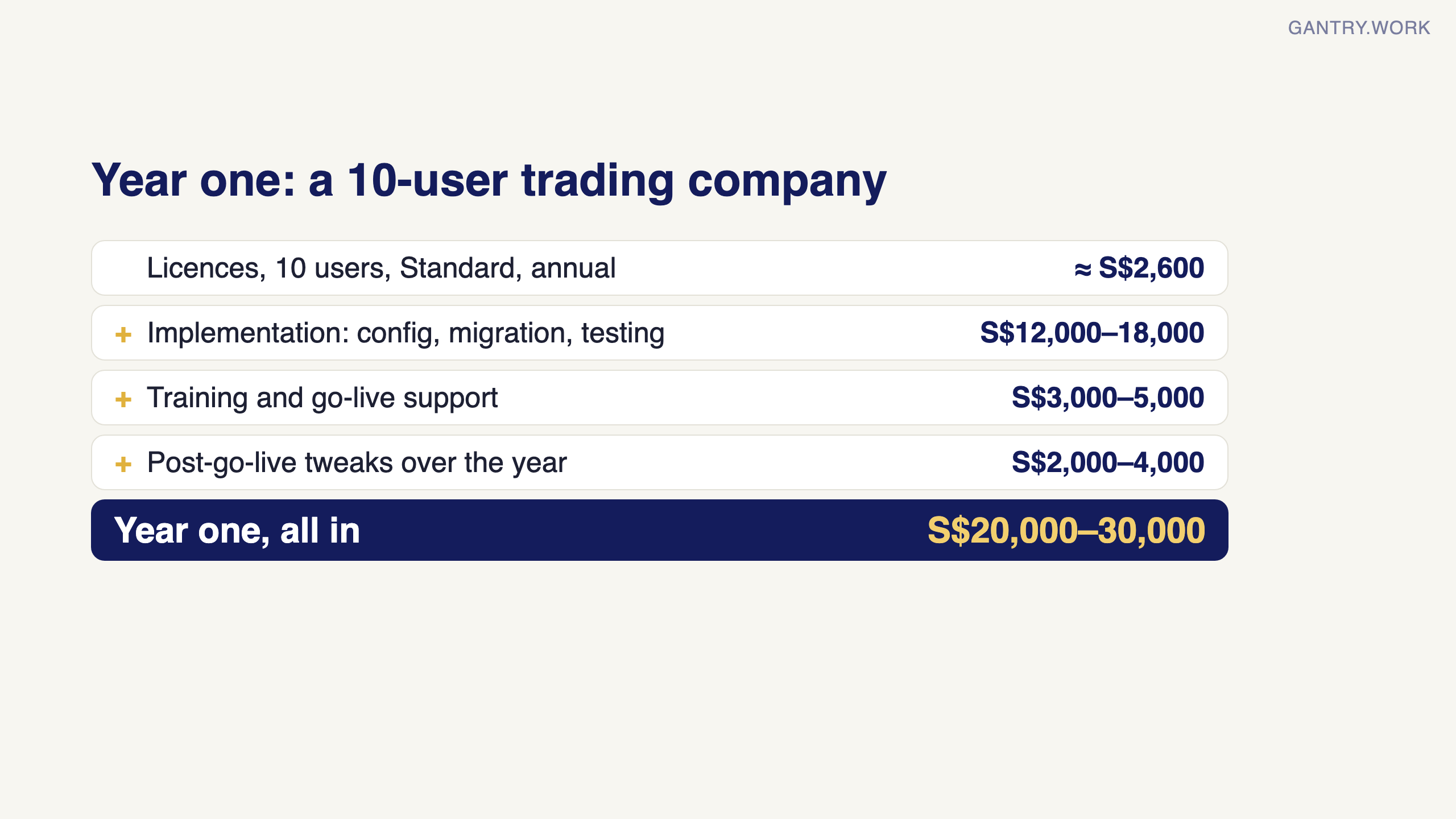
A typical scope I see for a Singapore trading/distribution SME — Sales, Purchasing, Inventory, Accounting, no custom code, data migrated from spreadsheets and an old accounting package:
Licences (10 users, Standard, annual): ≈ S$2,600/year (US$2,028 at list price)
Implementation (config, migration, testing): ≈ S$12,000–18,000 one-off
Training and go-live support: ≈ S$3,000–5,000
Post-go-live tweaks over the year: ≈ S$2,000–4,000
Year one lands around S$20,000–30,000, and year two drops to licences plus a small support retainer. Compare that against what the company is paying today: the accounting package subscription, the inventory tool, the standalone CRM, and — the number nobody calculates — the hours spent re-typing data between them.
The costs nobody budgets
Three line items that surprise people, in order of how often I see them:
Data cleaning. Not migration — cleaning. Deciding which of your 4,000 contacts are real, standardising product codes, agreeing what your chart of accounts should look like. The software can’t do this for you, and it takes internal hours from your best people.
The month-two list. After go-live, users generate a list of “can we just…” requests. Good ones are worth doing — a custom report here, an automated email there. Budget S$1,500–6,000 for the year and you’ll never feel stuck.
Parallel-running the old system too long. Every extra month you keep the old system “just in case” costs its subscription and doubles data entry. Set a kill date.
What does an Odoo upgrade cost?
Odoo releases a new major version every year and supports the last three. The upgrade of the database itself is part of what you pay for: on Odoo Online, Odoo upgrades your database for you, and on Odoo.sh or your own server an Enterprise subscription includes Odoo's upgrade service. So moving from Odoo 17 to 18, or 18 to 19, does not come with a separate licence bill.
What costs money is everything around it. Custom modules have to be rewritten for the new version, third-party apps need versions that support it, and someone has to test your real processes on an upgraded copy of the database before you switch. On a standard Odoo with no custom code, the work is mostly that testing. With heavy customisation the upgrade becomes a project of its own, which is why the cheapest upgrade is the one where you kept custom code out in the first place (see configuration vs customisation).
Odoo Community has no upgrade service. Moving a Community database to a new version means using the community-maintained OpenUpgrade scripts or paying a developer, so budget for it if you choose the free edition.
Is Odoo free or paid?
Both, genuinely. The Community edition is free open-source software, and the One App Free plan is a free hosted single app. But for a company that wants accounting, localisation, support, and hosting handled — the paid Standard plan is the honest baseline. If a proposal you’ve received is built on Community “to save licence fees”, make sure you understand what you’re giving up and who is maintaining the server.
How to keep the budget at the bottom of the range
Phase the rollout. Go live with the two modules that hurt most, stabilise for a month, then add the next. Smaller bites, faster wins, less training shock.
Start standard, customise later. Live with default workflows for 60 days before commissioning any custom development. Half the “must-have” customisations evaporate once people actually use the system.
Assign an internal owner. One person on your side who makes decisions quickly. Projects stall — and stalled projects bill — when every config question needs a committee.
Clean data before the project starts. Internal hours are cheaper than consultant hours.
Weighing Odoo against staying on Xero? Odoo vs Xero in Singapore compares 3-year costs for a 12-person trader, including the inventory app most Xero users end up adding.
The bottom line
Odoo is one of the most affordable ways for an SME to get a real ERP — but “affordable” lives in the implementation decisions, not the licence table. If you’re budgeting: take the worked example above, adjust for your module count and data mess, and you’ll be within striking distance of any honest quote you receive.
One more thing before you sign with anyone: run the demo around your own workflows, not the vendor's sample company. I wrote a one-page brief for that in how to get an Odoo demo that actually tells you something.
Related reading: How Long Does an Odoo Implementation Take? 6 Weeks vs 6 Months, Explained
What does Odoo cost per user in 2026, checked from Singapore?
From Singapore on 7 October 2026, Odoo costs US$16.90 per user per month on Standard and US$32.00 on Custom, billed yearly, with lower first-year rates.
This is the full Odoo pricing list the page showed me, per user per month:
One App Free: US$0 for one app with unlimited users on Odoo Online. If that app depends on others (eCommerce needs Website and Invoicing), you get those free as well.
Standard, billed yearly: US$16.90, discounted to US$13.50 for the first 12 months.
Standard, billed monthly: US$21.10, discounted to US$16.90 for the first 12 months.
Custom, billed yearly: US$32.00, discounted to US$25.50 for the first 12 months.
Custom, billed monthly: US$40.00, discounted to US$32.00 for the first 12 months.
Light User: US$5.90, quoted through an Odoo advisor rather than bought online.
Odoo shows these prices in US dollars to Singapore visitors. There was no SGD price on the page, so budget for exchange-rate movement. The discount covers only the users you order at the start.
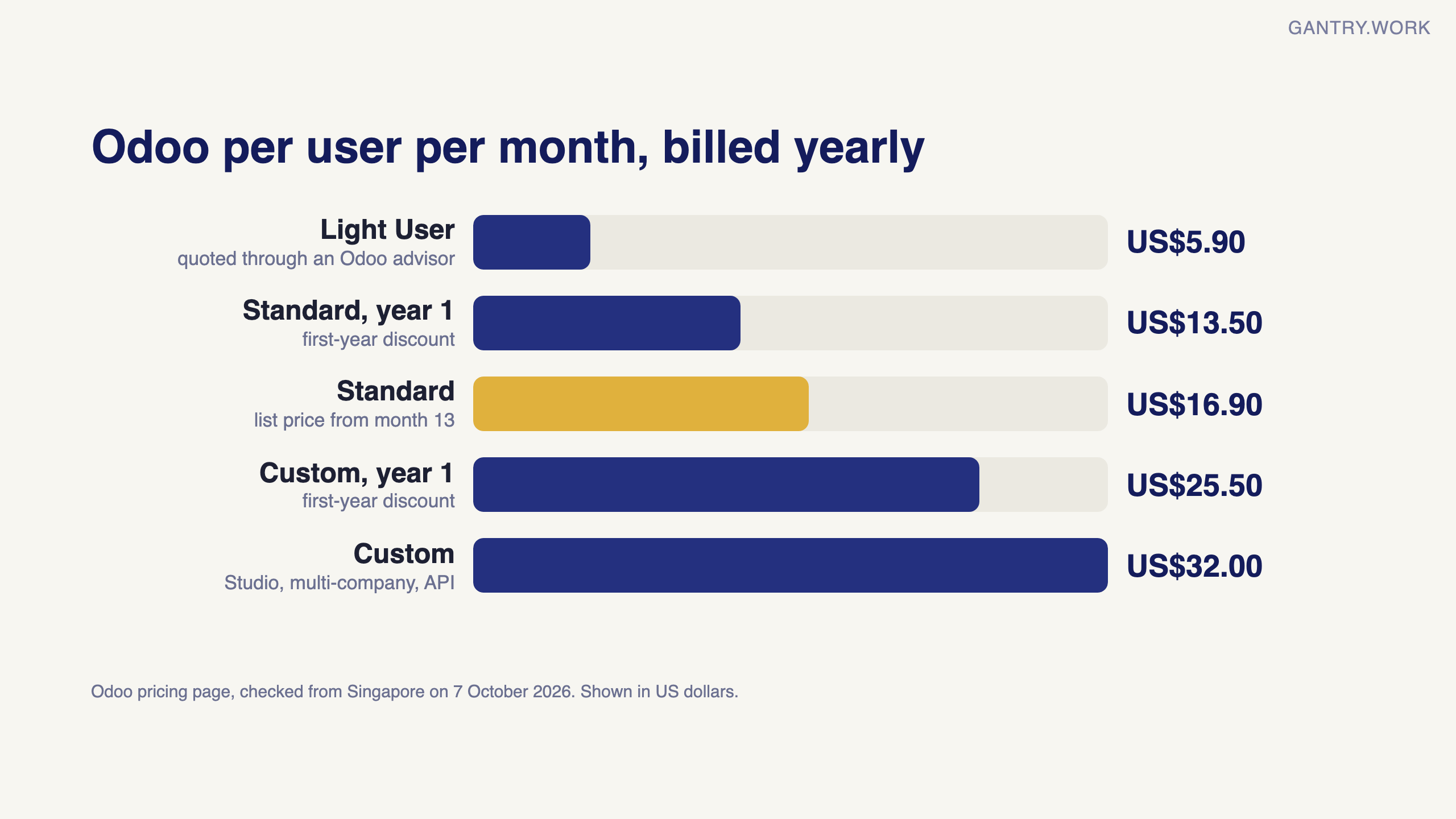
A typical example: 10 users on Standard billed yearly pay US$1,620 in year one (10 × 13.50 × 12) and US$2,028 a year from year two (10 × 16.90 × 12). The same team on Custom pays US$3,060, then US$3,840.
Who counts as a paying Odoo user?
Anyone with backend access to create, view or edit records is a paying user, and so is any HR employee record with no linked user.
That second rule catches people out. If you load all 30 staff into Employees so time off or payslips run in Odoo, the staff without a login still count. Odoo's Light User covers exactly those records and limited-use staff (time off, expenses, attendance, barcode scanning, payslips, POS and the shop floor), so ask for a Light User quote before you price 30 full licences. The "12 licences, not 30" example in this guide holds only if the other 18 are not set up as employees. Customers and suppliers on the portal, and shoppers on your website, are always free.
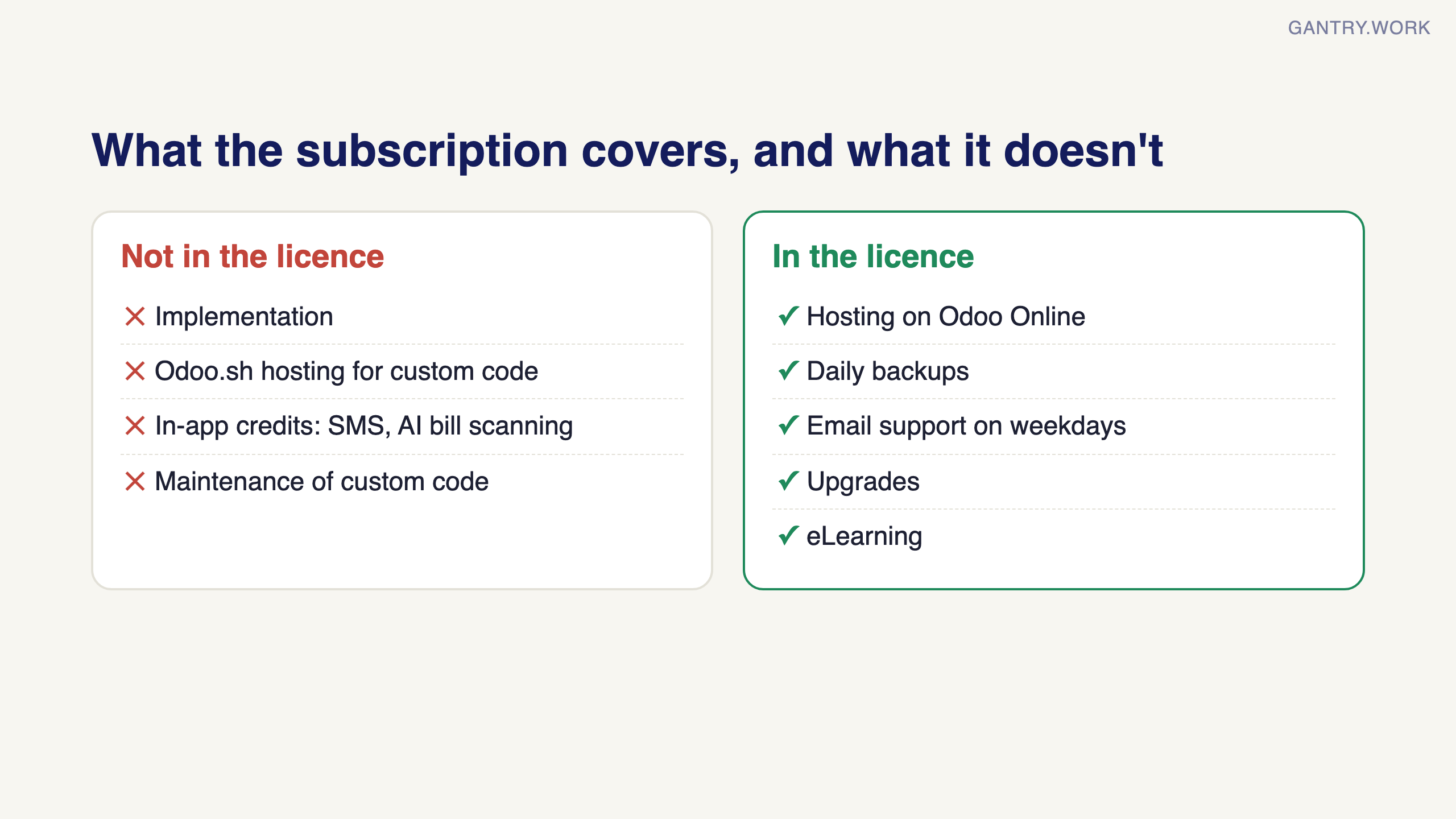
What the subscription includes: hosting on Odoo Online, daily backups, email support on weekdays, upgrades and eLearning. What it leaves out: implementation, Odoo.sh hosting for custom code, in-app purchase credits (SMS, AI bill scanning, lead generation) and maintenance of custom code.
Sources, checked 7 October 2026: Odoo pricing page and FAQ (plan prices, first-year discount terms, Light User definition, paying-user definition, One App Free rules, inclusions and exclusions).
Frequently asked questions
How much does Odoo cost per user? From Singapore, US$16.90 per user per month on Standard billed yearly (US$13.50 in the first year) and US$32.00 on Custom (US$25.50 in the first year). Monthly billing is US$21.10 and US$40.00.
Is Odoo free? One app is free forever for unlimited users on Odoo Online, and Odoo Community is free open-source software you host yourself. Install a second app on Odoo Online and you move to the paid Standard plan.
Does Odoo charge Singapore businesses in SGD? Not on its public pricing page. On 7 October 2026 it showed US dollars from a Singapore connection.
Is implementation included in the Odoo price? No. Odoo lists implementation services as not included, which is why the S$8,000 to S$35,000 implementation range in this guide is a separate budget line. If you are deciding whether to hire help, here is when an Odoo consultant is worth it.
I’m Sayed — I work closely with business owners to automate their operations and build workflows that actually make sense. I write The Gantry about ERP and automation for SMEs. If you’re weighing up an ERP move, the next posts cover how to choose between Odoo’s editions, what migrations really involve, and when Odoo is the wrong answer. Subscribe to get them.
Cost is only half the maths. The other half is what the system hands back, and over how long.

The free ERP ROI calculator at work: your team, hours and setup cost in, payback and 15-year value out. Click the animation to try it.
Most of the implementation cost sits in a handful of project steps. The ERP glossary explains each one, including fit-gap analysis, configuration vs customisation and scope creep.
Working on something similar? Connect with me on LinkedIn and tell me what you are working on. I read and reply to every message, and the questions people send become the next guides.
How I test everything and how this site makes money: How The Gantry works.