

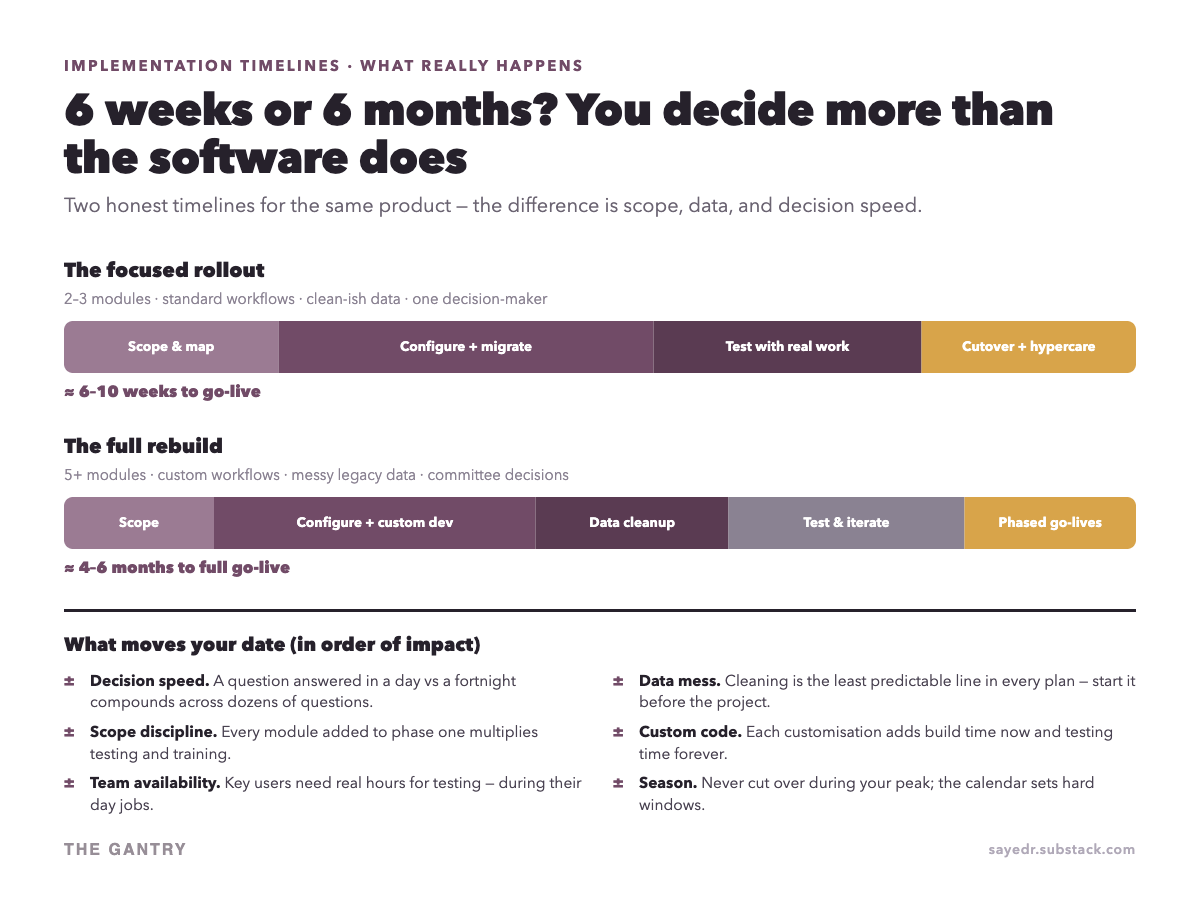
The unsatisfying-but-true answer: between six weeks and six months — and here’s the useful part: which end of that range you land on is decided mostly by choices you control, not by the software. A focused two-module rollout with clean data and a decisive owner goes live in six to ten weeks. A five-module rebuild with custom workflows, messy legacy data and committee sign-offs takes four to six months. Same product, same kind of consultant — different project design. Let’s break down where the time actually goes.
Where the weeks actually go
People imagine implementation time is consultants configuring software. Configuration is the fast part. The real timeline is made of four other things: decisions (yours), data cleaning (mostly yours), testing (jointly), and waiting — for answers, for availability, for the season to allow a cutover. When a project doubles its estimate, the overrun almost always lives in those four, not in the software work.
The focused rollout: 6–10 weeks
This is the timeline when a company goes live with two or three core modules — say Sales, Inventory and Accounting — on standard workflows:
Weeks 1–2: scoping and process mapping; you start data cleaning immediately in parallel.
Weeks 3–5: configuration, master data import, first transaction trials.
Weeks 6–7: key users re-run last month’s real transactions in the new system; fixes land daily.
Weeks 8–10: cutover weekend, then hypercare while everyone finds their feet.
What makes this possible isn’t heroics — it’s the constraints: standard workflows (no custom code), a single decision-maker who answers questions within a day, and data cleaning that started on day one, not week five.
The full rebuild: 4–6 months
Add manufacturing with custom routing, a webshop integration, approval chains that mirror a complex org chart, and fifteen years of legacy data — and the same phases stretch honestly: custom development needs specifying, building and (the part people forget) testing every time anything changes. Data archaeology takes weeks. Committee decisions add a week of latency each. None of this is wrong — some businesses genuinely need the bigger scope — but it should be a choice made knowingly, not a surprise discovered in month three.
The six levers you control
Answer fast. Appoint one internal owner empowered to decide. This is the single biggest schedule lever in every project I’ve run.
Start data cleaning before the kickoff. It’s on your critical path and only you can do the judgment calls. Every week early is a week saved at the end.
Shrink phase one. Ask of every module: “does the business break without this on day one?” If not, it’s phase two. You can add modules to a live system easily; you can’t easily un-delay a go-live.
Defer customisation 60 days. Run standard first. Half the “essential” customisations dissolve once people use the real system — and the ones that survive get built better, informed by actual usage.
Protect testing time. Key users need scheduled hours, on the calendar, treated like customer meetings. Testing squeezed into evenings produces go-live surprises.
Pick the cutover window early. Month-end, quarter-end, or fiscal-year start; never peak season. Working backwards from that date disciplines everything upstream.
How long do ERP implementations take in general?
For calibration beyond Odoo: SME implementations across the industry commonly run 3–9 months, and mid-market/enterprise projects run 1–3 years. If a vendor promises any real ERP fully live in two weeks, they mean “we created your account”. If one quotes a year for a 10-person company, they’re scoping a rebuild you probably don’t need. The 6-week-to-6-month band is where honest SME projects live.
The bottom line
Ask not “how long does it take?” but “which timeline am I choosing?” Design a focused phase one, clean your data early, empower one decision-maker — and the six-to-ten-week version is genuinely available to you. The full playbook for running the switch is in my earlier cornerstone post on changing ERP without stopping the business.
Want a second pair of eyes on your setup? Bring the process that keeps going wrong to a free 20-minute systems review. I'll tell you honestly what to fix first, or whether you need anything new yet.
I’m Sayed — I work closely with business owners to automate their operations and build workflows that actually make sense. I write The Gantry about ERP and automation for SMEs. One more post in this opening series: what construction firms specifically need from an ERP. Subscribe to catch it.
Working on something similar? Connect with me on LinkedIn and tell me what you are working on. I read and reply to every message, and the questions people send become the next guides.
How I test everything and how this site makes money: How The Gantry works.
Before comparing systems, check whether your business is ready for one. The free ERP Readiness Scorecard takes about three minutes and tells you what to fix first.

The free ERP readiness scorecard at work: a few honest answers and a score with what to fix first. Click the animation to try it.