

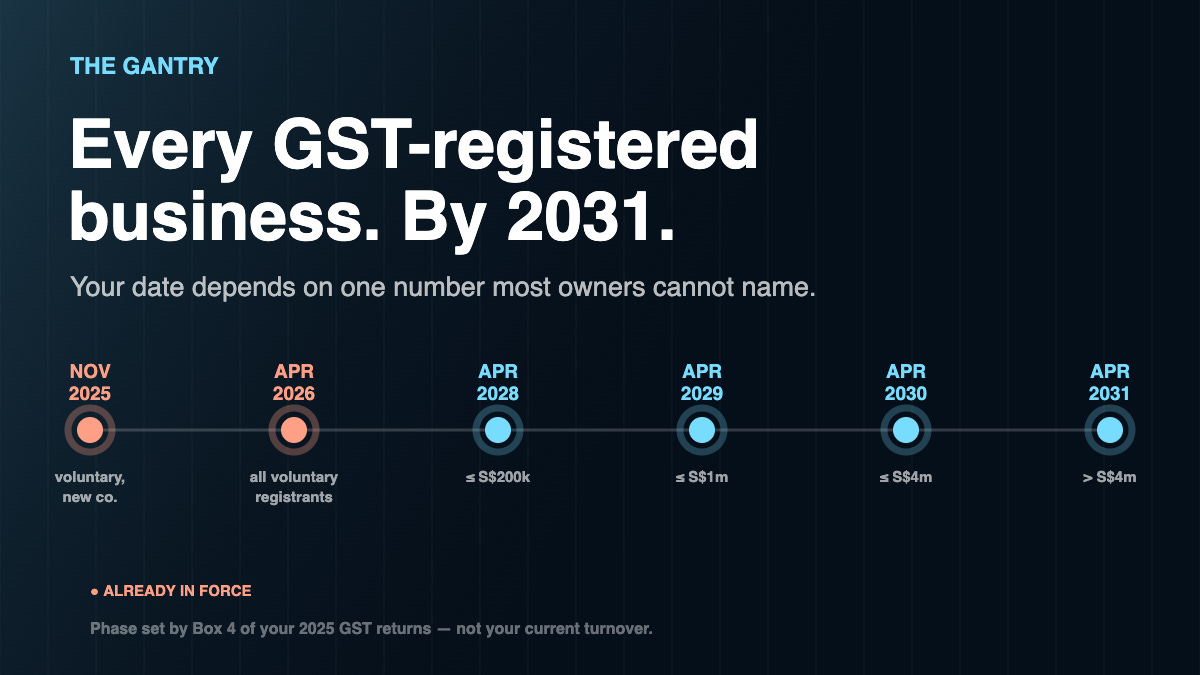
Every GST-registered business in Singapore will have to send its invoice data to IRAS through InvoiceNow. Not the large ones. Not eventually. All of them, on a published schedule that finishes on 1 April 2031.
Short answer: Every GST-registered business in Singapore must send invoice data to IRAS through InvoiceNow on a phased schedule that finishes on 1 April 2031. For existing registrants, the date runs from 1 April 2028 to 1 April 2031, set by total annual supplies in Box 4 across GST periods ending in 2025.
Key facts
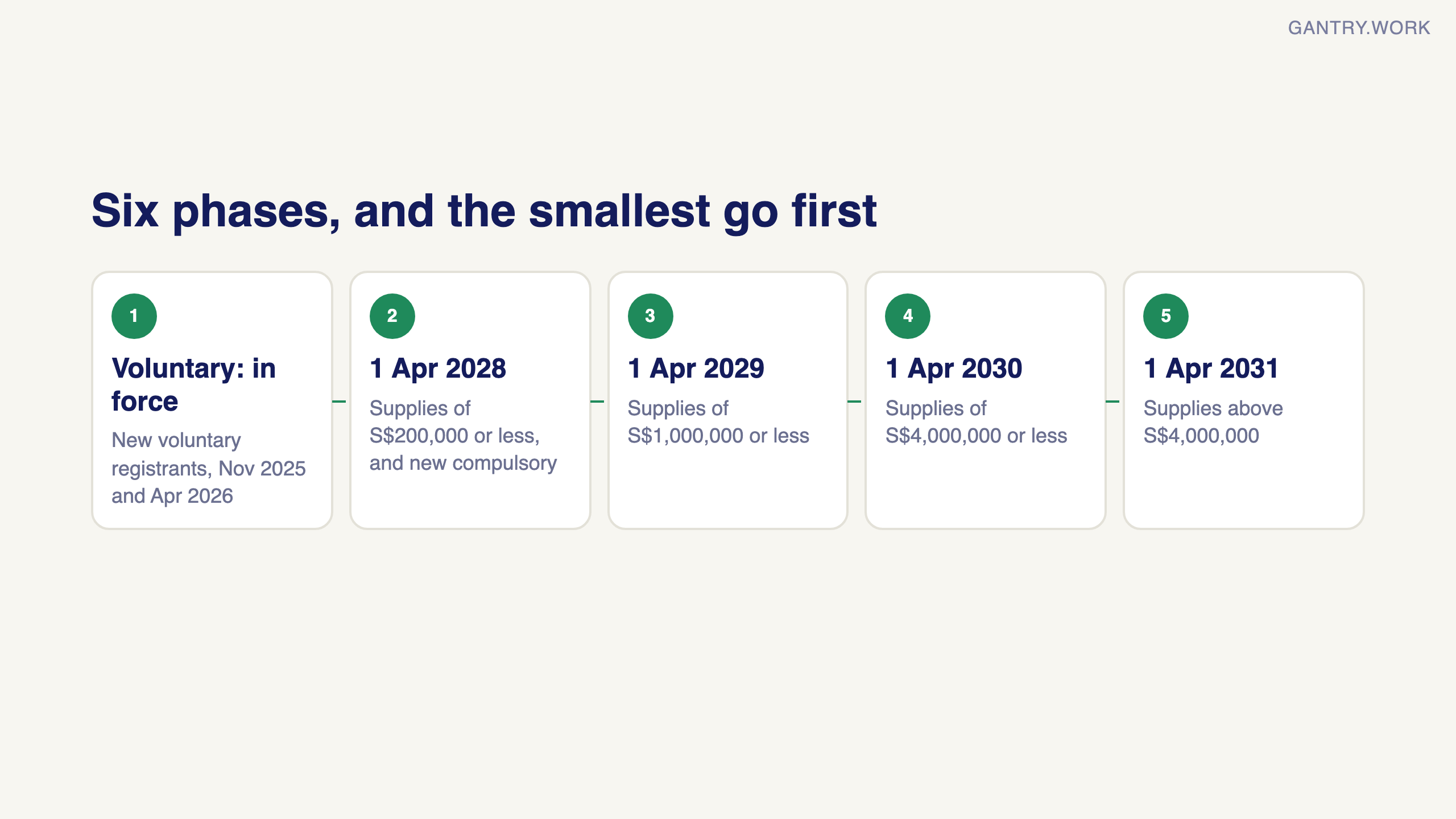
Existing GST-registered businesses join on 1 April 2028 (supplies of S$200,000 or less), 1 April 2029 (S$1,000,000 or less), 1 April 2030 (S$4,000,000 or less) or 1 April 2031 (above).
Already in force: from 1 November 2025 for companies registering voluntarily within six months of incorporation, and from 1 April 2026 for any voluntary registration.
Total annual supplies means Box 4 of the GST return, covering standard-rated, zero-rated and exempt supplies; the 2025 figure fixes your phase permanently.
Only overseas entities and businesses liable to register wholly because of the Reverse Charge regime are exempt.
After your date, IRAS also receives the invoice-level data behind each GST return, due by the earlier of the filing date or due date.
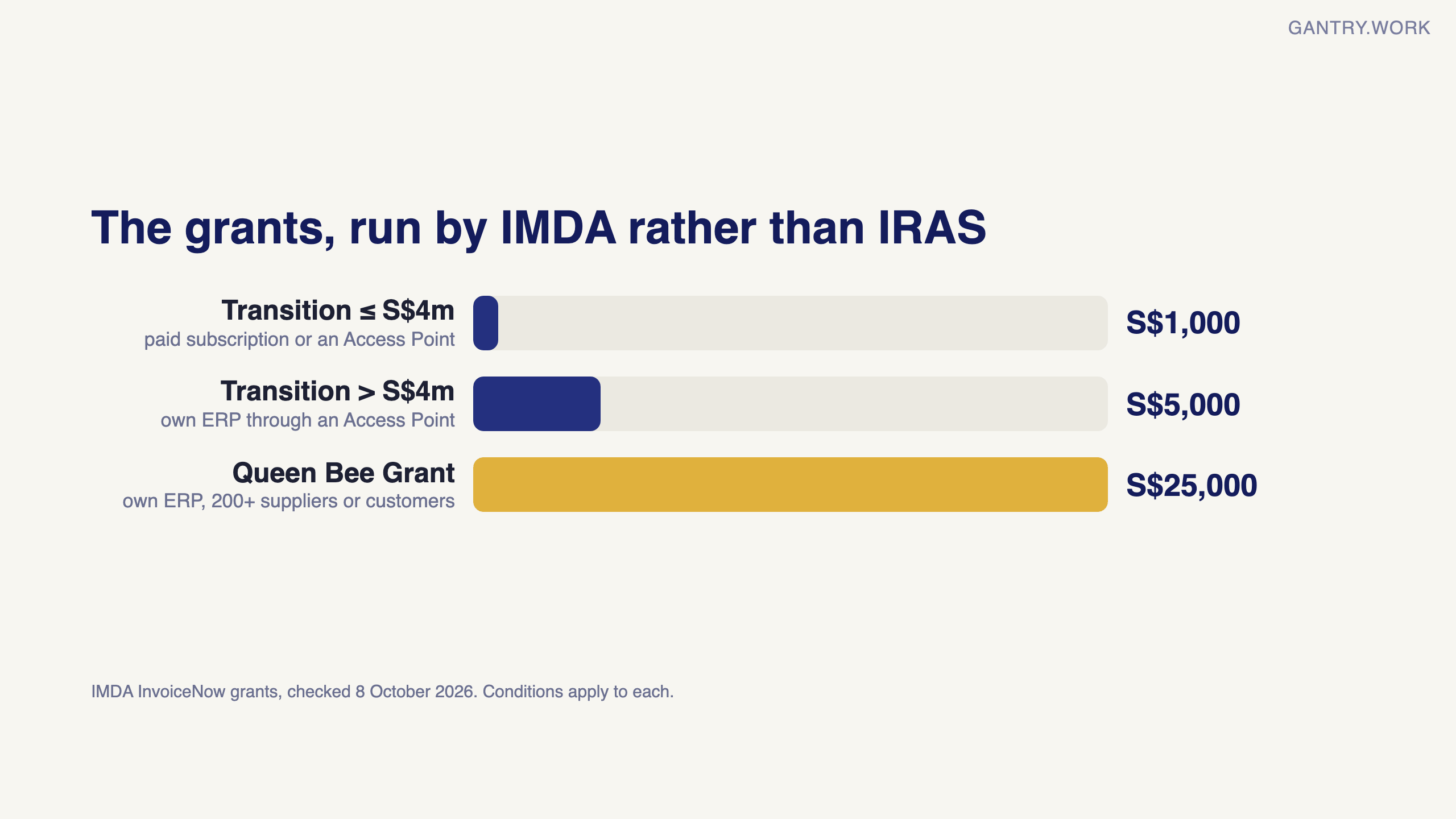
IMDA offers a GST InvoiceNow Transition Grant of S$1,000 or S$5,000, depending on supplies, and an InvoiceNow Queen Bee Grant of S$25,000.
Figures checked 8 October 2026, against IRAS's GST InvoiceNow Requirement, IMDA's InvoiceNow Grants pages, terms and list of free packages, and Enterprise Singapore's EDGE Grant pages and FAQ.
Most owners I speak to know this is coming and have no idea when it applies to them. That is reasonable — the schedule is phased by size, the size is measured in a way nobody quotes in conversation, and IRAS only began notifying businesses of their individual dates in mid-2026.
So: here is your date, the number that decides it, and the part that actually matters — which is not the software.
InvoiceNow in 45 seconds
The short version: your phase is set by one fixed figure from your 2025 GST returns, the smallest businesses go first, and what changes on the day is visibility, not filing. The dates, the grants and what to fix are below.
The full schedule
IRAS is rolling this out in six phases. Two have already started.
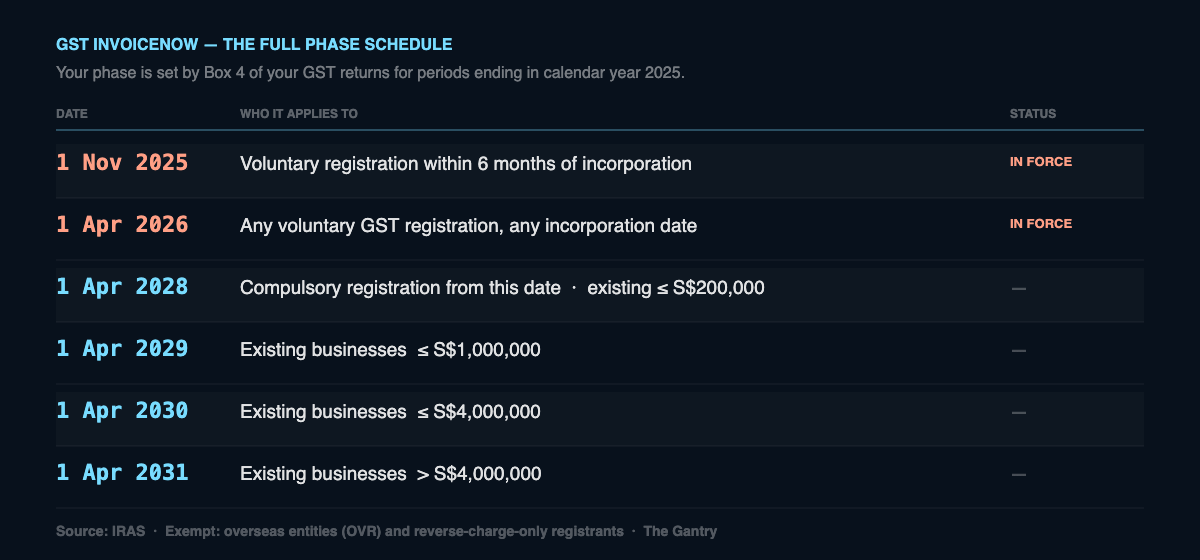
1 Nov 2025 — companies registering for GST voluntarily within six months of incorporation. Already in force.
1 Apr 2026 — any business applying for voluntary GST registration, whatever its incorporation date or structure. Already in force.
1 Apr 2028 — businesses applying for compulsory registration from that date, and existing GST-registered businesses with total annual supplies of S$200,000 or less.
1 Apr 2029 — existing businesses with total annual supplies of S$1,000,000 or less.
1 Apr 2030 — existing businesses with total annual supplies of S$4,000,000 or less.
1 Apr 2031 — existing businesses with total annual supplies above S$4,000,000.
Note the shape of it. The smallest businesses go first and the largest go last — the opposite of how these things usually run. If you are a S$2m trading company thinking you have until 2031, you do not. You have until April 2030.
The number that decides your phase
This is where people get it wrong, and it is worth being precise.
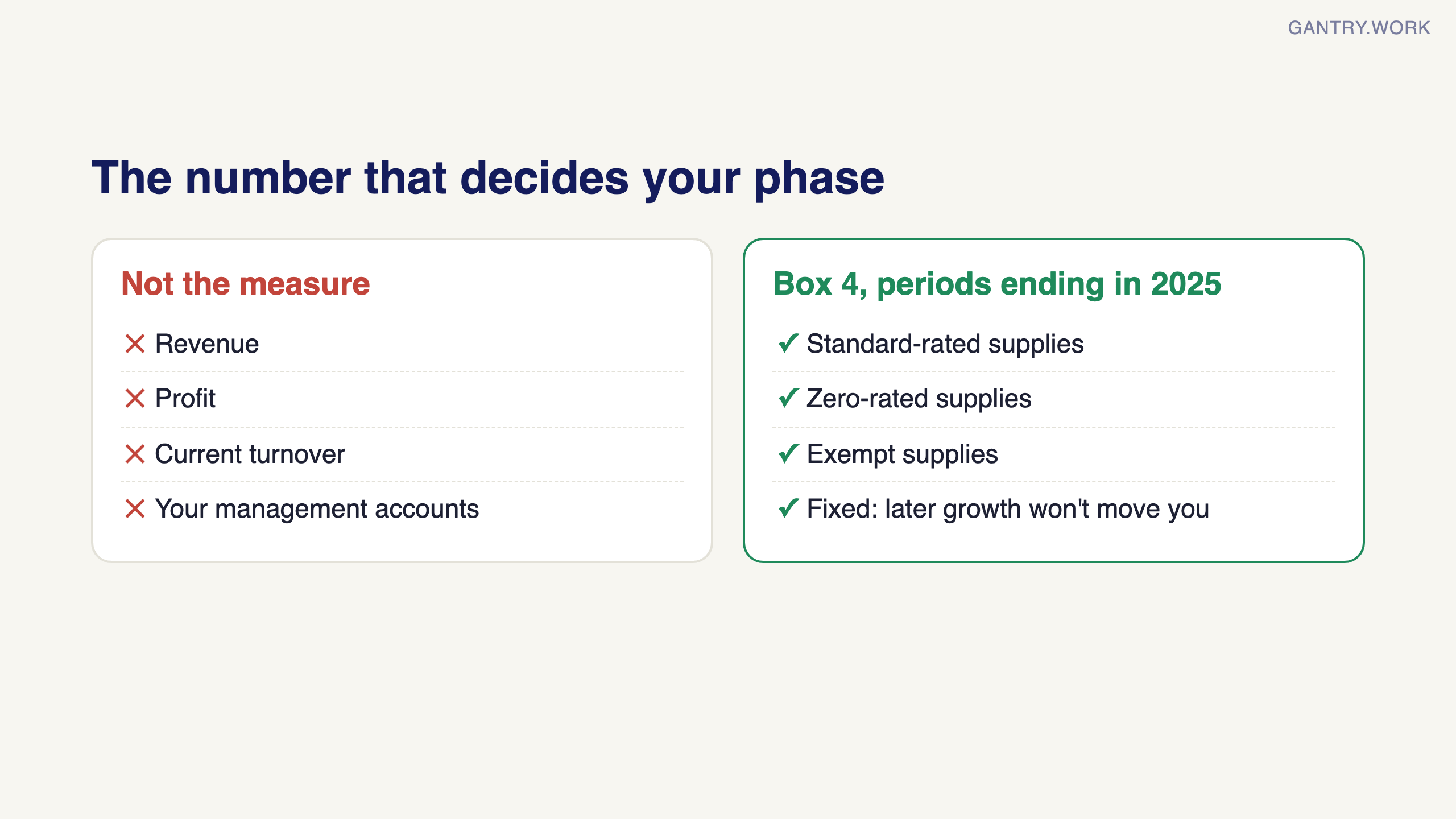
"Total annual supplies" does not mean your revenue, your profit, or your current turnover. It means the total of your standard-rated, zero-rated and exempt supplies — Box 4 of your GST return — added across all prescribed accounting periods ending in calendar year 2025.
Three consequences worth sitting with.
It is a fixed historical figure. Your 2025 number decides your phase permanently. Growing past S$4m in 2027 does not move you into a later phase, and shrinking does not move you earlier.
Zero-rated and exempt supplies count. Exporters in particular get caught here. If most of your sales are zero-rated, your Box 4 figure is far larger than the GST you actually charge, and you may be in an earlier phase than you assumed.
It is not on your P&L. You cannot eyeball it from management accounts. Open your 2025 GST returns and add up Box 4.
IRAS has been notifying businesses registered before 2026 of their individual date from mid-2026. If you did not get one — for instance because you had no GST returns for periods ending in 2025 — yours will come later, and IRAS says you will get enough time to prepare.
Who is exempt
Two categories only:
Overseas entities, including those registered under the Overseas Vendor Registration pay-only or full regime.
Businesses liable to register for GST wholly because of the Reverse Charge regime.
If you think you fall into either, get it confirmed in writing rather than assuming. Exemption turns on the precise basis of your registration.
What actually changes on the day
Here is the part almost every guide skips, and it is the only part that will affect how your week runs.
Today, your invoice data reaches IRAS once a quarter, summarised into nine boxes, after your bookkeeper has had a chance to tidy it. After your implementation date, IRAS also receives the invoice-level data behind each GST return, due by the earlier of the date you file that return or its due date.
Read that again, because it is the whole thing. The summary now comes with every invoice behind it, so errors your bookkeeper used to tidy away become visible.
This is not a filing change. It is a visibility change, and it moves the cost of messy data forward in time. Errors that used to get caught and quietly fixed during the quarterly close now arrive at the tax authority first.
The specific things that stop being survivable:
Tax codes applied by habit. If someone has been coding a supplier as standard-rated when it should be zero-rated, that pattern is now visible in the data rather than buried in a total.
Invoices raised outside the system. The Word template someone uses for the occasional odd job does not reach IRAS. Now it has to.
Credit notes handled loosely. Credit and debit notes are in scope. If your team issues them inconsistently, the inconsistency is now transmitted.
Customer and supplier records that are duplicated or wrong. InvoiceNow runs on Peppol, which is structured data with identifiers. "ABC Trading" and "ABC Trading Pte Ltd" as two records is not a cosmetic problem any more.
None of that is caused by InvoiceNow. All of it is exposed by it. That is why the businesses that struggle with this are not the ones with old software — they are the ones with loose data habits and no single place where invoicing happens.
The money on the table
There is real support, and it is administered by IMDA rather than IRAS, which is why people miss it.
GST InvoiceNow Transition Grant — S$1,000 for SMEs with annual supplies of S$4,000,000 or less.
GST InvoiceNow Transition Grant — S$5,000 for businesses with annual supplies above S$4,000,000.
InvoiceNow Queen Bee Grant — S$25,000 for larger businesses.
And the one I would check before spending anything: IRAS lists free-of-charge InvoiceNow solution packages, available up to 31 March 2031. The current list runs to 31 March 2027, with the next list published later. These give basic e-invoicing capability sufficient to comply.
If you are a small business whose only requirement is to comply, start there. You may not need to buy anything at all, and anyone selling you a system should be able to explain clearly why the free package is not enough for you.
Our take: do not treat this as a compliance project
The instinct is to handle InvoiceNow the way you handle any deadline — find the cheapest thing that satisfies it, close the ticket, move on.
That instinct will cost you, for one reason: the work that makes you InvoiceNow-ready is the same work that makes everything else possible.
Clean customer and supplier master data. Every invoice raised in one system. Tax codes that are right by configuration rather than by memory. Credit notes that follow a rule. That list is the InvoiceNow prerequisite, and it is also the prerequisite for automating your invoicing, for closing your month in days instead of weeks, for handing the finance role to someone new without a three-month shadow, and for any AI tool ever giving you a useful answer.
You are going to be made to do this work by a deadline. The choice is whether you get anything else out of it.
The businesses that will look back on this well are the ones that used a compliance date as cover for fixing something they had been avoiding for years. The ones that bolt on the cheapest compliant thing will comply, and still have the same mess underneath, and will do this again in three years for the next requirement.
What to do, depending on how long you have
If your date has passed or is within six months: check whether your existing accounting software is already an InvoiceNow-Ready Solution — many common ones are, and activation can be quicker than expected. Talk to your tax agent this month.
If you have one to two years: pull your 2025 Box 4 figure and confirm your phase. Then audit the four things above — master data, single system, tax codes, credit notes. That audit is a day of work and it tells you whether this is a switch or a project.
If you have three years or more: do nothing urgent, but add one line to any system decision you make between now and then: it must be InvoiceNow-ready. Choose on that basis and compliance costs you nothing extra.
IRAS publishes the full requirement, the e-Tax Guide and an Implementation Date Calculator. Confirm your date there — this article is a guide, not tax advice.
Find your date in thirty seconds
I built a free checker that applies the IRAS schedule to your situation: your implementation date, how long you have, which grant applies, and where you sit in the rollout. No signup, no email.

The free InvoiceNow deadline finder at work: your GST status in, your date out. Click the animation to try it.
Planning to use one of the free InvoiceNow packages? Read The Free Package That Quietly Expires in March before you sign up for one.
The other four questions people ask next
Once you know your date, these are the decisions that follow. Each one is a free checker, no signup.
Is my software ready? — check your accounting software against the 203 accredited providers — including the ones still pending accreditation.
Do I have to pay? — compare the 13 free InvoiceNow packages, three of which expire on 31 March 2027.
Can I claim a grant? — the real IRAS grant amounts — S$1,000, S$5,000, or up to S$25,000 through the Queen Bee route.
Who do I actually call? — solution providers versus Access Points — 203 of one, only 47 of the other, and the difference matters.
Which InvoiceNow grant can a Singapore business claim in October 2026?
IMDA lists three InvoiceNow grants on 8 October 2026: the GST InvoiceNow Transition Grant of S$1,000 or S$5,000, and the InvoiceNow Queen Bee Grant of S$25,000. The conditions matter more than the amounts:
GST InvoiceNow Transition Grant, S$1,000: for GST-registered businesses with total annual supplies of S$4 million or less in periods ending in 2025. It defrays a paid subscription to an InvoiceNow-Ready Solution Provider (at least 12 months paid) or connecting your own ERP through an IMDA-accredited Access Point after 26 February 2026. Businesses already subscribed or connected, or that used such a provider in the previous 3 months, are excluded. You must activate GST InvoiceNow before your mandate deadline and submit data to IRAS. Open from 1 July 2026 to 31 March 2030, or until fully claimed.
GST InvoiceNow Transition Grant, S$5,000: for annual supplies above S$4 million, with your own ERP (SAP, Microsoft Dynamics or custom) connected through an accredited Access Point. The project must start after 26 February 2026 and go live within 12 months, by 31 March 2028. Submit an expression of interest first. Open from 1 July 2026 to 31 March 2028, or until fully claimed.
InvoiceNow Queen Bee Grant, S$25,000: for companies over a year old, with turnover above S$4 million, 200 or more suppliers or business customers and their own custom ERP. They must receive InvoiceNow invoices from at least 20 suppliers or send them to at least 40 customers by 31 March 2031. It can be claimed on top of the S$5,000 grant.
Both Transition Grants pay out through PayNow Corporate. To see which IMDA InvoiceNow grant fits your numbers, use the free InvoiceNow grants checker.
Free packages are the other route: IRAS says they are available up to 31 March 2031. IMDA's list, updated 17 September 2026, names 13 providers: 10 run to 31 March 2031 and 3 end on 31 March 2027. Read the free package that quietly expires before choosing one.
Does the EDGE Grant cover InvoiceNow-ready software?
Not by name: Enterprise Singapore's EDGE pages, checked 8 October 2026, do not mention InvoiceNow, though EDGE does fund pre-approved digital solutions. PSG, EDG and MRA closed on 29 September 2026 and EDGE replaced them from 30 September. EDGE's FAQ gives SMEs up to 50% support on most activities, within a S$100,000 annual cap, of which up to S$30,000 can go on single-function digital solutions, integrated enterprise systems and pre-scoped equipment. Ask your vendor whether its package is an EDGE pre-approved solution.
Do not plan on stacking: the S$1,000 grant's terms bar other government funding for the same project.
Sources, checked 8 October 2026: IRAS, GST InvoiceNow Requirement (grants, free packages; updated 23 September 2026); IMDA, InvoiceNow Grants (eligibility and dates; updated 17 July 2026); IMDA, S$1,000 grant terms and conditions (no double funding); IMDA, list of free InvoiceNow packages (13 providers, updated 17 September 2026); Enterprise Singapore, EDGE Grant (PSG, EDG and MRA ceased 29 September 2026); Enterprise Singapore, EDGE FAQ (support levels and caps).
Frequently asked questions
Is there a GST InvoiceNow grant if I use a free package? Probably not: the S$1,000 grant needs at least 12 months of paid subscription, or your own ERP connected through an Access Point. Confirm with IMDA.
Can I claim the GST InvoiceNow Transition Grant if my software is already on InvoiceNow? No. IMDA excludes businesses already subscribed or connected.
Who pays out InvoiceNow grants, IRAS or IMDA? IMDA. IRAS sets the GST InvoiceNow Requirement and its deadlines, and its page sends grant questions to IMDA.
Working on something similar? Connect with me on LinkedIn and tell me what you are working on. I read and reply to every message, and the questions people send become the next guides.
Related reading: Seventy Firms Are Selling You the Same Thing · Your Accounting Software Might Not Be on the List
Want a second pair of eyes on your setup? Bring the process that keeps going wrong to a free 20-minute systems review. I'll tell you honestly what to fix first, or whether you need anything new yet.
How I test everything and how this site makes money: How The Gantry works.