

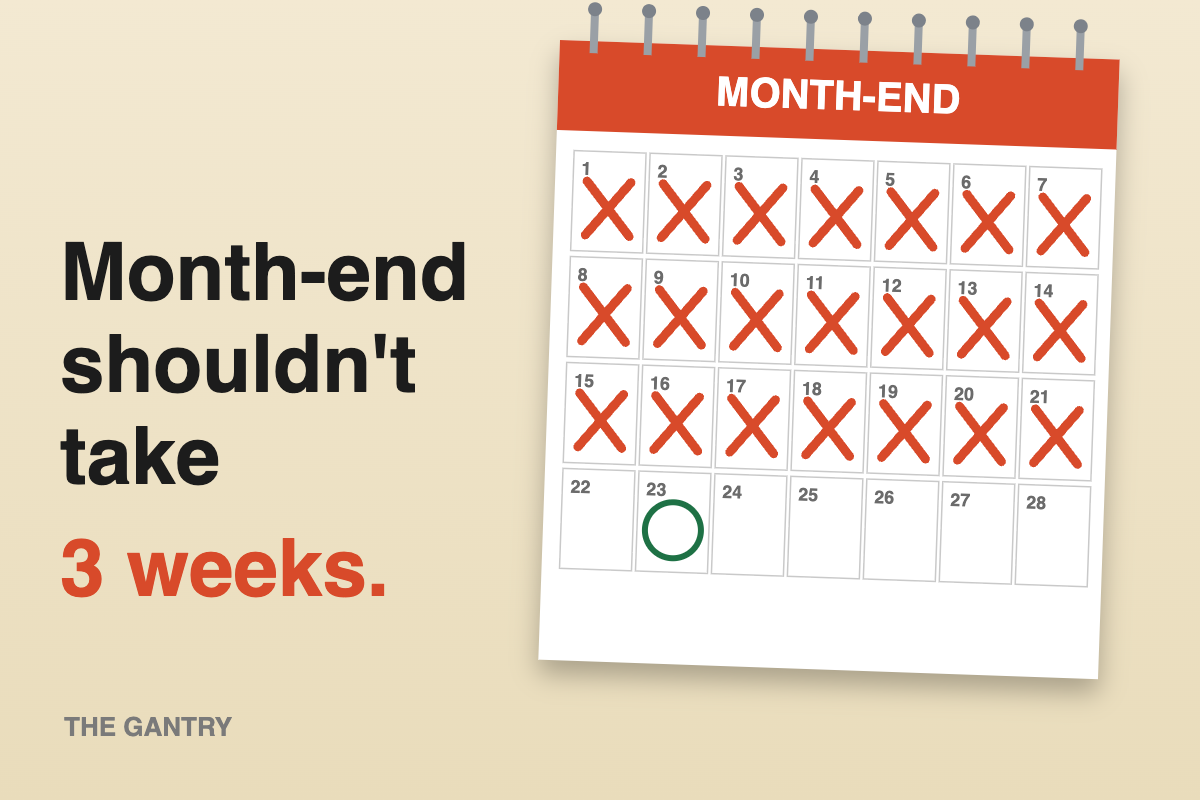
Ask an SME owner what last month’s gross margin was, and you’ll usually get one of two answers: a guess, or “the accounts aren’t ready yet.”
Both answers cost money. You just can’t see the line item.
The whole argument in under a minute
The short version: a three-week close is the month being reconstructed from evidence. Move each record to the moment the event happens, in the order below, and the close shrinks to a few days of review.
A slow close is an operations problem, not an accounting one
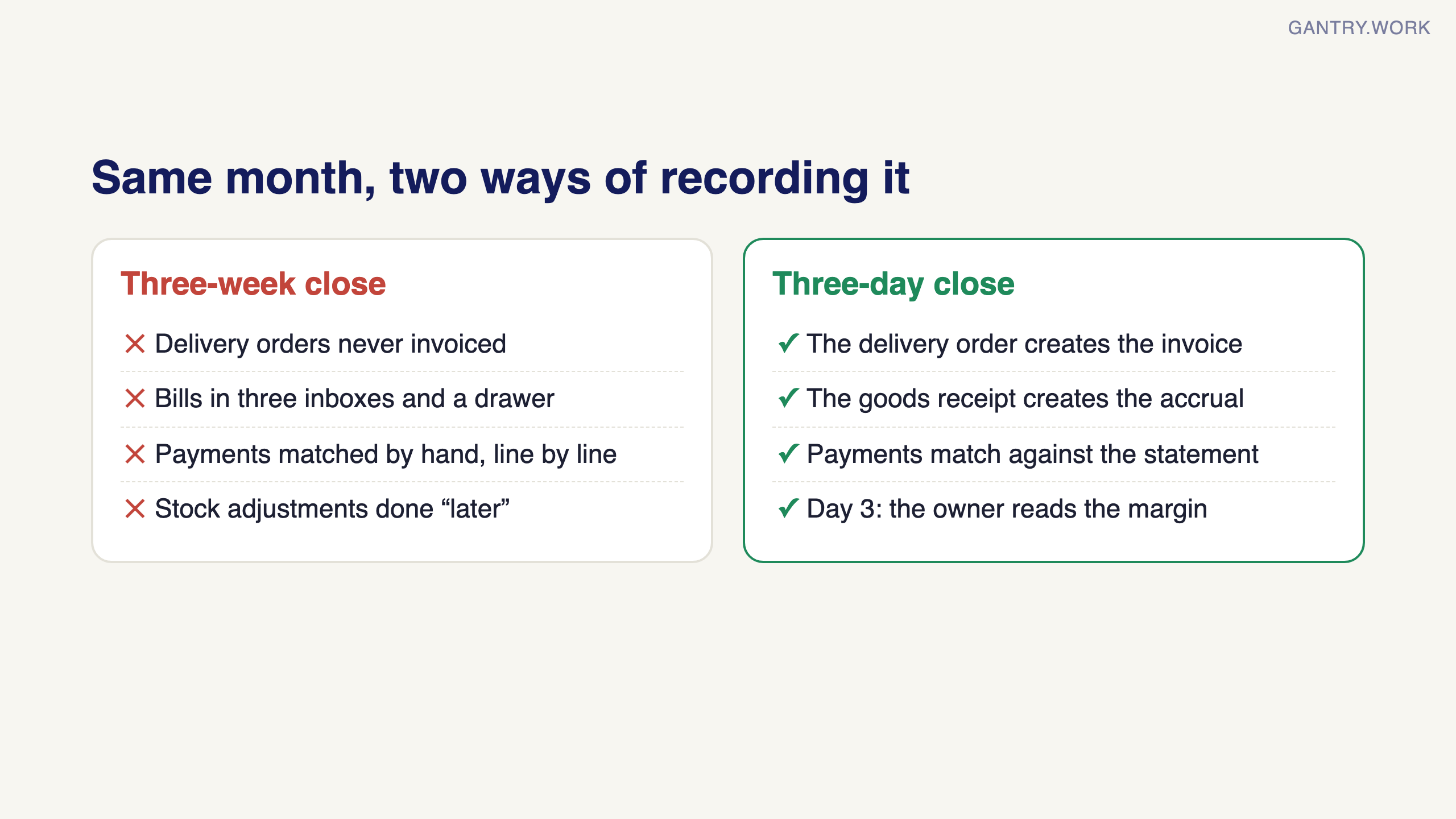
A three-week close isn’t an accounting problem. It’s an operations problem wearing accounting’s clothes. The close is slow because the month’s data was never captured properly while it was happening: delivery orders that never became invoices, supplier bills sitting in someone’s inbox, petty cash in a notebook, stock adjustments done “later.”
Finance doesn’t close the month. Finance reconstructs the month. That’s the three weeks.
How the three-day companies actually do it
The businesses that close in three days aren’t working harder in week one. They’ve simply made the transaction and the record the same event. The delivery order creates the invoice. The goods receipt creates the bill accrual. The payment matches itself against the statement.
When the month ends, there’s nothing left to reconstruct — you’re just reviewing.
Run this diagnostic on your last close
Here’s a diagnostic you can run this week: list the five slowest items in your last close. For each one, ask — when did the business event happen, and when did it get recorded? The gap between those two timestamps is your close time. Shrink the gap, and the close shrinks with it.
You don’t need a bigger finance team. You need fewer things that happen twice.
Where the three weeks actually go
When I sit with a finance person and time their close, the days never go where the owner thinks. Nobody is slow at accounting. They are slow at finding out what happened.
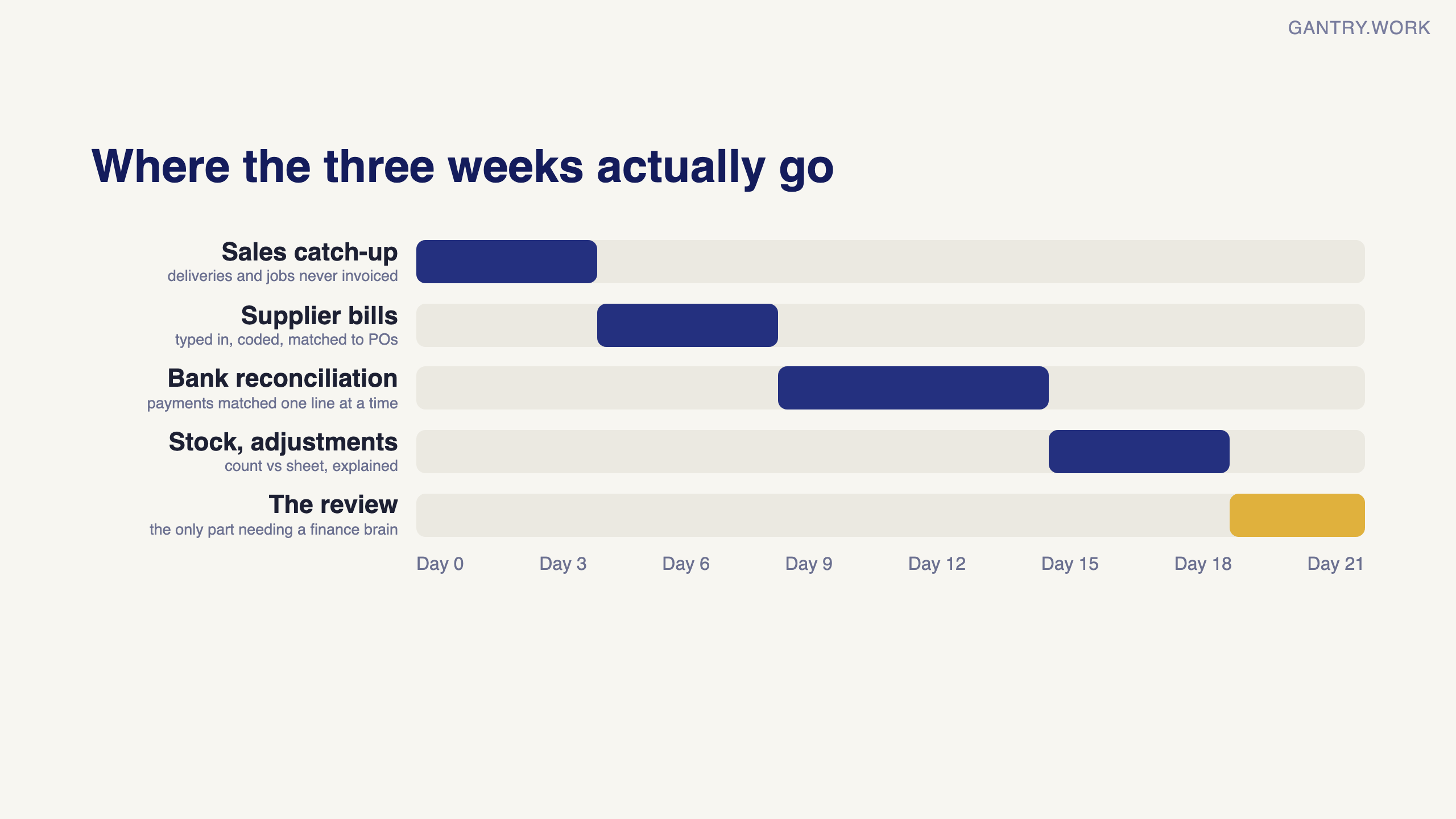
A typical close for a 15-person trading or services firm breaks down like this:
Days 1–4: sales catch-up. Delivery orders and completed jobs that were never invoiced. Someone walks the floor, opens the WhatsApp groups, and works out what actually went out last month.
Days 4–8: supplier bills. Bills sit in three inboxes and a drawer. Half arrive after the month has ended. Each one is typed in, coded, and matched to a purchase order that may only exist as an email.
Days 8–14: bank reconciliation. Payments matched to invoices by hand, one line at a time. If you take card or gateway payments, every payout is a net amount that has to be broken back into invoices, fees and FX before it matches anything (this gets worse with every payment method you add).
Days 14–18: stock and adjustments. The count says one thing, the sheet says another, and the difference has to be explained before cost of sales can be posted.
Days 18–21: the review. The only part that actually needs a finance brain, squeezed into the last three days.
Notice that the first eighteen days are not accounting. They are archaeology. The month is being reconstructed from evidence because it was never recorded while it happened.
How many days is acceptable?
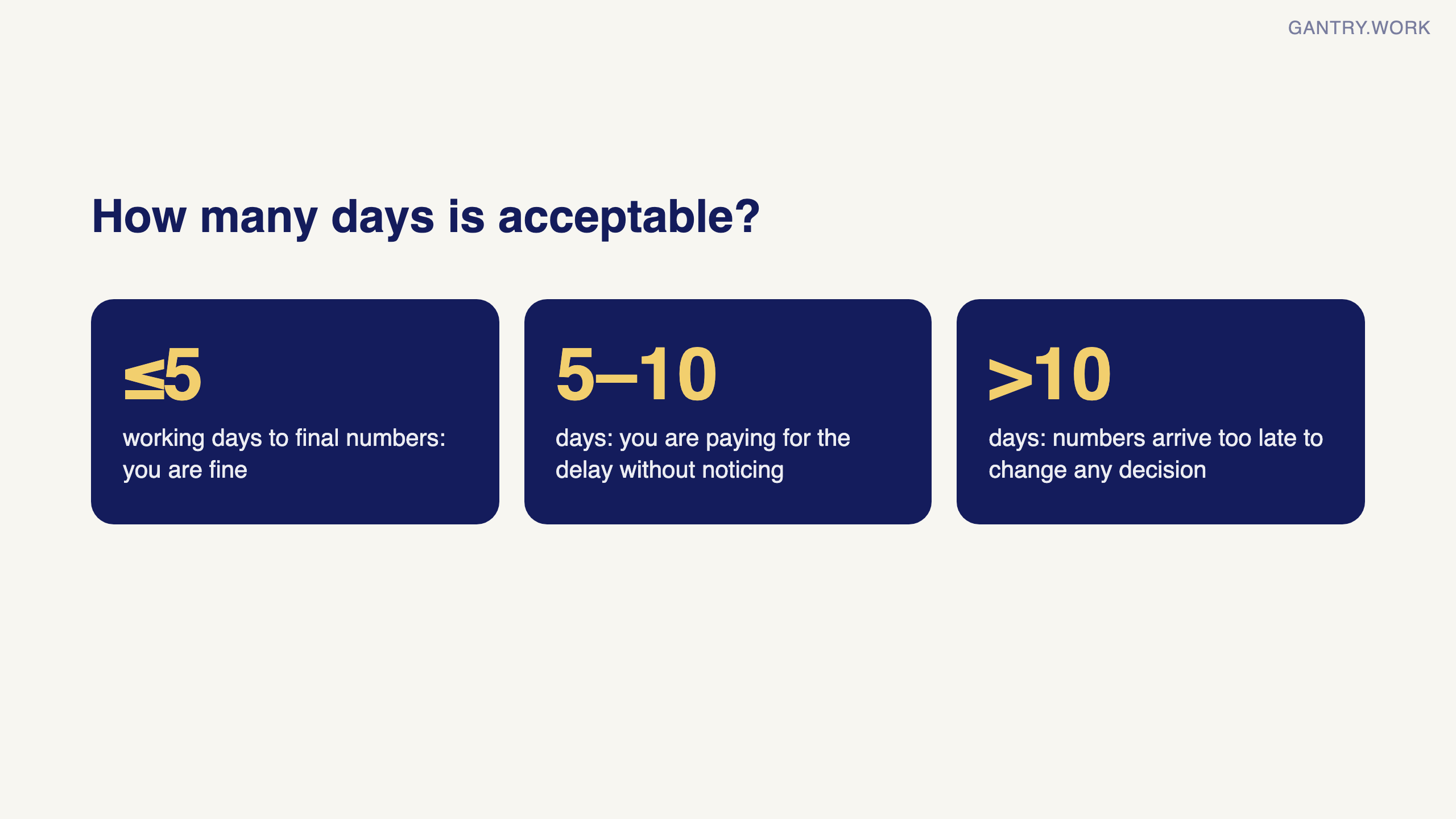
The number I use with owners: if you see final numbers inside five working days, you are fine. Between five and ten, you are paying for the delay without noticing it. Past ten, the numbers arrive too late to change any decision they describe, which is the polite way of saying you are running the business on last month's picture.
A good close week looks unremarkable. Day one, most transactions are already posted because they were created by the events themselves. Day two, someone works a short list of exceptions the system flagged. Day three, the owner reads a margin report and asks questions. That is the whole thing.
This matters beyond convenience. A director's duty to exercise reasonable diligence assumes the numbers you review are current. Six-week-old numbers do not meet that bar, however carefully you read them.
What to fix first, in order
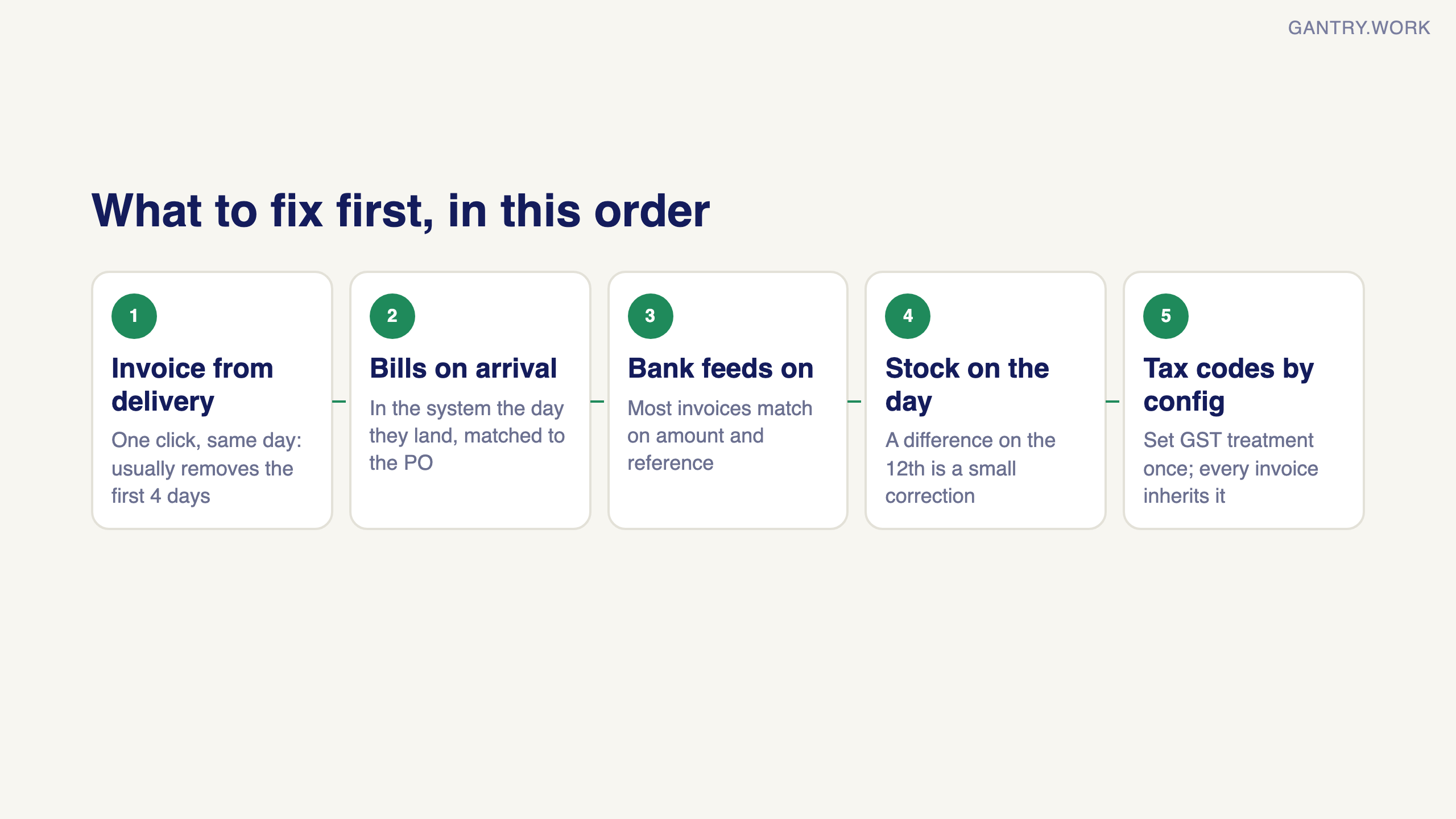
You do not fix a slow close by working on the close. You fix it by moving each record to the moment the event happens. Do them in this order, one at a time:
Invoice from the delivery, not from memory. The delivery order or completed job should become the invoice with one click, the same day. This alone usually removes the first four days.
Capture supplier bills on arrival. Bills come in by email; have them land in the system on the day they arrive, matched to the purchase order, waiting for approval. Nothing lives in an inbox.
Turn on bank feeds and let the matching run. Most invoices match themselves on amount and reference. Your finance person should only see the ones that did not.
Post stock adjustments on the day. A count difference recorded on the 12th is a small correction. Twenty of them found on the 30th are a mystery.
Set tax codes by configuration, not by habit. Once a customer or product carries the right GST treatment, every invoice inherits it. InvoiceNow is about to send that data to IRAS as you issue it, so this one is no longer optional.
Each step is a small project measured in days, not a system overhaul. Together they are the difference between a three-week close and a three-day one.
If you want to know what the current close is costing you in salary, the Month-End Close Cost Calculator will give you the number in a minute. It is usually larger than the software that would fix it.
What does a 5-day month-end close checklist look like?
A five-day close runs in fixed order: capture on day 1, bank on day 2, ledgers on day 3, adjustments on day 4, review and lock on day 5. Working days after month-end; give each line one owner.
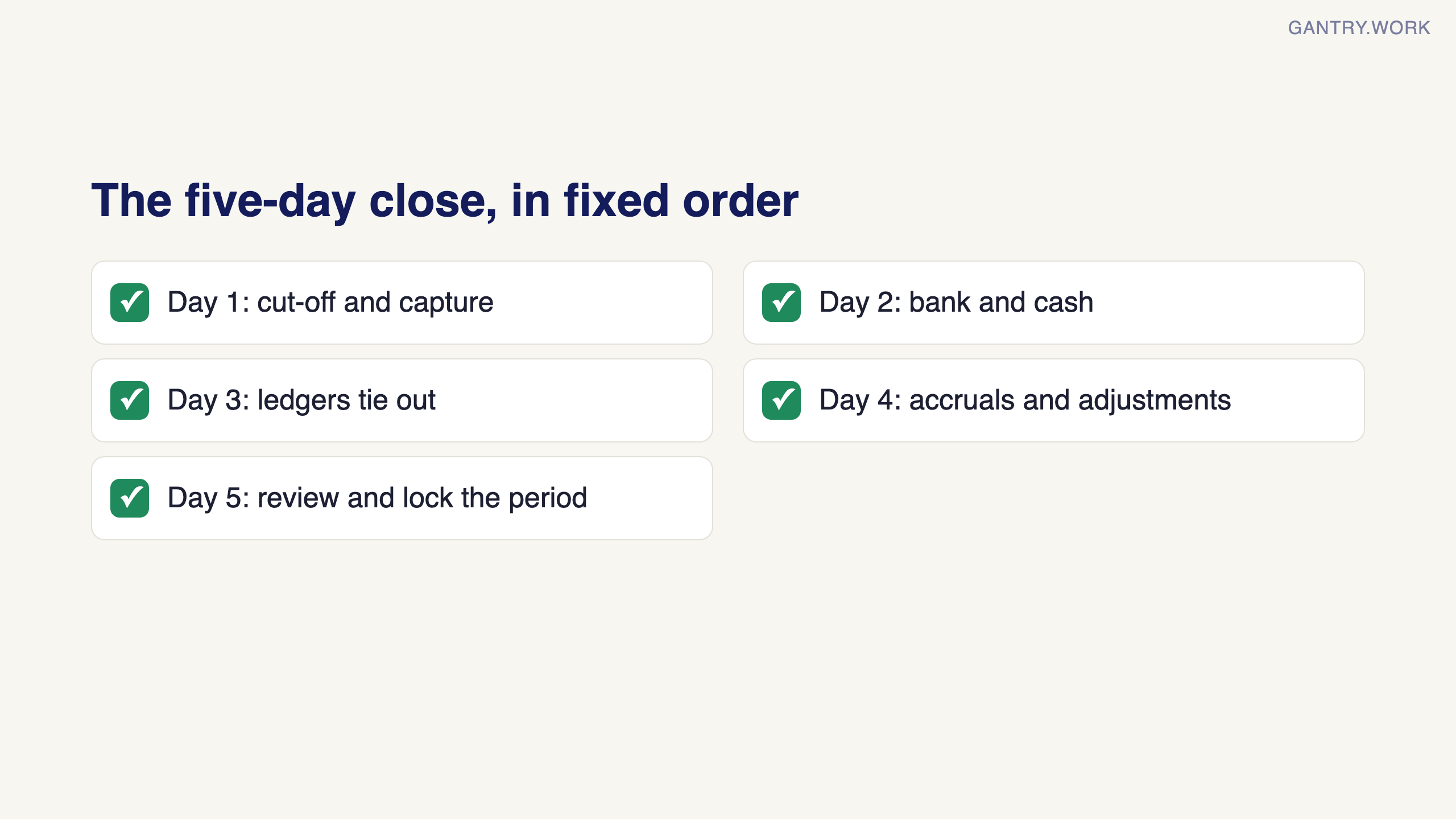
Day 1: cut-off and capture
Every delivery and completed job invoiced; the "delivered, not invoiced" list is empty.
Every supplier bill received entered and matched to its purchase order and receipt.
Goods received but not yet billed are listed for accrual.
Expense claims and petty cash posted.
Payroll posted, including employer CPF.
Day 2: bank and cash
Every bank and card account reconciled to the statement's closing balance.
Payment gateway payouts split into sales, fees and refunds.
Unidentified receipts listed, each with a person chasing it.
Day 3: ledgers tie out
Aged receivables total equals the receivables control account.
Aged payables total equals the payables control account.
Stock valuation equals the inventory account; count adjustments posted.
Day 4: adjustments
Accruals for goods and services received but not billed.
Prepayments released and depreciation run.
Intercompany balances agreed, if you have them.
GST accounts checked against the GST report for the period, if you are GST-registered.
Day 5: review and lock
Profit and loss and balance sheet compared with last month and budget.
Every variance above your threshold explained in one line.
Gross margin by product, customer or job reviewed.
The period locked so nothing posts into it by mistake.
The owner's pack sent.
Three-week closes lose their time on days 1 and 2. If three-way matching runs as bills arrive and the bank feed matches daily, those days shrink to an exception list.
Which deadlines does the month-end close have to protect?
For a Singapore company, the two hard dates are CPF contributions and, if you are GST-registered, the GST return. CPF Board says contributions are due on the last day of the calendar month, and it takes enforcement action against employers who have not paid by the 14th of the following month. IRAS says the GST return and payment are due one month after the end of the accounting period, and that extensions are generally not granted, because it expects businesses to keep proper transaction tracking systems. A close that takes three weeks leaves little more than a week to prepare and check the return.
Sources, checked 9 October 2026: CPF Board, When is the due date for CPF contributions? (due on the last day of the month; enforcement if unpaid by the 14th of the following month); IRAS, GST filing due dates and requests for extension (return and payment due one month after the accounting period; extensions generally not granted).
Frequently asked questions
What is the month-end close process? The steps that confirm every transaction of the month is recorded, reconciled and reviewed before the period is locked. The full cycle is record to report.
Why does month-end take three weeks? Usually because transactions were not recorded when they happened, so finance spends the first two weeks reconstructing deliveries, bills and bank receipts.
How many days should a month-end close take for a small business? Five working days or fewer is a sound target; past ten, the numbers arrive too late to change decisions.
Can you close the month before all supplier bills arrive? Yes. Accrue goods and services received but not yet billed, then reverse the accrual when the bill is posted.
Two automations that shorten a close this month: file every supplier document the day it arrives (free Make template, setup guide), and record every Stripe payment in QuickBooks as it happens (free Make template). Neither needs a new system, and both run on Make's free plan at small-business volumes.
Affiliate links: if you sign up to Make through them, The Gantry may earn a commission at no extra cost to you. How I test tools and how this site makes money.
When the books have not been closed properly for years, the fix looks different. The Books Nobody Had Closed in Twenty Years is an anonymised case study of exactly that.
Put a number on your own close
Three inputs and you get the annual salary cost your close is burning, and what the same close costs once the re-keying is gone. Price your month-end close — free, no signup.

The free month-end close calculator at work: days and people in, what a slow close really costs out. Click the animation to try it.
The finance process behind a fast close is called record-to-report. It and the other core processes are explained in the ERP glossary.
Working on something similar? Connect with me on LinkedIn and tell me what you are working on. I read and reply to every message, and the questions people send become the next guides.
Want a second pair of eyes on your setup? Bring the process that keeps going wrong to a free 20-minute systems review. I'll tell you honestly what to fix first, or whether you need anything new yet.
How I test everything and how this site makes money: How The Gantry works.