


The free SME Systems Health Check at work: ten honest answers, a score and the biggest leak to fix first. Click the animation to try it.
Last month, at 3:07 in the morning, one of my clients issued a purchase order.
Nobody was awake. Nobody approved it in a WhatsApp group. Nobody copy-pasted part numbers from an Excel sheet into an email.
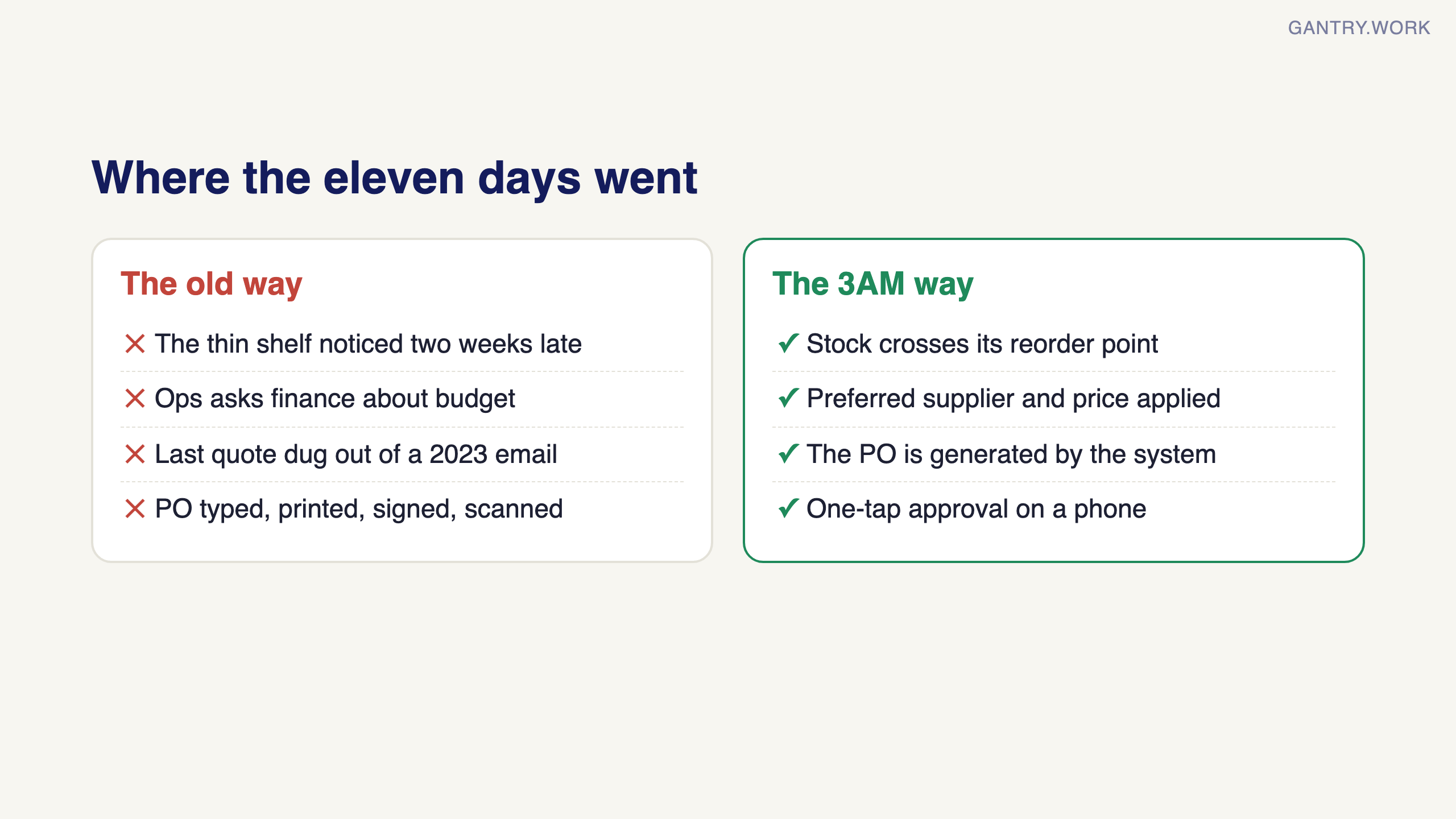
A stock level crossed its reorder point. The system checked the preferred supplier, applied the agreed price list, generated the PO, and routed it for a one-tap approval that was waiting on the manager’s phone at breakfast.
Total human effort: one tap.
The story in 45 seconds
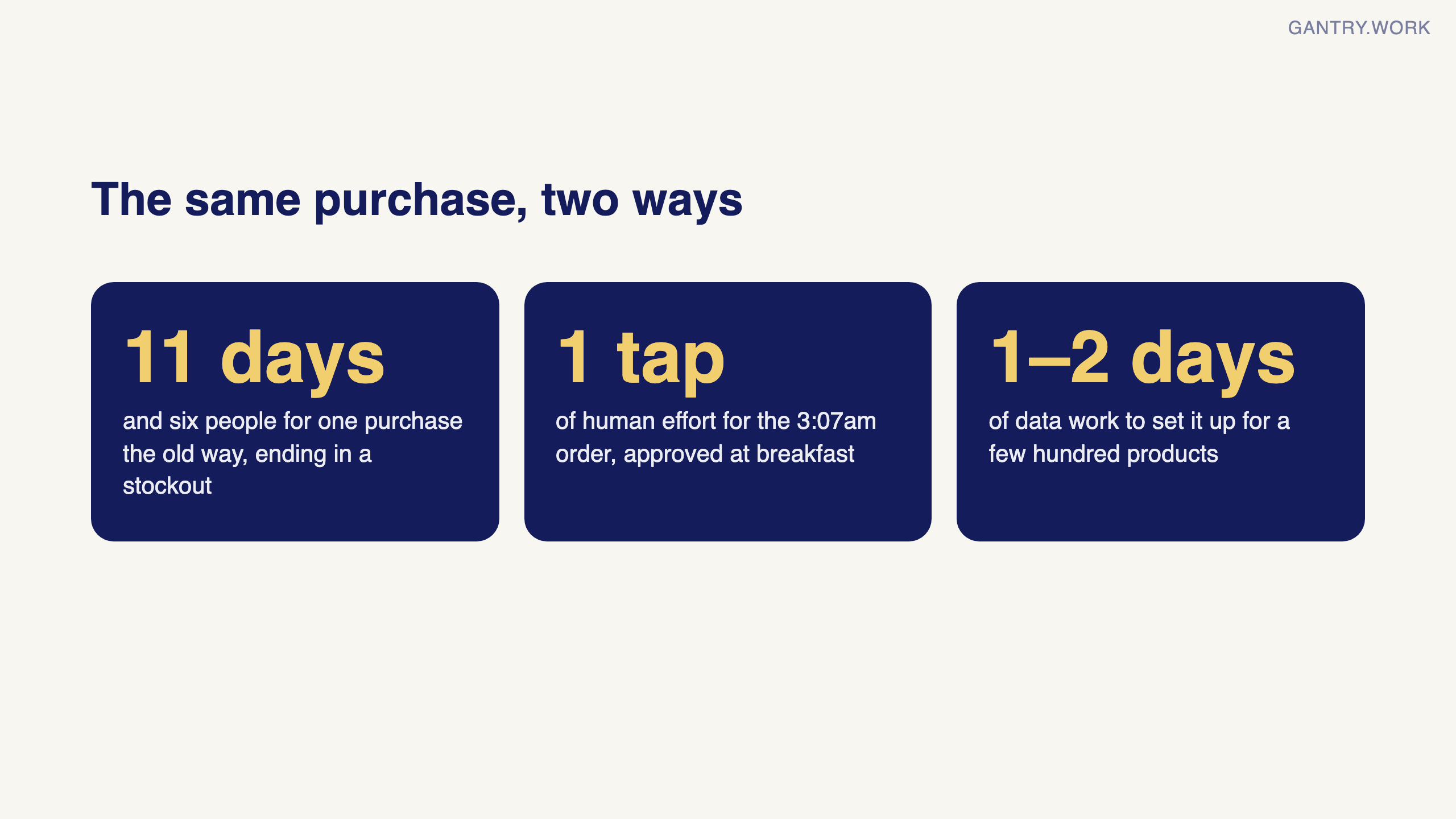
The short version: one purchase used to take eleven days and six people. Now it takes one tap, because five decisions were made once and written into the system. The human only steps in where there is judgment to add.
The old way: eleven days, six people, one stockout
Here’s what that same purchase used to look like: the storeman notices the shelf is looking thin — two weeks after it started looking thin. He messages the ops manager. The ops manager asks finance if there’s budget. Finance asks what it costs. Someone digs out the last supplier quote from a 2023 email thread. The PO gets typed into Word, printed, signed, scanned, and emailed.
Eleven days, six people, and one stockout later — the goods arrive.
The lesson is not "buy more software"
The lesson isn’t “buy software.” Most SMEs I meet already own more software than they use.
The lesson is that a process only deserves a human when a human adds judgment. Reordering stock you always reorder, from the supplier you always use, at the price you already negotiated? There’s no judgment in that. There’s only delay, typos, and the salary cost of six people passing a baton.
Try this on one process this week
This week, pick one process in your business that runs on reminders and chasing. Write down every handoff. Then ask of each one: what judgment happens here?
If the answer is “none” — that handoff is a candidate for deletion, not delegation.
The 3AM purchase order isn’t impressive because it’s clever. It’s impressive because it’s boring. Boring is what a business that runs without heroics feels like.
Not on an ERP yet? You can get part of the way with a spreadsheet and Make. The free template Update inventory numbers on Google Sheets based on Shopify orders keeps stock counts current, and one more step can email the buyer when an item falls to its reorder point. It is not a purchase order at 3am, but it is the alert that stops the stockout.
Affiliate links: if you sign up to Make through them, The Gantry may earn a commission at no extra cost to you. How I test tools and how this site makes money.
What had to be true for that PO to fire
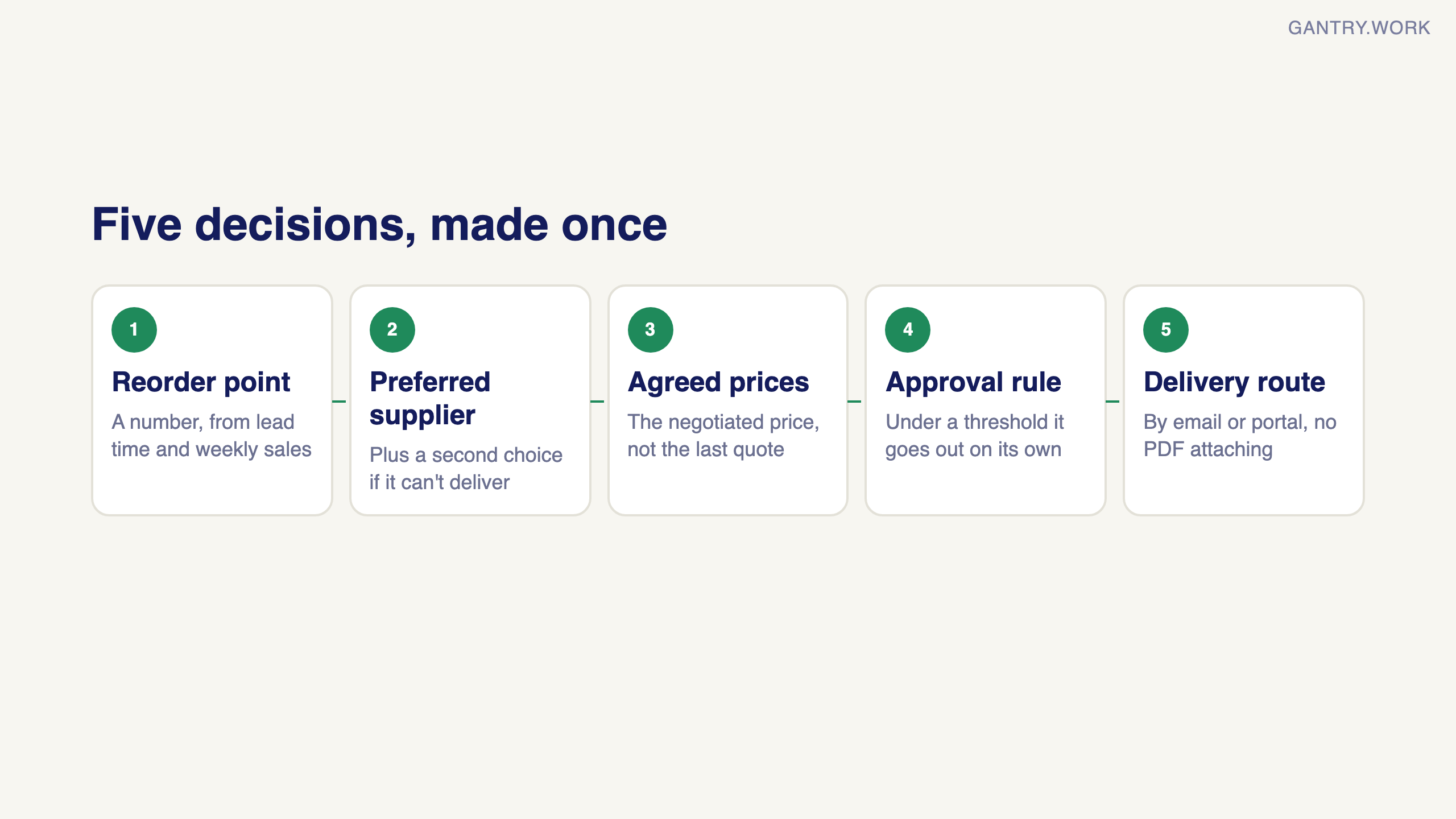
The 3AM order looks like magic from the outside. From the inside it is five decisions the owner made once, then stopped making:
A reorder point per product. Not a feeling about the shelf; a number, set from lead time and typical weekly sales.
A preferred supplier per product, with a second choice for when the first cannot deliver.
An agreed price list attached to that supplier, so the PO carries the negotiated price rather than whatever was quoted last time.
An approval rule. Under a threshold, the order goes out on its own. Over it, one person taps yes.
A delivery route. The PO reaches the supplier by email or portal without anyone attaching a PDF.
For a company with a few hundred products, setting this up is one or two days of data work, most of it pulling numbers out of the spreadsheet and the heads where they currently live. That is the whole investment. Everything after it is the system doing the boring part.
Where automatic reordering goes wrong
I would be lying if I said it never misfires, so here is where it does, and what to do about each.
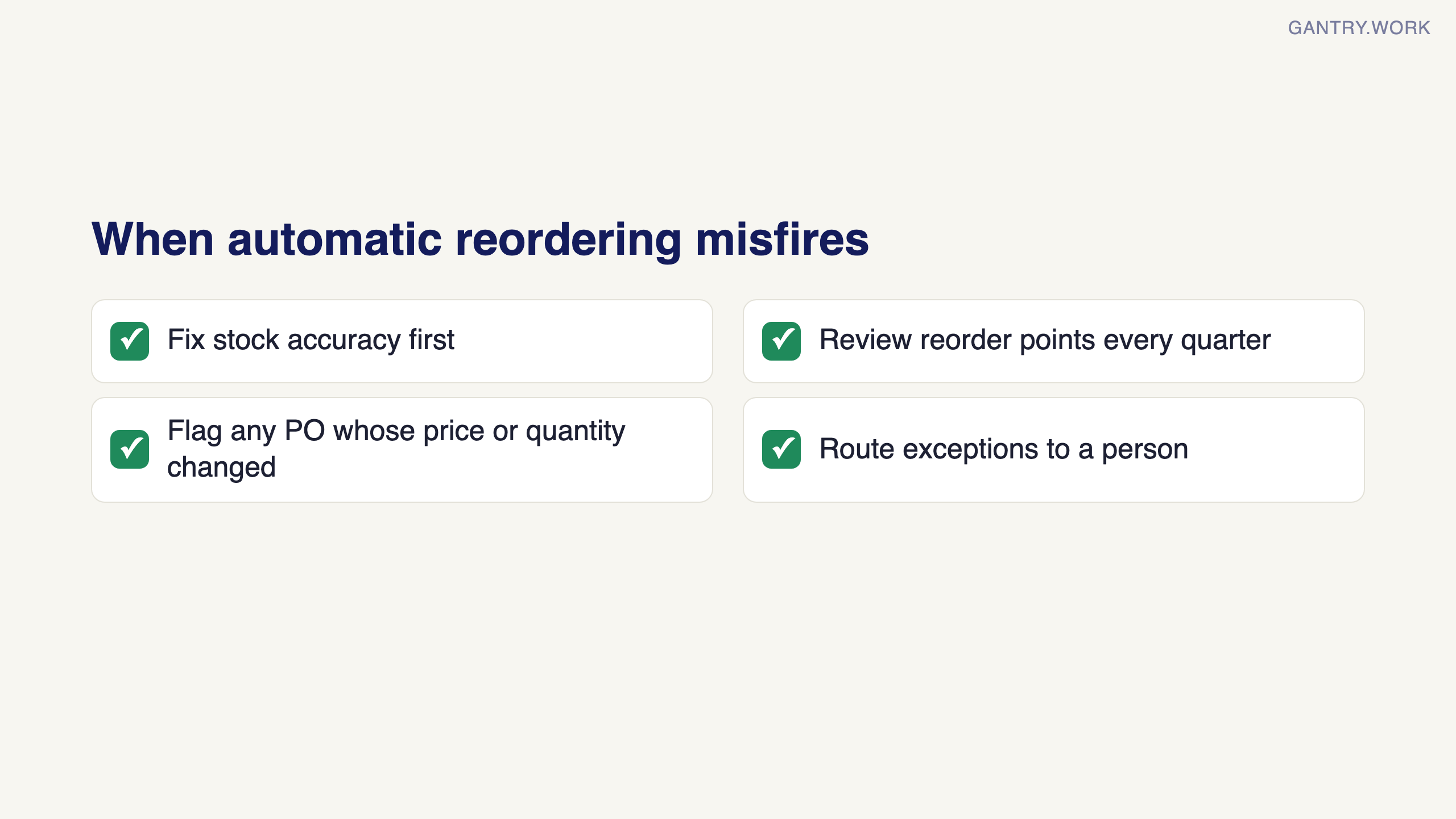
The stock figure is wrong. If the system thinks you have forty units and the shelf has four, the reorder never triggers. Automation is only as good as the count underneath it, which is why stock accuracy is the first thing to fix, not the last.
Seasonal items. A reorder point set in a quiet month will be too low in a busy one. Review the points quarterly; it takes an hour.
Minimum order quantities and lead-time changes. The supplier changes terms and nobody updates the record. The fix is a rule that flags any PO whose price or quantity differs from the last one, rather than letting it through silently.
Notice the pattern. When the automation gets something wrong, the answer is never to go back to the WhatsApp group. It is to route the exception to a human and leave the routine alone. The human handles the ten orders that need judgment instead of the two hundred that do not.
The four processes that usually qualify next
Once reordering runs itself, owners start seeing the same shape everywhere. These are the ones that most often go next:
Quote follow-ups. A quote unanswered for three days gets a reminder without a salesperson remembering.
Invoice chasing. Statements and reminders on a schedule, escalating in tone, with the human stepping in only at the phone-call stage.
Delivery notifications. The customer gets told when goods leave, so nobody rings to ask.
Supplier bill capture. Bills land in the system the day they arrive, matched to the PO that was raised at 3AM.
That last one closes the loop, and it is why companies that automate purchasing tend to find their month-end gets shorter as a side effect. The record was created when the event happened.
Two things to keep in mind. First, write the process down before you automate it; the document is the hard part, the software is the easy part. Second, do it before you need it. The company that sets this up at forty orders a week is the one that copes at ninety, which is the whole argument of building the shell before the ramp.
Working on something similar? Connect with me on LinkedIn and tell me what you are working on. I read and reply to every message, and the questions people send become the next guides.
Want a second pair of eyes on your setup? Bring the process that keeps going wrong to a free 20-minute systems review. I'll tell you honestly what to fix first, or whether you need anything new yet.
How I test everything and how this site makes money: How The Gantry works.