

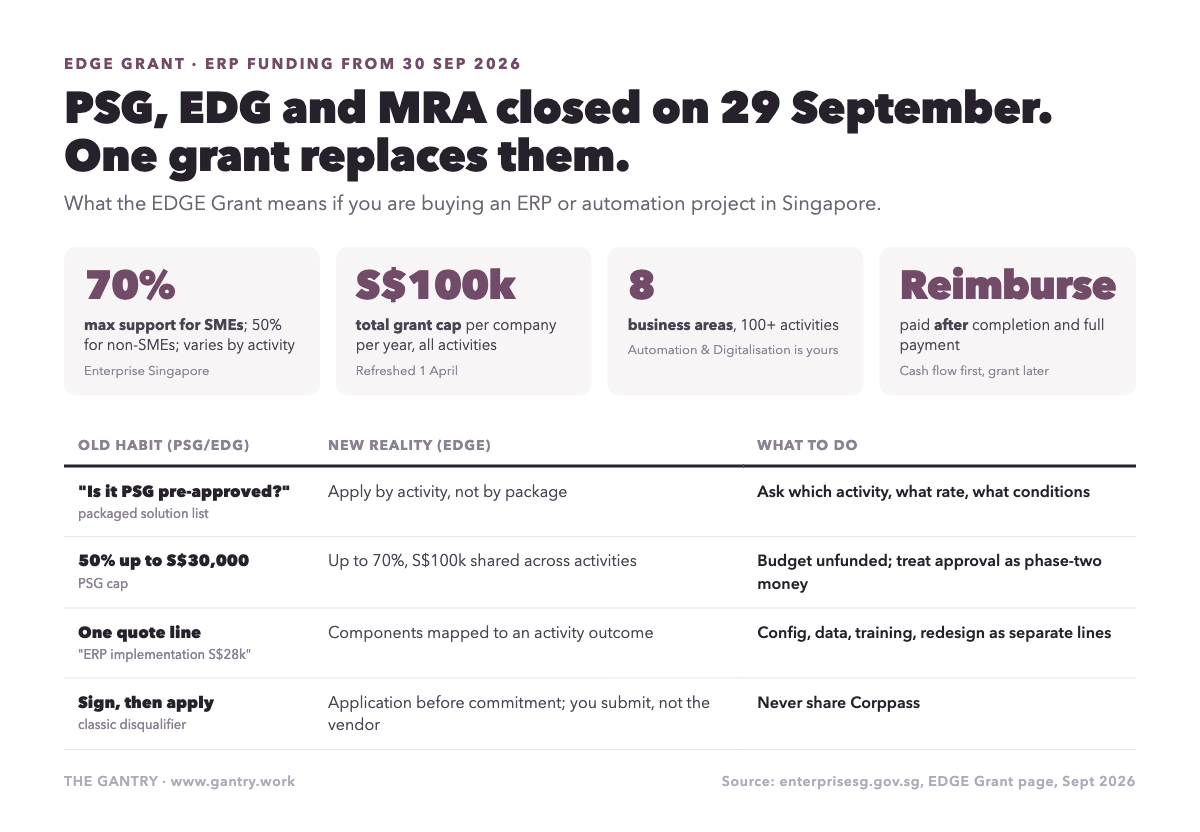
For years, the grant conversation in an ERP project went like this. "Is it PSG pre-approved?" Fifty percent of the qualifying cost, capped at S$30,000 a year, from a list of packaged solutions. If the project needed real process redesign, that was EDG, a separate application with a separate logic. Overseas expansion was MRA, a third. Every owner I worked with had to learn which of three doors to knock on before they could think about the system itself.
That ended on 29 September 2026. From 30 September, Enterprise Singapore runs business grant support through a single scheme, the EDGE Grant. This post is what the change means if you are planning an ERP, automation or digitalisation project, written from the perspective of someone who has to scope those projects around the funding.
What EDGE is, in the words that matter
According to Enterprise Singapore's own description, EDGE covers eight business areas and more than a hundred activities, from automating operations and adopting digital solutions to expanding overseas and building sustainability. The areas you pick from include Automation and Digitalisation, Business Strategy, Financial Management, Innovation, Internationalisation, Standards and Sustainability.
The three numbers to hold onto:
Support of up to 50 percent for SMEs and up to 30 percent for non-SMEs for most activities, including ERP and digital solutions. The 70 percent (SMEs) and 50 percent (non-SMEs) rates apply only to internationalisation and sustainability activities.
A total cap of S$100,000 in grant support per company per year (1 April to 31 March), shared across all activities, with a sub-cap of S$30,000 for digital solutions, integrated enterprise systems and equipment.
Reimbursement basis. You pay the vendor in full, complete the activity, then claim. The grant does not arrive before the invoice does.
EDGE is open to all Singapore businesses, not only SMEs, which is a change from PSG. The higher support level, though, is reserved for SMEs.
What happened to PSG, EDG and MRA
They closed to new applications on 29 September 2026. Anything already submitted or in progress continues under its original terms, and claims can still be made on completion. So if you applied for PSG for an ERP package in September, nothing changes for that project. If you were planning to apply in October, you apply under EDGE instead.
Two practical consequences. First, the old PSG pre-approved solution directory was the thing vendors leaned on: "we are on the list, so you get 50 percent". Under EDGE the question becomes which activity your project falls under and what that activity's support level and conditions are, although pre-approved vendors still matter because their applications are processed faster. Check the live activity list on the Enterprise Singapore or GoBusiness portal, not a vendor's slide from last quarter. Second, the S$30,000 figure has not gone away: EDGE keeps a S$30,000 sub-cap for digital solutions, integrated enterprise systems and equipment, inside the S$100,000 annual cap that every activity shares. So an ERP project and an overseas expansion in the same year draw from the same pool, and the ERP portion is capped at S$30,000 of grant.
The EDGE rules that matter most for an ERP
Who qualifies: a business registered in Singapore with at least 30 percent local ownership (Singaporeans or PRs). An SME is a group with annual sales of up to S million or up to 200 workers.
ERP counts as an integrated enterprise system, and must cover at least three core functions, for example sales, inventory and accounting.
Pre-approved vendors are faster: Enterprise Singapore quotes about 1 week to process an application with a pre-approved vendor, against about 10 weeks otherwise.
Claims open from 1 November 2026 for digital solutions, integrated enterprise systems and equipment, and from 1 December 2026 for other activities.
Source: Enterprise Singapore's EDGE Grant FAQ, checked 6 October 2026. Work out your own number with the free EDGE grant calculator: enter your quotation and it applies the rate, the S$30,000 sub-cap and the eligibility rules.
Not sure your ERP project fits EDGE? Book a free 20-minute systems review. We check which activity it falls under, whether it covers three core functions, and how to split the quotation so the qualifying parts are clear. No pitch; if a grant is not worth chasing for your project, I will say so.
Where an ERP project fits
ERP and automation projects sit naturally in the Automation and Digitalisation area, and depending on scope, parts of the work may fall under Financial Management or Business Strategy, since an implementation often includes process redesign and reporting design. The important habit is to scope the project in the language of the activity you are applying under, and to separate the software subscription, the implementation service and any consultancy clearly in the quotation, because different components may be supported at different rates.
This is also where a partner earns their fee. A quotation written as "ERP implementation, S$28,000" is harder to fund than one that shows configuration, data migration, training and process redesign as distinct lines mapped to a defined outcome. Ask any vendor you are considering how they structure quotes for EDGE, and whether they have completed a project under it yet. In the first months of a new scheme, honest answers to that second question are worth more than confident ones.
How it changes the budget
Take the 10-user trading company from what Odoo actually costs: year one about S$21,000 to S$31,000 for four modules, data migration and training. Under the old PSG logic, a pre-approved package might have attracted 50 percent of the qualifying portion, up to S$30,000. Under EDGE, an SME doing the same project as an integrated enterprise system is supported at up to 50 percent of qualifying costs, and the grant for that system is capped at S,000 a year. So for a project of this size the rate, not the cap, is what limits the grant, and only the qualifying portion counts.
Do not budget on the maximum. Budget on the project being unfunded, apply, and treat an approved grant as the reason to add the second phase sooner. Companies that size the project to the grant tend to buy modules they do not need. Companies that size it to the problem and then fund it tend to go live.
Construction firms have a separate track as well: BCA's Built Environment PSG for robots and other advanced equipment, and a new scheme that co-funds suppliers who lease robots to builders. See BCA's Robot Leasing Support Scheme for how the two compare.
Five mistakes to avoid under the new scheme
Signing before applying. Grant applications are made before you commit to the vendor. A contract signed in advance is the classic way to disqualify a project.
Assuming last year's rate. Support levels differ by activity and were reset on 30 September. Read the activity page.
Letting a vendor apply for you. Government sites warn against sharing your Corppass with vendors for a reason. Have the vendor prepare the documents; submit them yourself.
Forgetting the cap is shared. If you are also funding a market-expansion trip or a sustainability audit this year, the ERP draws from the same S$100,000.
Treating the grant as the reason to buy. A funded system that nobody uses is still a system nobody uses. The three signs you need an ERP have not changed; the grant only changes the price.
What I would do this quarter
If you have a project that was planned around PSG, re-scope it in EDGE terms: identify the activity, restructure the quote by component, and check the reimbursement timing against your cash flow, since you will pay the vendor before the grant lands. If you have not started, start with the demo brief and the data clean-up, because those take longer than the application and neither depends on the funding decision.
The scheme details on this page are drawn from Enterprise Singapore's published description and EDGE FAQ, checked on 6 October 2026, and will change as the activities are refined. Treat this as orientation and the government portal as the record.
Is your ERP project scoped around the problem, or around the grant?
Before you apply, run the ERP Readiness Scorecard. If it says "not yet", the grant will not fix that.
I'm Sayed. I work closely with business owners to automate their operations and build workflows that actually make sense. I write The Gantry about ERP and automation for SMEs.
Working on something similar? Connect with me on LinkedIn and tell me what you are working on. I read and reply to every message, and the questions people send become the next guides.
How I test everything and how this site makes money: How The Gantry works.
Before comparing systems, check whether your business is ready for one. The free ERP Readiness Scorecard takes about three minutes and tells you what to fix first.

The free ERP readiness scorecard at work: a few honest answers and a score with what to fix first. Click the animation to try it.