

The Robot Leasing Support Scheme (RLSS) is a new BCA scheme that co-funds up to 50% of the cost of each robot for solution providers who lease proven construction robots to built environment firms. The money goes to the robot supplier, not to the builder. What builders get is the option to lease a concrete-levelling or tile-grouting robot at a fixed rate for up to two years, with local technical support, instead of paying for the machine upfront.
Announced on 2 September 2026. Checked against BCA's press release and media factsheet on 6 October 2026. Rules can change, so confirm with BCA before you commit.
What BCA announced
Minister of State Alvin Tan announced the scheme on 2 September 2026 at the closing of the Construction Technology (ConTech) Summit 2026. BCA's reasoning is simple: robots for jobs like ALC panel installation, drilling, painting, concrete levelling and tile grouting are proven, but the upfront cost stops many firms, especially SMEs, from using them. Many firms told BCA they would rather lease. So BCA will pay part of the cost of building up leasing fleets, and the saving should reach builders through lease rates.
The same speech announced two other changes: virtual inspections for TOP and CSC across government agencies, and a possible new cycle of BCA's innovation challenge programme. Both are summarised further down.
How the scheme works
Who applies: robot solution providers that lease equipment to built environment firms. Builders do not apply.
How much: up to 50% of qualifying costs for each robot if the provider is an SME, and up to 30% if it is not. BCA defines an SME as a group with annual sales of up to S$100 million or up to 200 employees.
Which grant pays: the Built Environment Technology and Capability (BETC) grant, so applicants must meet the existing BETC rules: a built environment business operating in Singapore that can finance and finish the project.
What providers must commit to: a fleet of at least five robots, a local maintenance team that supports adopters during the lease, and fixed leasing rates for up to two years.
How many robots: BCA says there is no cap on the number of robots a provider can seek co-funding for.
Which robots: BCA names concrete-levelling and tile-grouting robots in its announcement, and lists ALC panel installation, drilling and painting robots among the proven solutions it wants more firms to use.
What it means if you are a builder
You do not fill in a form for this. You benefit when a supplier you lease from has been funded under the scheme, because its costs are lower and it has committed to fixed rates for up to two years. In practice:
Ask robot suppliers whether they are, or plan to be, RLSS-funded, and when their leasing fleet will be available.
Expect the first leasing offers to cover the robots BCA highlighted: concrete levelling and tile grouting first.
The fixed-rate commitment is the most useful part for a contractor pricing a tender. You can put a known robot cost into a job budget that runs for a year or more.
Lease or buy? The two routes side by side
Leasing is not the only help available. Since 1 April 2026 the Built Environment Productivity Solutions Grant (BE PSG) also covers pre-approved advanced equipment, including wall-finishing, tile-grouting, concrete-finishing, drilling, rebar-tying and floor-grinding robots.
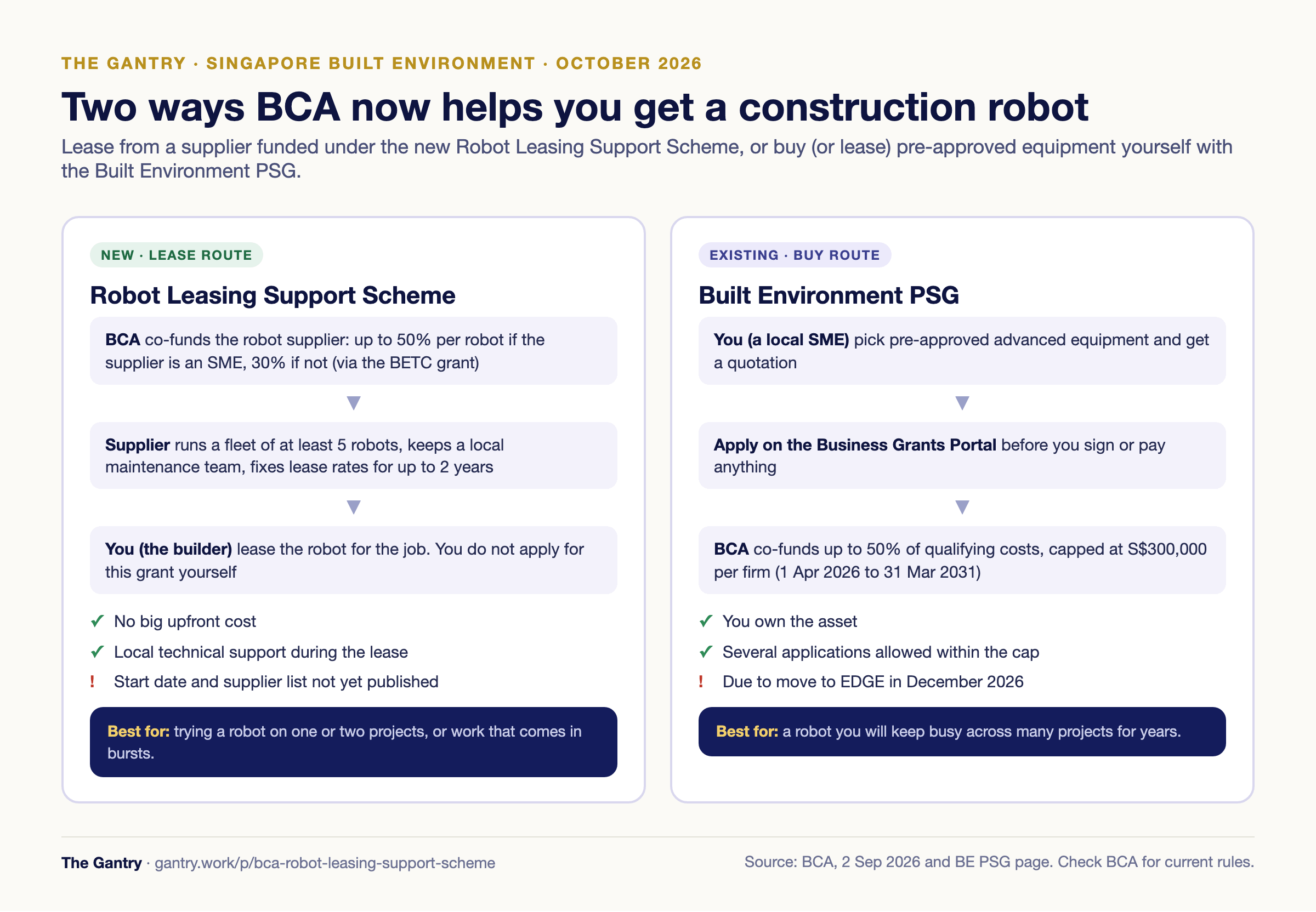
Lease through an RLSS-funded supplier if you want to try a robot on one or two projects, your work comes in bursts, or you do not want to own and maintain a machine. Support during the lease comes from the supplier's local team.
Buy (or lease) pre-approved equipment with the BE PSG if you are a local SME and you will keep the robot busy across many projects. The grant covers up to 50% of qualifying costs, capped at S$300,000 per firm for advanced equipment between 1 April 2026 and 31 March 2031. You apply on the Business Grants Portal with a quotation, three years of financial statements and a Digital Health Check result, and you must apply before you sign a contract or pay a deposit.
Watch the December change. BCA's BE PSG page says this grant is scheduled to move into EDGE in December 2026. The general PSG run by Enterprise Singapore already closed to new applications on 29 September 2026 and was replaced by EDGE, so check on the Business Grants Portal which scheme is open before you sign anything.
Questions to ask a robot leasing supplier
Is this robot covered by the Robot Leasing Support Scheme, and is the lease rate fixed? For how long?
What is included in the rate: delivery, set-up, operator training, maintenance, breakdown response time?
What happens if the robot is down for three days in the middle of a pour or a tiling programme?
What site conditions does it need: power, floor flatness, access, storage?
Which projects in Singapore has this model already run on, and can I speak to the site team?
How is the lease billed: per day, per month, per square metre? Can I see a sample invoice?
What does early return or extension cost?
The part nobody budgets: tracking a leased robot against your jobs
A robot only pays for itself if you can see what it saved. That sounds obvious, but most contractors I speak to track equipment in a spreadsheet that nobody updates once the project gets busy. For one robot on one site, a spreadsheet is fine. Once you have two or three leased robots moving between projects, three questions become hard to answer:
Which project should carry the lease cost this month? If the robot moved sites on the 14th, the lease needs splitting between two jobs, or one job looks cheaper than it really was.
How many days did it actually work? A robot that sat in storage for a week still costs the lease. Utilisation is the number that tells you whether to extend, return or buy.
What did it replace? If the robot was meant to save manpower on tiling, compare the labour hours on that trade with a similar job without the robot. Without that comparison, the decision to lease again is a guess.
The fix is the same as for any shared equipment: record each robot as an asset, log which project it is on and for which dates, charge the lease to that project's cost, and keep a simple utilisation and downtime log. If your project costs already live in an accounting or project system, add the robot there rather than in a separate sheet. If they don't, this is often the first job that shows a contractor their project costing has outgrown spreadsheets. The free Cost of Manual Work Calculator puts a number on the hours your team spends keeping those spreadsheets alive, and the three-way matching guide shows how an M&E contractor checks supplier invoices against what actually arrived on site.
Also announced: virtual inspections and a new innovation cycle
Whole-of-government virtual inspection. Builders can use 360-degree virtual scans for TOP and CSC inspections, with BCA and seven other regulatory agencies taking part. BCA says pilots saved up to 30% of manpower and got TOP up to two months earlier, and it has published a guidebook for the industry.
BEAMP. BCA is exploring another cycle of its Built Environment Accelerate to Market Programme, which since 2019 has put out more than 100 industry challenges and brought about 80 firms together with innovators.
What we don't know yet
When the scheme opens for applications, and which suppliers will be funded first.
What lease rates will look like in practice. The scheme fixes rates for up to two years, but BCA has not published a rate level.
Whether the robot list will widen beyond concrete levelling and tile grouting at launch.
I will update this page when BCA publishes the application details.
Frequently asked questions
Can a construction company apply for the Robot Leasing Support Scheme? Not as a robot user. The scheme co-funds solution providers that lease robots out. A builder benefits by leasing from a funded provider. A builder that wants to buy equipment with grant support should look at the BE PSG instead.
How much does the Robot Leasing Support Scheme cover? Up to 50% of qualifying costs for each robot when the provider is an SME, and up to 30% when it is not. There is no cap on the number of robots.
Which robots are covered? BCA's announcement names concrete-levelling and tile-grouting robots, and its factsheet lists ALC panel installation, drilling and painting robots among proven solutions. Check with BCA for the final list.
Can I lease a robot under the BE PSG instead? The BE PSG supports pre-approved solutions that are purchased, subscribed to or leased, with up to 50% co-funding for SMEs and a S$300,000 cap per firm for advanced equipment. You must apply before signing or paying.
Is the BE PSG ending? BCA's page says it is scheduled to move into EDGE in December 2026. The general PSG closed to new applications on 29 September 2026 and EDGE took its place, so confirm on the Business Grants Portal before you apply.
Sources
BCA press release, 2 September 2026: Singapore accelerates innovation and technology adoption to drive productivity in the built environment sector
BCA media factsheet, Annex A: Robot Leasing Support Scheme
First spotted in The Good Builder
Want a second pair of eyes on your setup? Bring the process that keeps going wrong to a free 20-minute systems review. I'll tell you honestly what to fix first, or whether you need anything new yet.
I'm Sayed. I work closely with business owners to automate their operations and build workflows that actually make sense, including contractors working out how to track equipment, labour and costs by project. If you are weighing up a robot lease and want to sanity-check the numbers, connect with me on LinkedIn and tell me what you are working on.