

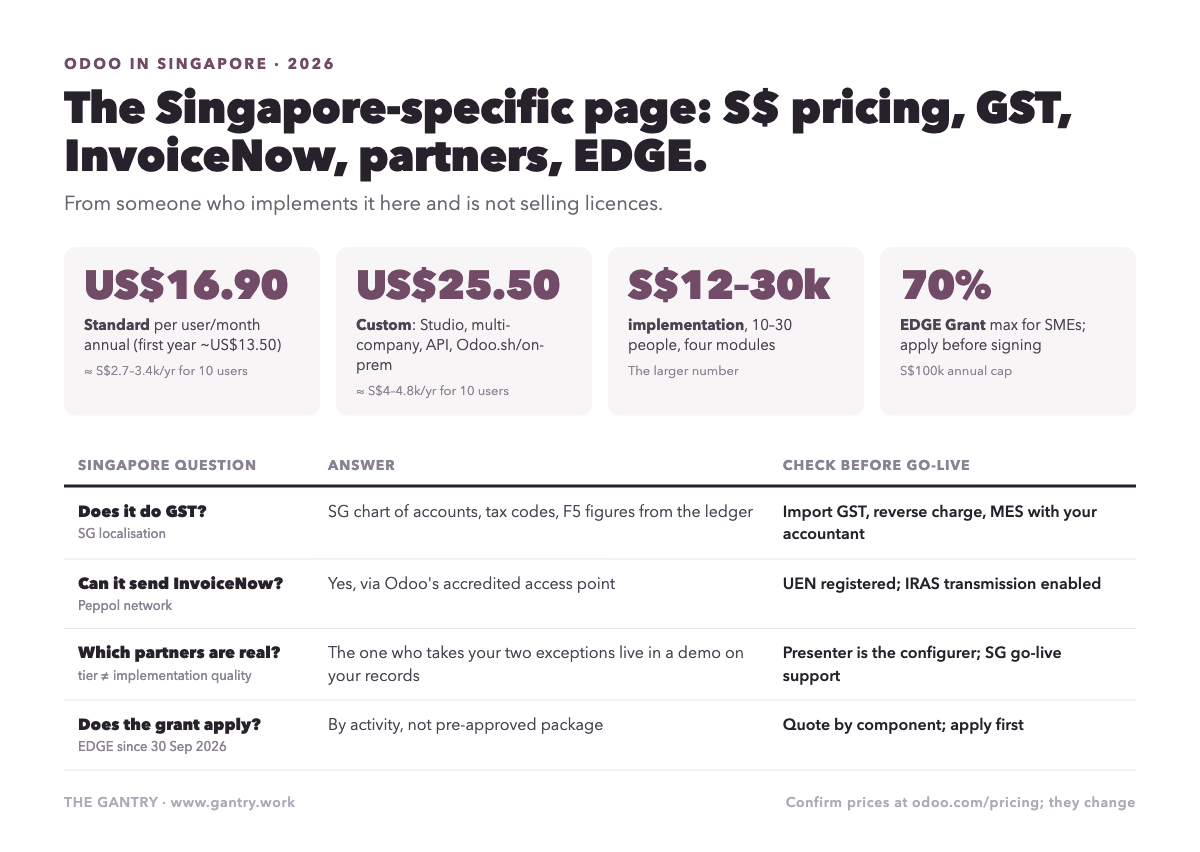
Odoo has become the most common single-database ERP among Singapore firms of 10 to 100 people, and the questions I get about it here are different from the ones on the global pricing page. What does it cost in Singapore dollars? Does it do GST properly? Can it send InvoiceNow? Which partners are real? Does the grant apply? This is the Singapore-specific page I wish existed, written by someone who implements it here and is not selling licences.
The whole picture in under a minute
The short version: the licence is the small line and the implementation is the big one, and the Singapore checks on GST, InvoiceNow and the EDGE Grant all happen before you sign or go live. The detail is below.
Pricing in Singapore dollars
Odoo publishes one price list worldwide, in US dollars, and shows a discounted first-year rate for new subscriptions. As I write, the Standard plan, all apps on Odoo's own cloud, lists at about US$16.90 per user per month on annual billing, with a first-year rate of about US$13.50. The Custom plan, which adds Odoo Studio, multi-company, external API access and the option of Odoo.sh or self-hosting, lists at about US$25.50, first year about US$20.40. Confirm current numbers at odoo.com/pricing before budgeting, because they change and the first-year discount applies only to the users ordered initially.
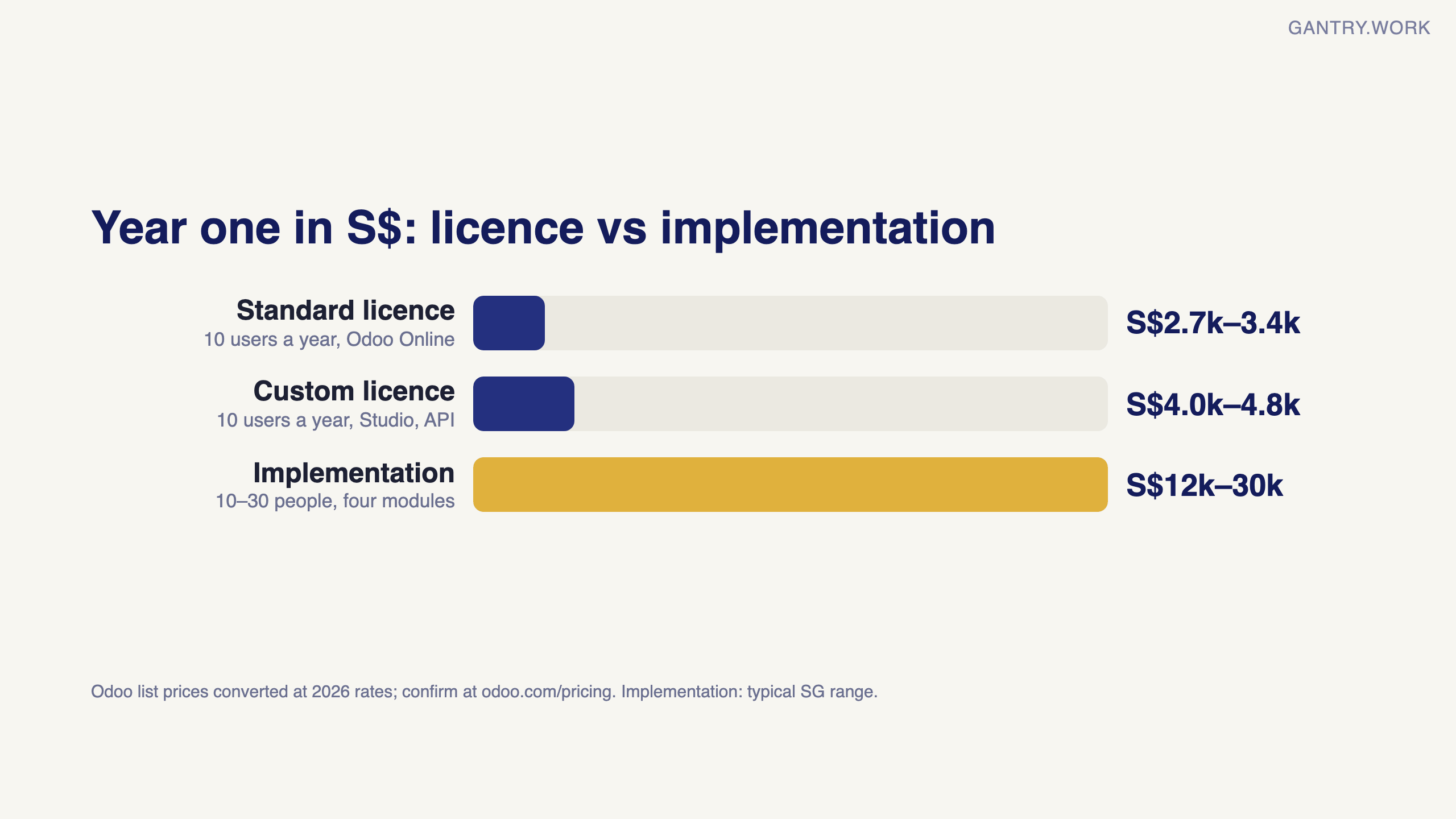
In Singapore dollars, at 2026 exchange rates, that puts a 10-user Standard subscription at roughly S$2,700 to S$3,400 a year, and Custom at roughly S$4,000 to S$4,800. Only internal users who create records need a licence; customers and suppliers on the portal are free, so most 20-person firms license 6 to 10 people.
The licence is the small part. Implementation for a typical 10 to 30 person Singapore firm going live with four modules runs S$12,000 to S$30,000, and I broke down the line items in what Odoo actually costs and, for the whole market, in ERP implementation cost in Singapore.
One plan question decides the hosting: Standard is Odoo Online only, with no custom code; Custom is required for Odoo.sh and on-premise. The hosting comparison covers when each is right. Community edition is free and self-hosted, without the accounting localisation; Community vs Enterprise explains that trade.
The Singapore localisation
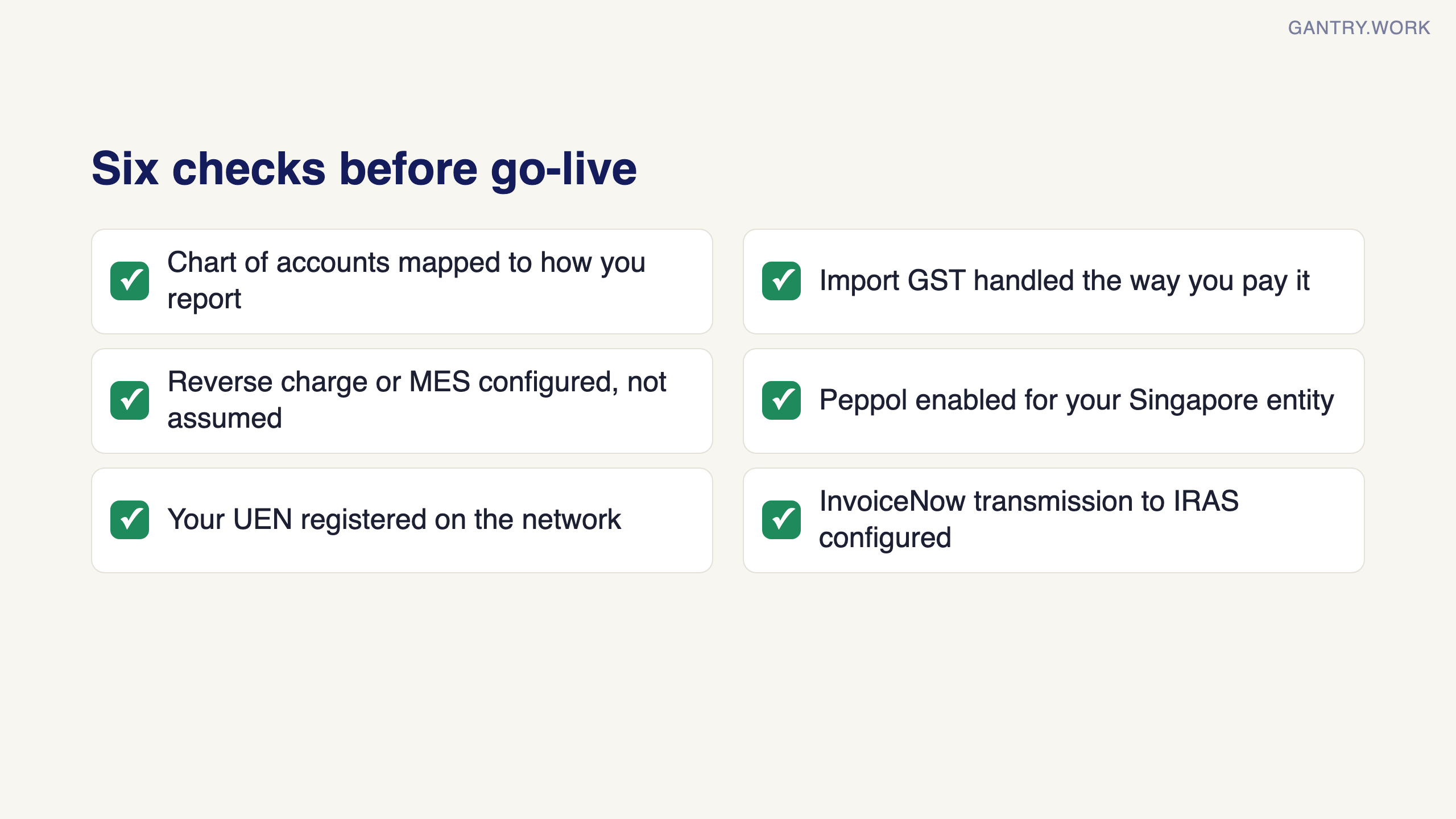
Odoo Enterprise ships a Singapore accounting package: a Singapore chart of accounts, GST tax codes covering standard-rated, zero-rated, exempt and out-of-scope supplies, and the GST F5 return figures produced from the ledger. What to check with your accountant before go-live: that the chart is mapped to how they report, that import GST is handled the way you actually pay it, and that any reverse-charge or Major Exporter Scheme treatment your business uses is configured rather than assumed. Payroll for Singapore, with CPF and IRAS submissions, is a separate consideration; many firms keep a local payroll product connected to the ledger, at least in year one.
InvoiceNow
Every GST-registered business in Singapore joins the InvoiceNow network on a phased schedule that runs to 2031, with the smallest businesses first; your own date depends on your 2025 total supplies, and the InvoiceNow post shows how to find it. Odoo's accounting app sends and receives on the Peppol network, which is what InvoiceNow runs on, through Odoo's accredited access point. Confirm that the connection is enabled for your Singapore entity, that your UEN is registered on the network, and that the InvoiceNow transmission to IRAS is configured, because that last step is the one the mandate is about. If you are keeping accounting in Xero and running only operations in Odoo, the e-invoice is generated from a synced copy of the document, which works but is one more thing to check; the trade-offs are in integrate or replace.
Finding a partner in Singapore
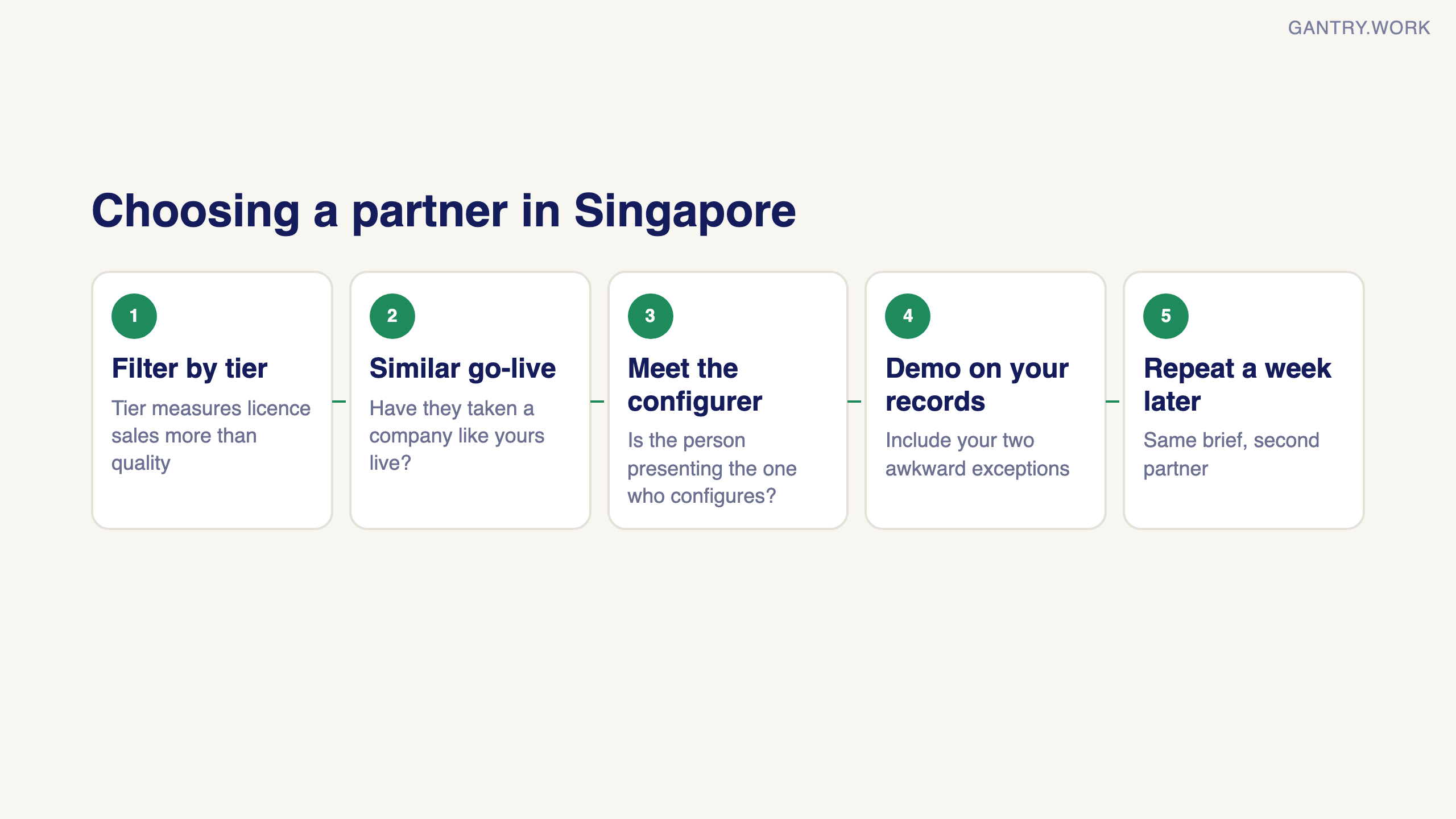
There are a handful of established Odoo partners in Singapore and a long tail of resellers, freelancers and regional firms who serve the market. The official partner directory on odoo.com lists them by tier, and tier is a useful first filter, but it measures licence sales more than implementation quality. What matters at your size is whether the partner has taken a company like yours live, whether the person who presents is the person who configures, and how they handle your two awkward exceptions in a demo run on your own records. The questions are in how to choose an implementation partner and the demo brief is in how to run a demo that tells you something. Run the same brief past two partners a week apart.
A note on regional partners: several strong Odoo firms serve Singapore from Malaysia, Vietnam or India at lower day rates. That can work well for configuration and development. It works less well for the accounting localisation and the go-live week, where someone who knows IRAS and can be in your office matters. Many firms use both.
From our projects: when the partner choice goes wrong
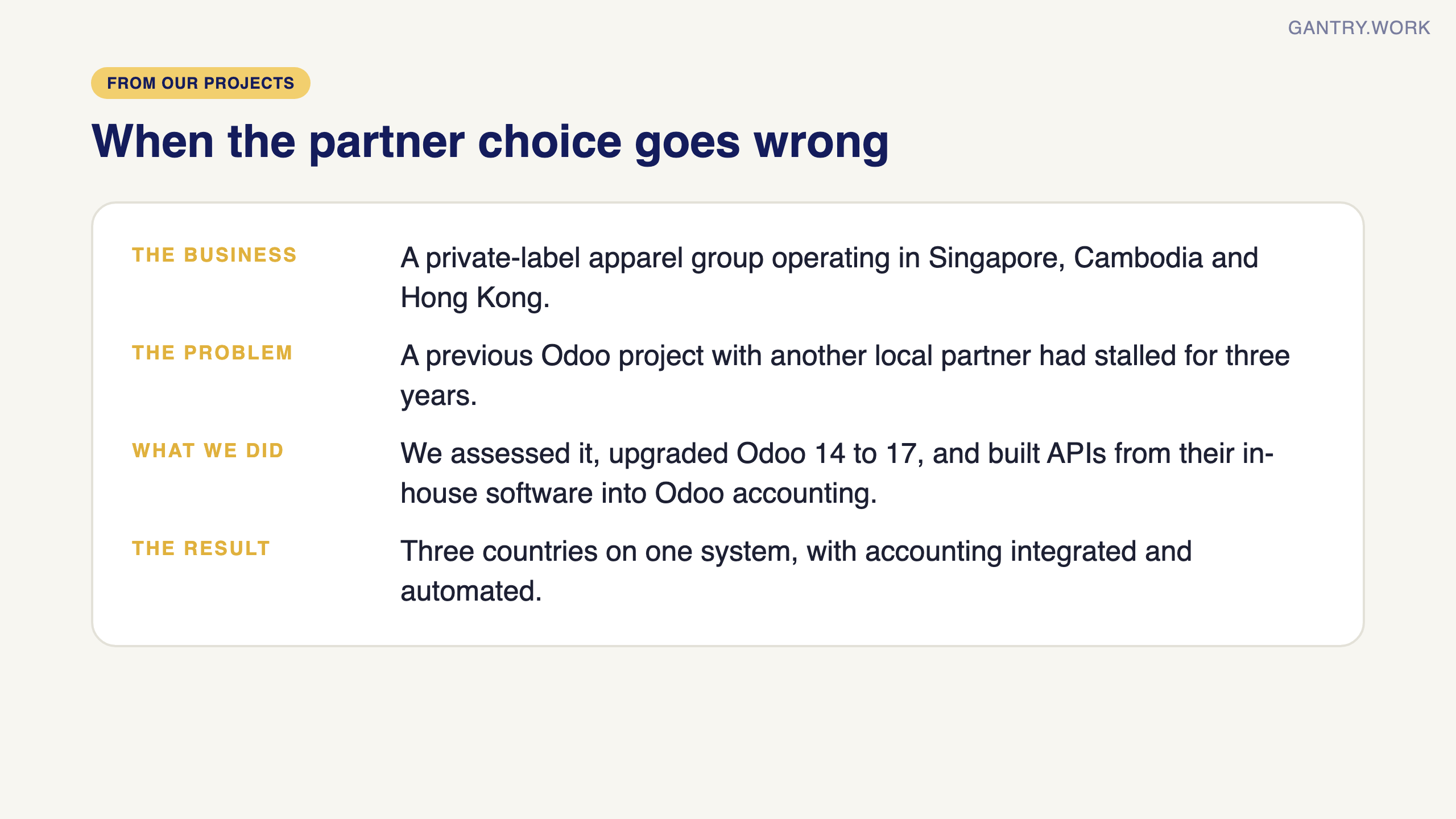
We were brought in by a private-label apparel group operating in Singapore, Cambodia and Hong Kong after a previous Odoo project with another local partner had stalled for three years. We assessed what was there, recommended an upgrade from Odoo 14 to 17, built custom APIs from their in-house software into Odoo accounting, and rebuilt the accounts, opening balances and reporting. The three countries now run on one system with accounting integrated and automated. It is the strongest argument I know for testing a partner on your own records before you sign.
The EDGE Grant
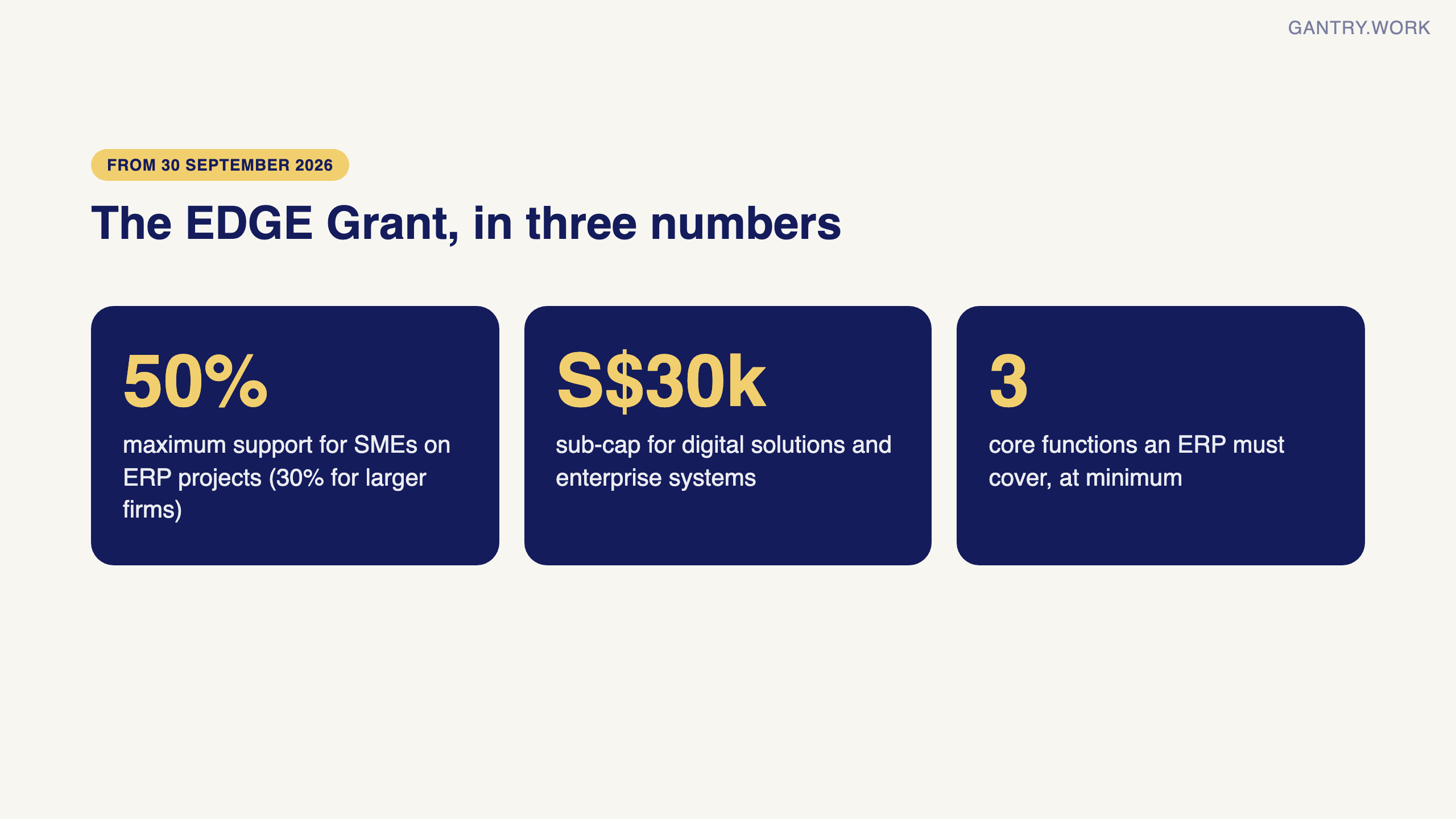
From 30 September 2026, Singapore's PSG, EDG and MRA grants were consolidated into the EDGE Grant, with support of up to 50 percent for SMEs (30 percent for larger firms) for most activities, including ERP and other integrated enterprise systems, within a S$100,000 annual cap per company and a S$30,000 sub-cap for digital solutions and enterprise systems, on a reimbursement basis. The 70 percent rate applies only to internationalisation and sustainability activities. Odoo projects were commonly funded under the old PSG pre-approved list; under EDGE you apply by activity, an ERP must cover at least three core functions, and pre-approved vendors still matter because Enterprise Singapore processes their applications in about a week rather than ten, so ask your partner how they structure a quote for it and whether they have completed an application under the new scheme. The details and the mistakes to avoid are in the EDGE grant and ERP. Apply before you sign. Estimate it for your own quotation with the free EDGE grant calculator.
Who Odoo is right for here, and who it is not
Right for: trading and distribution firms with stock, importers who need landed cost, small manufacturers, multi-outlet retail and F&B, contractors and services firms with costed projects, and any 10 to 100 person company that has outgrown an accounting package plus apps. The single per-user price with every module included is the reason it wins on cost at this size.
Not right for: a five-person consultancy with no stock, which should stay on its accounting package; a group with many entities and a listing on the horizon, which should look at the mid-market suites; and anyone who wants a system nobody has to own, because Odoo rewards an internal owner and punishes their absence. The wider map is in Odoo alternatives and the honest weaknesses in my implementer's review.
The short version
Budget S$15,000 to S$40,000 for year one at 10 to 30 people, most of it implementation. Confirm the Singapore localisation with your accountant and the InvoiceNow connection with the partner before go-live. Pick the partner on a demo run on your records, not on tier. Apply for EDGE before you sign. Go live on three or four modules and add one a quarter.
What is the one Singapore-specific requirement you would want to see working before you trusted the system?
If you are at the "is this even the right kind of system" stage, the ERP Readiness Scorecard will tell you in eight questions.
Want a second pair of eyes on your setup? Bring the process that keeps going wrong to a free 20-minute systems review. I'll tell you honestly what to fix first, or whether you need anything new yet.
I'm Sayed. I work closely with business owners to automate their operations and build workflows that actually make sense. I write The Gantry about ERP and automation for SMEs.
Working on something similar? Connect with me on LinkedIn and tell me what you are working on. I read and reply to every message, and the questions people send become the next guides.
How I test everything and how this site makes money: How The Gantry works.
To see whether the numbers work for your own business, the free ERP ROI Calculator turns your team size, hours lost and setup cost into a payback period and 15-year value.

The free ERP ROI calculator at work: your team, hours and setup cost in, payback and 15-year value out. Click the animation to try it.