

Full disclosure before anything else: I implement Odoo for a living. So when I say ERPNext is a genuinely good ERP that’s sometimes the right choice, you can weigh what that admission costs me. Both systems came out of the open-source world, both cover the full quote-to-cash-to-ledger cycle, and both are priced within reach of SMEs. The differences that actually decide the choice are about money, ecosystem, and who’s going to maintain the thing — so let’s go through exactly those.
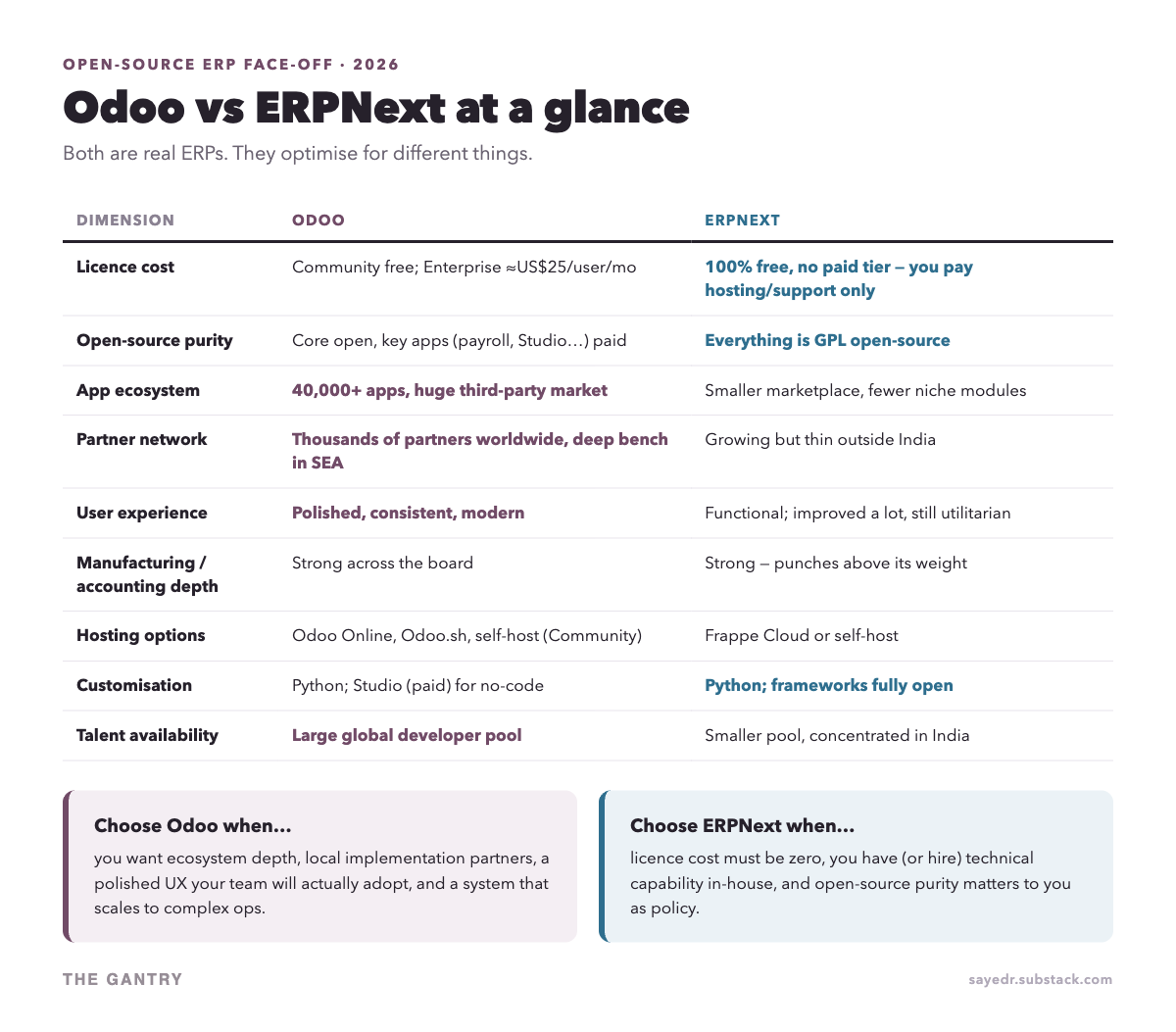
The whole comparison in 40 seconds
The short version: ERPNext wins on licence cost, Odoo wins on ecosystem, and the deciding question is who will maintain the system after go-live. The prices and the trade-offs are below.
The licence question (where ERPNext wins outright)
ERPNext is 100% open-source under GPL. Every module — accounting, manufacturing, HR, payroll — is free. You pay for hosting (Frappe Cloud or your own server) and for whoever implements and maintains it. If your licence budget is zero and must stay zero, ERPNext is the honest answer and you can stop reading here.
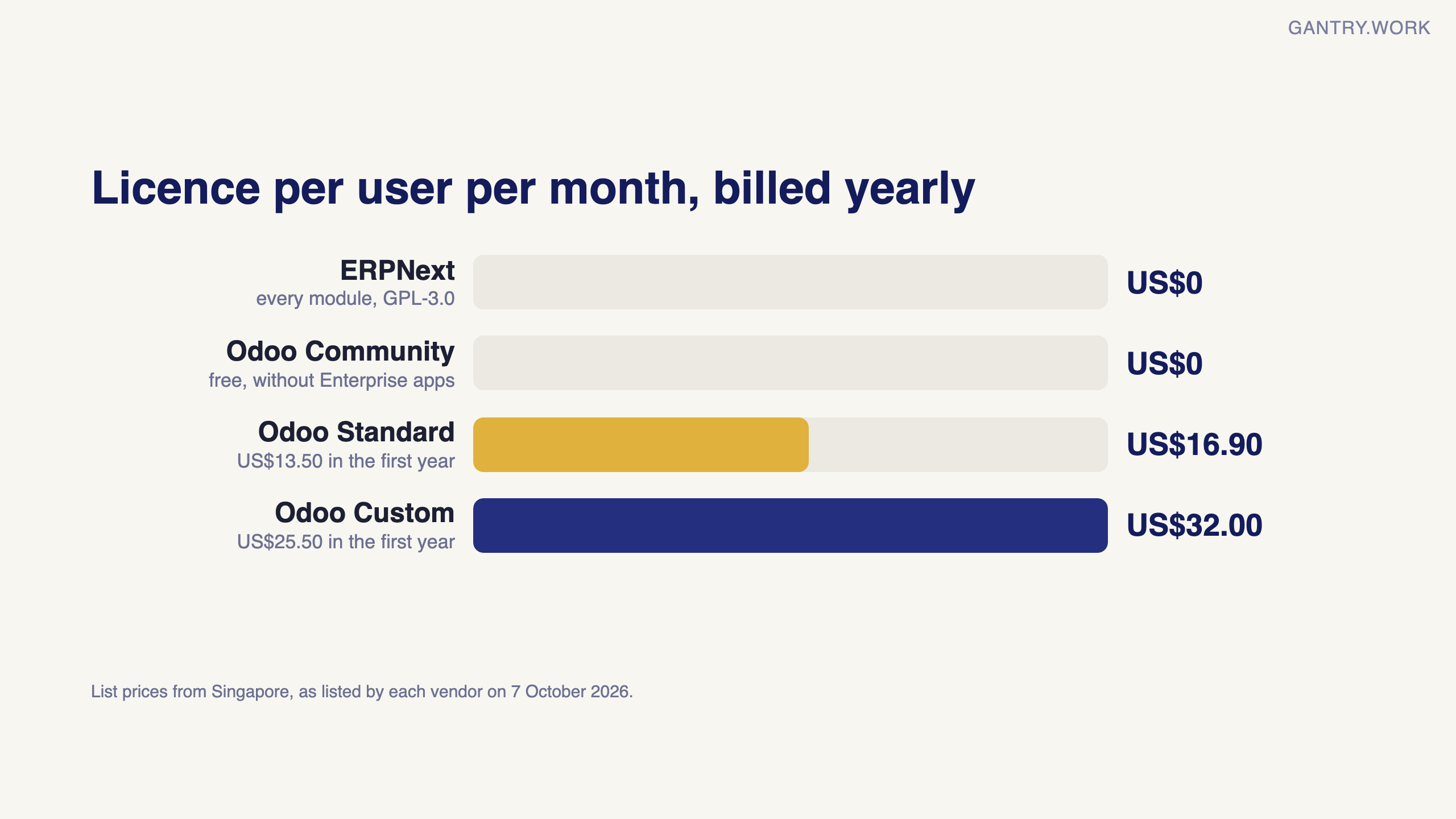
Odoo splits its editions: Community is open-source and free but missing pieces you’ll probably want (full accounting localisation, payroll, Studio, hosted upgrades), while Enterprise costs US$16.90 per user per month on Standard billed yearly (US$13.50 in the first year) or US$32.00 on Custom. For a 10-person team on Standard that is US$2,028 a year, roughly S$2,600 — not nothing, but usually smaller than one month of the productivity problem you’re trying to fix. If you are choosing between the two editions, I lay out the decision in Odoo Community vs Enterprise.
Deciding on a system for your own business? In a free 20-minute systems review, you walk me through how sales, stock and accounts run today, and I tell you honestly which system fits, or whether you need one yet. No pitch. Book a free 20-minute review
The ecosystem question (where Odoo wins outright)
This is the difference people underestimate until they live with it:
Apps: Odoo’s app store has tens of thousands of modules — if your industry has a weird requirement, someone has probably built it. ERPNext’s marketplace is much smaller; unusual needs mean custom development.
Partners: Odoo has thousands of implementation partners worldwide, including a deep bench across Southeast Asia. ERPNext’s partner network is growing but thin outside India — if your implementer disappears, replacing them is harder.
Developers: Both are Python, but the pool of developers who know Odoo’s framework is many times larger. That’s your maintenance insurance policy priced into the decision.
Product depth: closer than you’d think
ERPNext punches above its weight. Its accounting is solid, its manufacturing module is genuinely capable, and recent versions have improved the UI substantially. Odoo is more polished — the UX consistency across modules is the best in this price class, which matters enormously for adoption (”will the sales team actually use it?”) — and its breadth is wider: website builder, e-commerce, POS, marketing automation, field service, all native. If your project is “run the whole company on one system”, Odoo’s surface area is hard to match. If it’s “core ERP for a focused operation”, both cover it.
Is ERPNext better than SAP? (a question people actually Google)
Wrong comparison. SAP is built for enterprises with dedicated IT departments and seven-figure budgets; ERPNext and Odoo are built for the rest of us. For an SME, either of them beats a SAP implementation you can’t afford to do properly — and a properly-done SAP beats both for a 5,000-person multinational. Choose the tool sized for your company.
The deciding questions
Who maintains it? If you have in-house technical capability (or a trusted dev partner) and want zero licence cost forever: ERPNext. If you want a vendor-backed upgrade path and a partner you can swap out: Odoo.
How unusual are your processes? Standard workflows: either. Industry quirks: check Odoo’s app store first — a S$200 module beats a S$8,000 custom build.
Who has to love it? If adoption risk is your biggest fear (it usually should be), Odoo’s UX buys real goodwill from the people doing data entry every day.
Where’s your implementer? The best system is the one with a good implementation partner near your timezone who understands your local compliance. Interview partners for both and weigh the humans, not just the software.
ERPNext vs Odoo at a glance
Licence. ERPNext: free and open source, every module, no per-user fee; managed hosting on Frappe Cloud is priced per site. Odoo: Community is free; Enterprise is US$16.90 (Standard) to US$32.00 (Custom) per user per month billed yearly, with first-year discounts and every app included.
Ecosystem. Odoo has by far the larger partner base, app store and hiring pool. ERPNext’s is smaller and more technical.
Accounting localisation. Odoo Enterprise ships a Singapore chart of accounts, GST reporting and an InvoiceNow connection. ERPNext gets there through community localisation and an accredited Peppol provider, which works but needs a technical hand.
Manufacturing and inventory. Both are genuinely capable for a small plant. Odoo’s barcode, quality and shop-floor tools are more polished; ERPNext’s are complete and free.
Upgrades. ERPNext upgrades are free but yours to run. Odoo Enterprise on the vendor’s cloud upgrades for you, and custom code costs money at every version.
Best for. ERPNext: firms with a technical person on staff and a small budget. Odoo: firms that want a partner, a local accounting localisation and a large ecosystem.
Is ERPNext free?
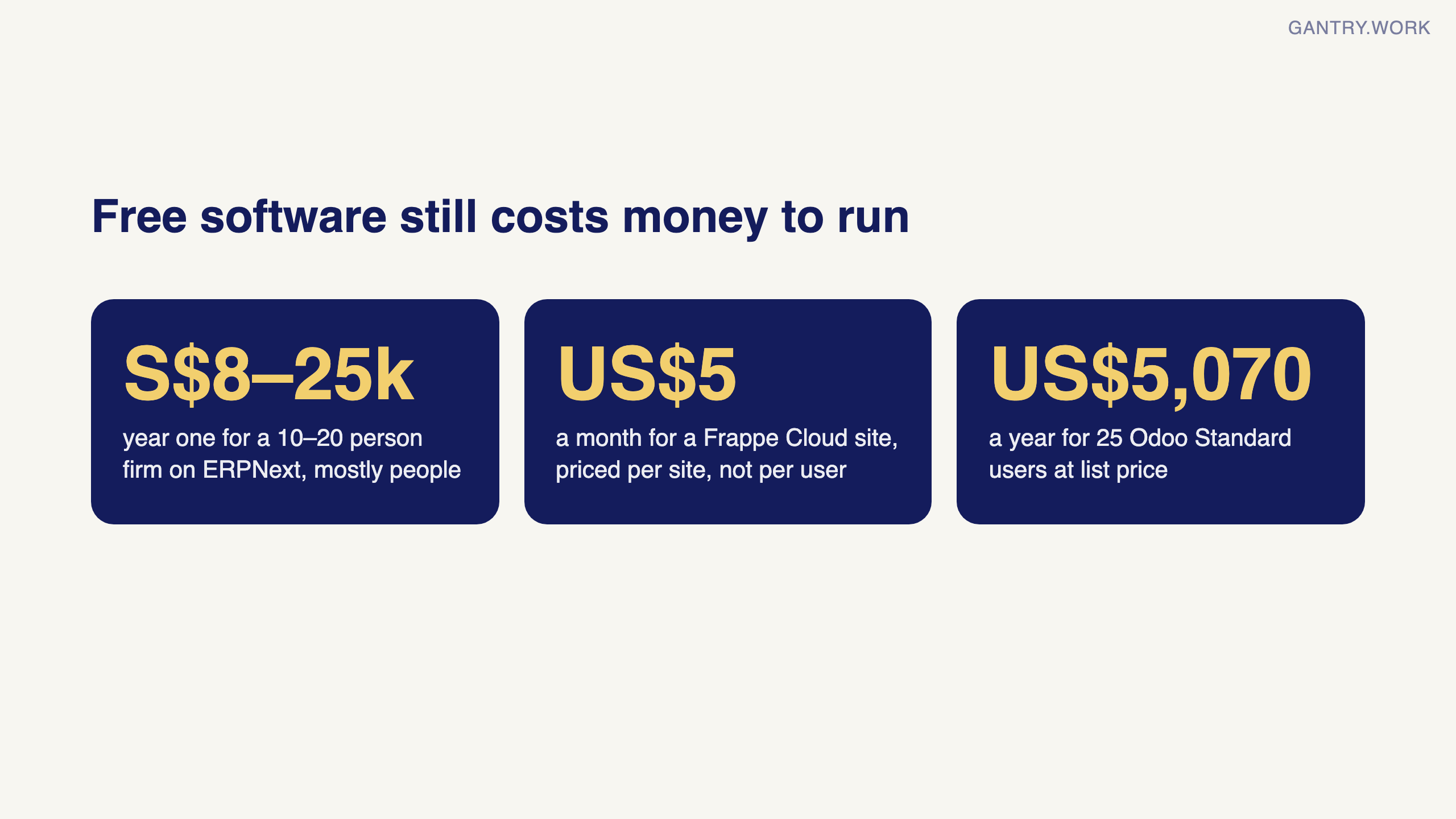
Yes in the sense that matters, and no in the sense that costs money. The software is free and open source, with no per-user licence and no paid tier holding features back. What you pay for is running it: a server or Frappe Cloud, someone to install and upgrade it, and an implementer if nobody in-house has done one. For a 10 to 20 person firm that is usually S$8,000 to S$25,000 in year one, most of it people rather than software, which is the same shape as what Odoo actually costs.
Which is easier to implement?
Odoo, on average, because more people have done it before and more of the standard workflows work out of the box. An ERPNext implementation run by a capable technical owner can be faster and cheaper; one without such a person tends to stall on the accounting setup. Whichever you choose, run the demo on your own records first. The demo brief applies to both systems.
ERPNext vs Odoo for a Singapore SME
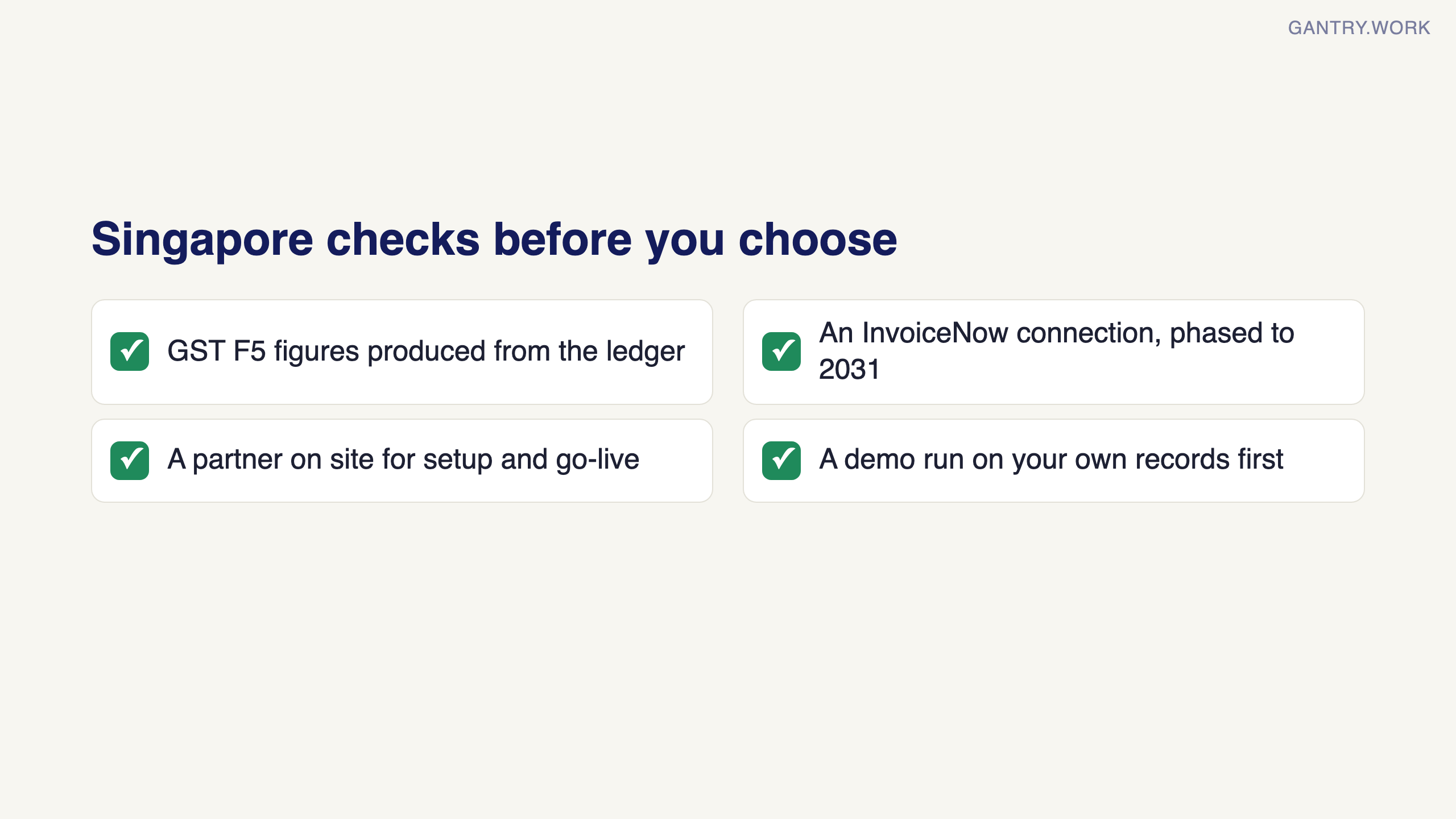
Three local checks decide it. GST F5 figures produced from the ledger. An InvoiceNow connection, since every GST-registered business joins on a phased schedule that ends in 2031. And a partner who can be in your office for the accounting setup and the go-live week; Odoo has many in Singapore, ERPNext a handful. If you have engineers and simple statutory needs, ERPNext is excellent value. If you do not, Odoo’s ecosystem is what you are paying for, and my honest review of Odoo after two years of implementing it covers what frustrates as well as what holds up.
The bottom line
ERPNext is the licence-free purist’s choice and a legitimate one — I’ve told prospects to pick it when their constraints pointed that way. Odoo costs more per user and gives you back a bigger ecosystem, a deeper partner bench, and a UX your team won’t fight. Most SMEs I meet weigh adoption and maintainability over licence purity, which is why most of them land on Odoo — but now you know exactly which trade you’re making.
ERPNext vs Odoo: which one should you choose?
Choose ERPNext if you have a technical owner and want no licence fees; choose Odoo if you want vendor-run hosting, a local partner and Singapore accounting features.
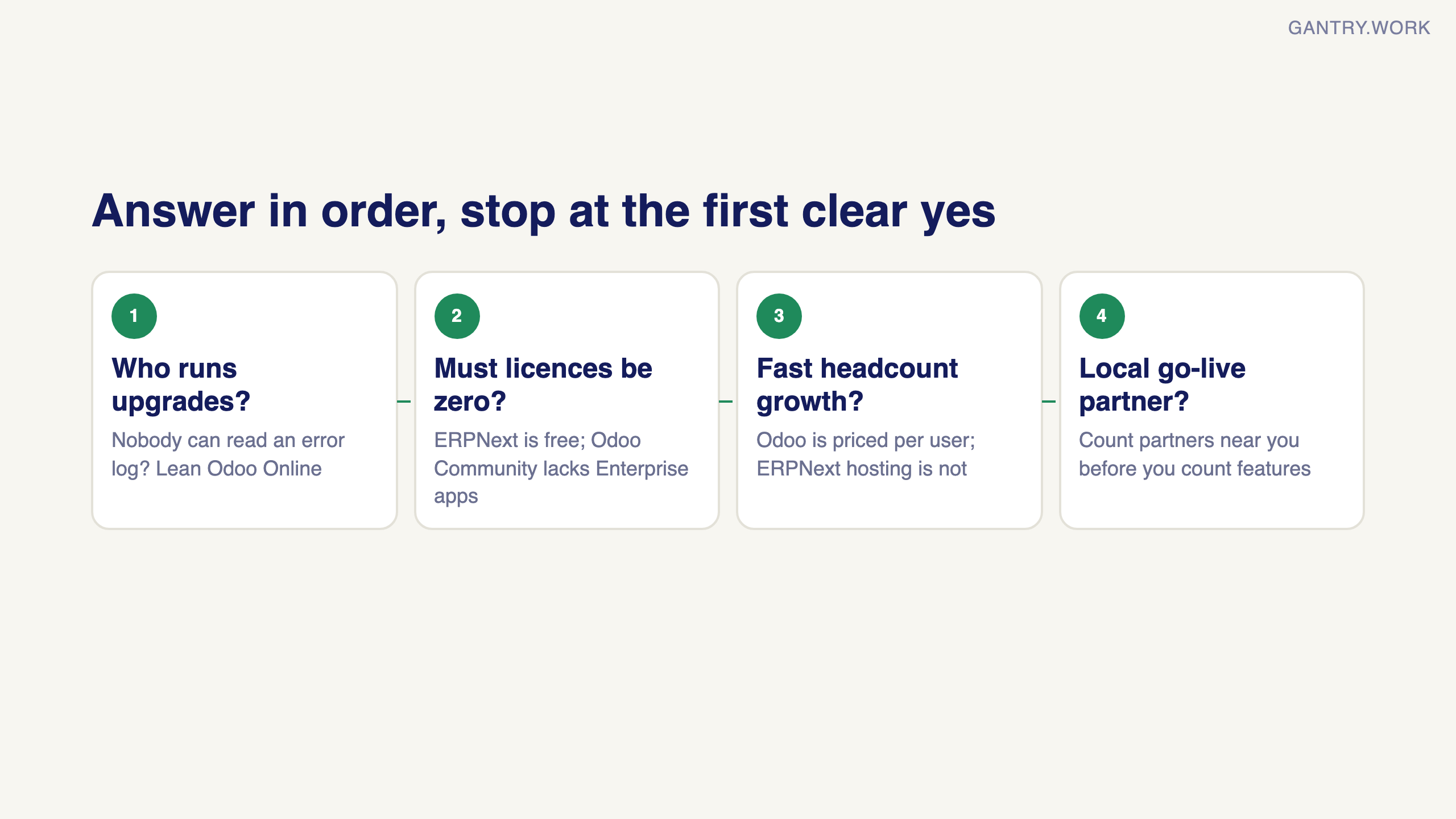
As I said at the top, I implement Odoo, so test this against your own situation. Answer these in order and stop at the first clear yes.
Is there someone, in-house or on retainer, who can run upgrades and read an error log? If not, lean Odoo Standard on Odoo Online, where hosting, backups and upgrades are part of the subscription.
Must the licence bill be zero? ERPNext is free, and Frappe Cloud hosts a site from US$5 a month, priced per site rather than per user. Odoo Community is also free, but without the Enterprise apps.
Will headcount grow fast? Odoo scales per user: 25 users on Standard billed yearly is US$5,070 a year at list price (25 × 16.90 × 12). ERPNext hosting does not scale per user, although a busier site needs a bigger plan.
Do you need local hands for go-live? Count the partners near you for each system before you count features.
Prices on 7 October 2026, as listed by each vendor:
ERPNext: free and open source under GPL-3.0, with no paid feature tier. Frappe Cloud sites start at US$5 a month with a 14-day free trial. Frappe does not implement directly; it refers you to its partner network, which it puts at more than 200 partners.
Odoo: Community is free. From Singapore, Standard is US$16.90 per user per month billed yearly (US$13.50 for the first 12 months) and Custom US$32.00 (US$25.50 for the first 12 months).
Sources, checked 7 October 2026: ERPNext pricing (free and open source, no paywalled features, Frappe Cloud sites from US$5 a month, 14-day trial, 200+ partners, no direct implementation); Frappe Cloud pricing (site plans from US$5 a month, 14-day trial); ERPNext licence on GitHub (GPL-3.0); Odoo licences (Community LGPLv3, Enterprise Edition Licence); Odoo pricing (Standard and Custom prices, free trial); Odoo Online documentation (shared demo databases).
Frequently asked questions
Is ERPNext really free? Yes. Frappe says ERPNext is 100% open source with no features behind a paywall. You pay for hosting, either Frappe Cloud or your own server, and for whoever implements and supports it.
What is the licence difference between Odoo Community and ERPNext? Odoo 19 Community is licensed under LGPL version 3 and ERPNext under GPL version 3. GPL is the stricter copyleft: if you distribute modified ERPNext code, you distribute it under GPL with the source. LGPL is looser about separate modules built on top. Odoo Enterprise is different again: a proprietary licence that needs a paid subscription. If you only run the software inside your own company, none of this changes your bill. It matters if you plan to sell modules.
Is ERPNext cheaper than Odoo? On licences, yes, always. In year one the gap is smaller than it looks, because implementation and data cleaning are most of the cost for either system, as the "Is ERPNext free?" section of this comparison explains.
Can I try both before deciding? Yes. Frappe Cloud gives a 14-day ERPNext trial, and Odoo offers a free trial with no credit card plus shared demo databases. Use them for orientation, then follow how to run an Odoo demo properly with your own records, whichever system you are testing.
I’m Sayed — I work closely with business owners to automate their operations and build workflows that actually make sense. I write The Gantry about ERP and automation for SMEs. Earlier in this series: what Odoo actually costs, and whether QuickBooks counts as an ERP. Next up: Odoo Community vs Enterprise — the edition decision inside the Odoo camp. Subscribe to follow along.
Whichever way you lean, the comparison that actually settles it is the one against doing nothing.

The free ERP ROI calculator at work: your team, hours and setup cost in, payback and 15-year value out. Click the animation to try it.
Working on something similar? Connect with me on LinkedIn and tell me what you are working on. I read and reply to every message, and the questions people send become the next guides.
How I test everything and how this site makes money: How The Gantry works.