

The best inventory software for a small business depends on what your stock does: Zoho Inventory or inFlow for a simple retailer or online seller, Cin7 Core or Unleashed for a distributor with several locations, Katana for a light manufacturer, and Sortly for a service business tracking parts. If you hold a few hundred items in one place, the stock module in Xero or QuickBooks Online is usually enough, and paying for a separate system is premature. Every price below was checked on the vendor's own pricing page on 6 October 2026.
Part of The Gantry's automation guides. Updated October 2026.
A disclosure: I implement Odoo for a living. It gets the same bullets as everyone else, and for most small businesses it is not the first answer.
Quick verdict: the best inventory software for small business
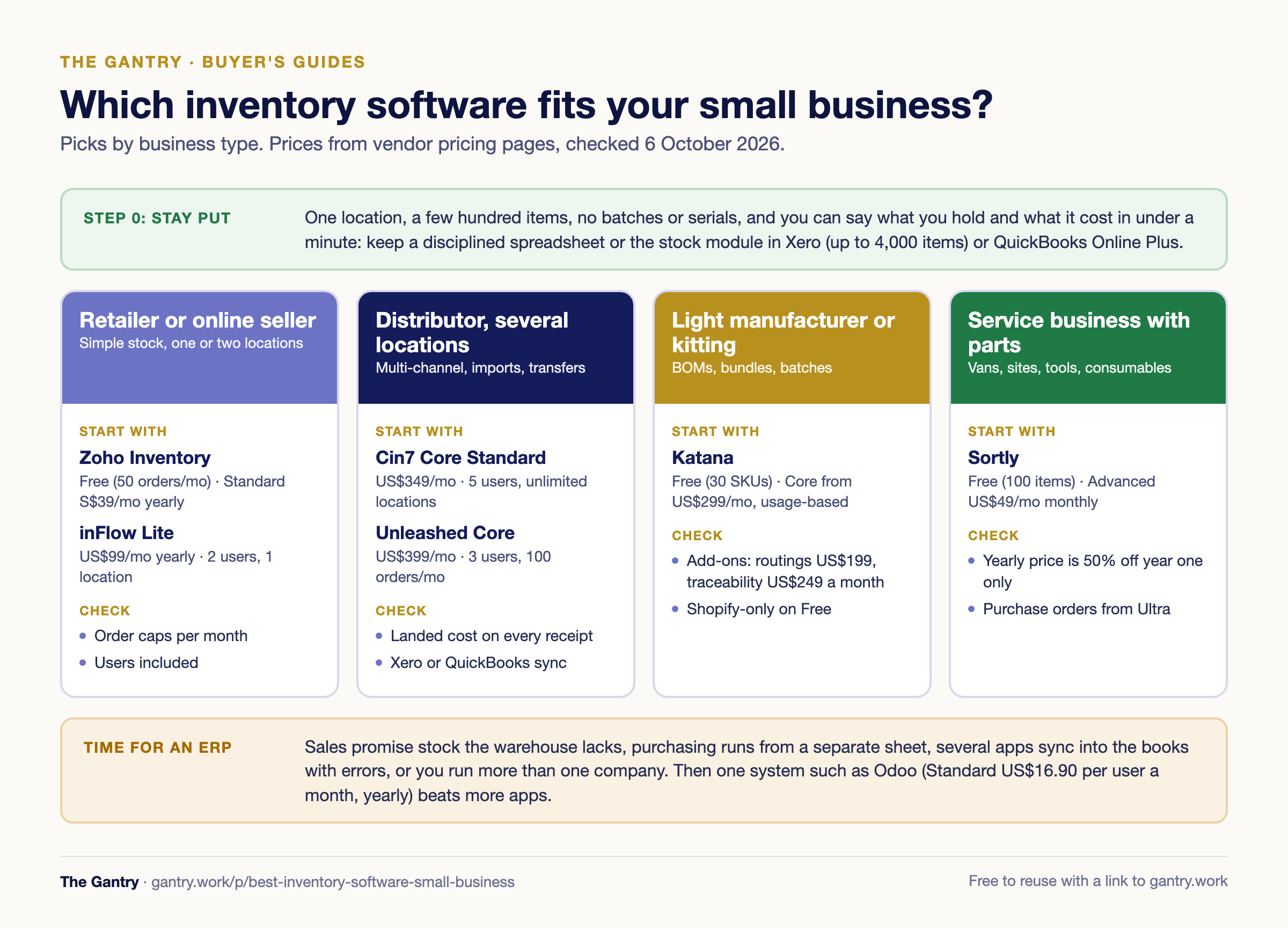
Xero or QuickBooks Online (built-in stock): best for one location, a few hundred items, and an accountant who already lives there.
Zoho Inventory: best for a small retailer or online seller who wants a free start and low monthly cost.
inFlow Inventory: best for a small wholesaler or retailer that wants a friendly app and a supplied barcode scanner.
Sortly: best for a service business tracking parts, tools and consumables across vans or sites.
Katana: best for a light manufacturer or kitting business that sells through Shopify.
Cin7 Core: best for a multi-location distributor selling through several channels on top of Xero or QuickBooks.
Unleashed: best for a distributor or light manufacturer that needs strong costing and batch tracking.
Odoo Inventory: best when sales, purchasing, stock and accounts all need to live in one system.
When is a spreadsheet or your accounting software enough?
A spreadsheet or your accounting package's stock module is enough while you have one location, a few hundred items, one person who updates stock, and no batches or serial numbers.
Xero's Singapore inventory page describes managing up to 4,000 finished items. In the US, Xero also sells Inventory Plus, a US$39 a month add-on for multiple locations and up to 10,000 orders a month, but Xero states it is only available in the United States. QuickBooks Online includes inventory on its Plus and Advanced plans; in the US those list at US$140 and US$340 a month before promotions. Intuit's help centre says QuickBooks Online values stock on FIFO, with moving average cost offered as a second option.
If you can answer "how many do we have and what did they cost?" in under a minute, stay put and get the basics right: safety stock and reorder points, a goods received note for every delivery, and clean purchase orders (the free purchase order generator handles GST and numbering if you are still on paper).
The four features that decide the shortlist
Barcode scanning, multiple locations, landed cost and accounting integration separate these products far more than dashboards do.
Inventory software for small business with a scanner
Most products now scan with a phone camera, so hardware is optional. Sortly scans in-app on every plan, including Free. Katana includes barcode scanning on Free and Core. Cin7 Core includes a warehouse app with barcode scanning on Standard. inFlow sells its own Smartphone Scanner and offers a Stockroom scan-in, scan-out app from US$39 a month as an add-on. Zoho Inventory lists barcode generation from its Premium plan.
Multi-location stock
Multi-location means stock held and transferred between warehouses, shops or vans, not a reporting tag. QuickBooks Online's pricing page lists "class and location tracking", which tags transactions for reports; if you need stock by warehouse, test it in the trial. Cin7 Core includes unlimited locations on every plan. Katana Core includes one and charges for each extra.
Landed cost
Landed cost adds freight, duty and insurance to the unit cost so your margins are real. Katana, Cin7 Core, Unleashed, Zoho Inventory, inFlow and Odoo all document a way to spread these costs onto items. Sortly does not cost stock this way. Read landed cost explained before you trust any margin report, then check your prices with the free profit margin calculator.
Accounting integration
The best accounting and inventory software for small business is usually two synced products: Xero or QuickBooks Online for the books, an inventory app for stock. Cin7 Core, Katana, Unleashed, inFlow and Fishbowl all integrate with both. Sortly integrates with QuickBooks Online on Premium and above. Zoho Inventory pairs with Zoho Books. Odoo is the exception: accounting is part of the same database. Agree on FIFO or weighted average early; both systems must match.
The best inventory software for small business, product by product
Zoho Inventory
Best for: retailers and online sellers with modest order volumes.
Price from: Free (50 orders a month, 1 user, 2 locations). Standard S$39, Professional S$109, Premium S$169, Enterprise S$329 a month billed annually, as shown to a Singapore visitor, excluding local taxes. Other regions see their own currency and price.
Strengths: cheap entry, serial and batch tracking from Professional, extra users S$10 and extra locations S$12 a month.
Limits: Standard and Professional include only 2 users; order caps (500 a month on Standard) bite as you grow.
Singapore notes: the only dedicated inventory app here that shows SGD prices to Singapore buyers.
inFlow Inventory
Best for: small wholesalers and retailers wanting a simple app plus scanning hardware.
Price from: Lite US$99, Core US$299, Pro US$499, Max US$699 a month billed annually. No free plan; a 14-day trial.
Strengths: unlimited products, sales and purchases on every plan; freight and duties spread onto product cost; Xero and QuickBooks Online integrations.
Limits: Lite has 2 users and 1 location; lot and serial numbers are add-ons on most plans; the page shows a US$499 one-time onboarding package, optional on Lite and listed as required above it.
Singapore notes: priced in USD.
Sortly
Best for: service, maintenance and trade businesses tracking parts, tools and consumables.
Price from: Free (100 items, 1 user). Advanced US$49 a month monthly, or US$24 a month billed yearly in the first year (US$288). Ultra US$149 monthly or US$74 yearly; Premium US$299 monthly or US$149 yearly.
Strengths: photos, check-in and check-out, in-app scanning on all plans.
Limits: the yearly prices carry a 50% first-year discount that drops to 20% at renewal; purchase orders start on Ultra; QuickBooks Online on Premium only. It tracks, it does not cost stock.
Singapore notes: priced in USD.
Katana
Best for: light manufacturers and kitting businesses, especially on Shopify.
Price from: Free (30 SKUs, unlimited users and locations). Core from US$299 a month, then usage-based on sales orders delivered and extra locations.
Strengths: unlimited users, barcode scanning and purchase added costs included; QuickBooks Online and Xero integrations.
Limits: add-ons cost extra on Core: manufacturing routings and insights US$199, batch and serial traceability US$249, warehouse management US$149 a month. Optional onboarding US$2,000. Annual billing carries a small premium.
Singapore notes: priced in USD; the Free plan's ecommerce link is Shopify only for now.
Cin7 Core
Best for: distributors and brands selling through several channels and locations.
Price from: Standard US$349 a month (5 users, 6,000 sales orders a year, 2 ecommerce or app integrations). Pro US$599, Advanced US$1,199, excluding taxes.
Strengths: unlimited locations on every plan, assembly with BOMs, batch and serial tracking, landed costs, Xero or QuickBooks Online integration.
Limits: a high entry price for a five-person firm; POS, B2B portal and MRP are add-ons.
Singapore notes: priced in USD.
Unleashed
Best for: distributors and light manufacturers who care about accurate costing.
Price from: Core US$399 a month (3 users, 100 sales orders a month), or US$4,389 a year. Pro US$729 a month (5 users), excluding taxes.
Strengths: multi-warehouse, batch and serial tracking, units of measure and landed costs listed as standard; Xero and QuickBooks integrations.
Limits: extra users US$69 to US$89 a month each; onboarding US$449 to US$5,549 one-off; 100 orders a month is low for a busy seller.
Singapore notes: priced in USD.
Odoo Inventory
Best for: firms where sales, purchasing, stock and accounts should be one system.
Price from: One App Free (one app, unlimited users). Standard US$16.90 per user a month billed yearly, with a current first-year rate of US$13.50 for initial users. Custom US$32.00 (first year US$25.50).
Strengths: multi-warehouse, landed costs, lots and serials, and accounting in the same database.
Limits: sales and purchase orders are separate apps, so most firms move to a paid plan; it needs a proper implementation, which costs more than the licences. See what Odoo actually costs in 2026.
Singapore notes: Odoo prepares GST F5 figures; compare it with local options in AutoCount vs Xero vs Odoo.
For QuickBooks users, Fishbowl Inventory lists Essentials at US$229 a month billed annually (2 users, mobile scanning, QuickBooks Online and Xero sync); manufacturing sits in its separately quoted Advanced product.
Picks by business type
Simple retailer or online seller: Zoho Inventory Free or Standard; inFlow Lite if you want supplied scanning hardware; Katana Free to test bundles on Shopify with 30 SKUs.
Wholesaler or distributor with several locations: Cin7 Core Standard if you sell across channels; Unleashed Core if costing and batches matter more than channels. Both sit on top of Xero or QuickBooks Online.
Light manufacturer or kitting: Katana. Budget the add-ons you will actually use, because traceability and routings are priced separately on Core.
Service business with parts: Sortly. It tracks what is on each van and who took it, which is the real problem for a service team.
Not sure which tier you need? Bring your item count, locations and the reports you rebuild in Excel to a free 20-minute systems review. I will tell you which tool fits, or whether your accounting software is still enough.
How much does inventory management software cost?
Inventory management software for small business costs from nothing to US$1,199 a month in this list, and five things drive the bill.
Users: Unleashed includes 3 on Core, Cin7 Core 5 on Standard, Zoho 2 on most plans. Katana is the exception with unlimited users.
Orders: Zoho caps orders a month, Cin7 Core caps orders a year, Unleashed includes 100 a month, Katana bills per order delivered.
Locations: inFlow Lite and Katana Core include one; Cin7 Core includes unlimited.
Add-ons: batch and serial tracking, warehouse apps, POS and extra integrations are often extra.
Onboarding: from US$449 (Unleashed self-service) to US$5,549 (Unleashed full), US$2,000 optional on Katana.
Is there free inventory software for small business?
Yes, with tight limits. Zoho Inventory Free allows 50 orders a month and 1 user; Sortly Free 100 items and 1 user; Katana Free 30 SKUs; Odoo One App Free one app for unlimited users. inFlow, Cin7 and Unleashed offer trials, not free plans.
Worked example: a 12-person distributor
A typical distributor: 6 people need logins, 2 locations, about 400 orders a month. Year-one licences at list price:
Zoho Inventory Professional: S$109 × 12 = S$1,308, plus 4 extra users × S$10 × 12 = S$480. Total S$1,788.
inFlow Core: US$299 × 12 = US$3,588, plus 1 extra member × US$29 × 12 = US$348, plus the US$499 onboarding package. Total US$4,435.
Cin7 Core Standard: US$349 × 12 = US$4,188 for 5 users; 4,800 orders a year fits the 6,000 cap. The sixth user is extra at a price the page does not publish.
Odoo Standard: 6 × US$16.90 × 12 = US$1,216.80 at the regular rate, before implementation.
Setup, item-master clean-up and a second system to reconcile usually cost more than the licences.
When does inventory software stop being enough?
Inventory software stops being enough when the pain moves between departments: sales promise stock the warehouse has not got, purchasing runs from a separate sheet, and finance rebuilds margins every month.
Other signs: several apps syncing into Xero with errors, more than one legal entity, or a warehouse needing bin control. Then compare a full ERP with a warehouse system using ERP vs WMS: what a warehouse actually needs. Singapore readers weighing local options should also read inventory management software in Singapore and Odoo vs Xero in Singapore.
Decision checklist
Count active SKUs, locations (including vans) and orders a month.
List who needs a login, not who might look once a quarter.
Decide whether you need batches, serials or expiry dates.
Decide how freight and duty should reach item cost.
Confirm the integration with your accounting software, in your country.
Price the plan you will need in 12 months, including add-ons and onboarding.
Run a trial with your own 50 messiest items before you sign.
Stuck on a step? Tell me where you're stuck and you'll get the fix, or a free 20-minute review if it's worth one.
Frequently asked questions
What is the best inventory software for a small business? Zoho Inventory or inFlow for simple retail, Cin7 Core or Unleashed for multi-location distribution, Katana for light manufacturing, Sortly for service teams tracking parts.
What is the best inventory tracking software for small business on a budget? Start with Zoho Inventory Free or Sortly Free, or with the stock module already in Xero or QuickBooks Online Plus. Upgrade when the order, item or user limits start to bite.
How much does inventory management software cost? In this list, from free up to US$1,199 a month for Cin7 Core Advanced. Paid entry plans run from S$39 a month (Zoho Inventory Standard) to US$399 (Unleashed Core), plus any onboarding fee.
Can I use inventory software with a barcode scanner? Yes. Sortly, Katana, Cin7 Core, inFlow, Fishbowl and Odoo all support scanning, mostly through a phone camera app, so a dedicated scanner is optional.
Do I need inventory software if I already use Xero or QuickBooks? Not while you have one location, a few hundred items and no batches. Add one when you need several locations, landed costs or traceability.
Related guides
Landed cost · Safety stock and reorder point · Perpetual vs periodic inventory · FIFO vs weighted average · Odoo vs Xero in Singapore
Sources
All checked 6 October 2026.
Zoho Inventory pricing: plans, SGD prices, order, user and location limits, add-ons.
Zoho Inventory: landed cost: landed cost allocation.
inFlow pricing: plans, users, locations, add-ons, onboarding.
inFlow: cost calculation and inFlow Xero integration: freight and duty in cost; accounting sync.
Sortly pricing: plans, item and user limits, discounts, scanning, QuickBooks Online.
Katana pricing: Free and Core plans, add-ons, onboarding, usage billing.
Cin7 pricing and Cin7 Core landed costs: plans, limits, features.
Unleashed pricing: plans, users, orders, onboarding, features.
Odoo pricing, Odoo 19 Inventory docs, landed costs and Barcode: plans, first-year discount, One App Free terms, features.
Fishbowl pricing: Essentials plan and integrations.
Xero Singapore inventory, Xero US pricing and Xero Inventory Plus: item limit, Inventory Plus price and availability.
QuickBooks Online pricing (US), QuickBooks Online pricing (Singapore) and QuickBooks inventory valuation: plans with inventory, location tracking, FIFO.
Want this handled properly? I do a free 20-minute systems review. No pitch, just your questions answered.
I'm Sayed. I work closely with business owners to automate their operations and build workflows that actually make sense. I write The Gantry about ERP and automation for SMEs.