

Every warehouse conversation I have eventually arrives at the same confusion. The owner has an ERP with an inventory module, or is about to buy one, and a vendor has told them they also need a warehouse management system. Or they run a 3PL, have been quoted a WMS, and someone has asked where the accounting will live. This post draws the line between the two in plain terms, and tells you which side of it a firm your size is on.
The difference in one line
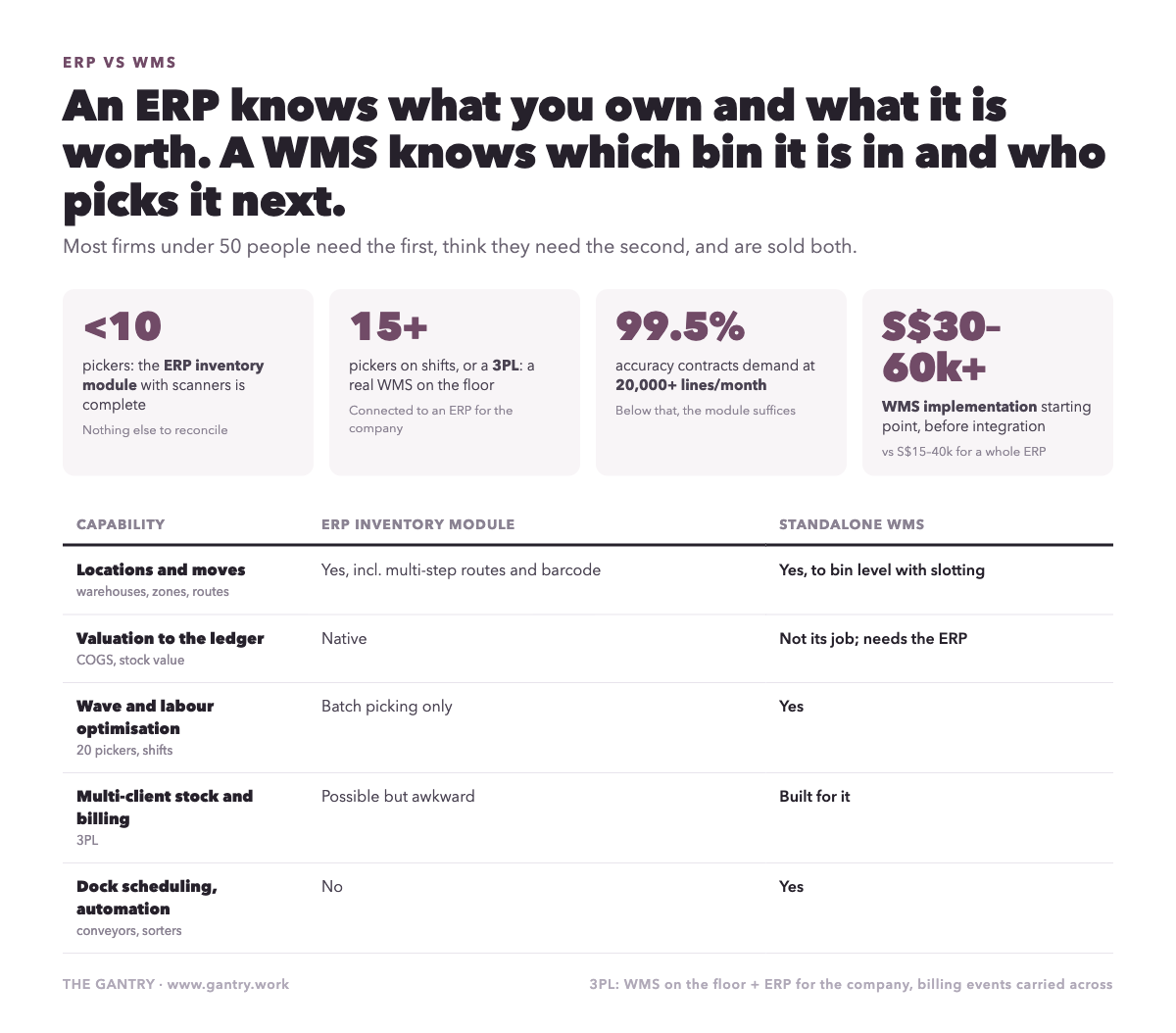
An ERP knows what you own, where it is, and what it is worth. A WMS knows which bin it is in, who should pick it next, and in what order.
The ERP's inventory module is a record: quantities by location, lots and serials, valuation that posts to the ledger, reorder rules, receipts and deliveries as documents. A WMS is an operating system for the physical warehouse: bin-level locations, put-away rules, wave and zone picking, packing stations, handheld scanner workflows, labour planning, dock scheduling. The ERP records that 40 cartons left. The WMS decided that Ahmad would pick them from bay C, row 3, before the 2pm truck.
Where an ERP's inventory module ends
Most small-business ERPs, Odoo included, go further into the warehouse than owners expect. Multiple warehouses and locations within them. Multi-step routes, receipt to quality to stock, or pick to pack to ship. Barcode scanning on a phone for receiving, picking, counting and transfers. Removal strategies such as first-in-first-out or first-expired-first-out. Batch picking of several orders at once. For a warehouse with fewer than about ten people picking and a few thousand order lines a month, that is a complete system, and it comes with the accounting attached. The eight inventory capabilities and which tier delivers them are in the inventory software guide.
The module runs out of road at three points. Dense bin-level slotting, where the question is not "which location" but "which of 4,000 bins, and which should this SKU be moved to because it is picked most". Labour and wave optimisation, where the system decides the sequence of work for twenty pickers across shifts. And multi-client operations, where the same warehouse holds stock for several owners who are billed for storage and handling.
The signs you need a real WMS
More than ten to fifteen people picking, on more than one shift.
Pick paths and slotting are a measurable cost, and a 10 percent improvement is worth a salary.
You are a 3PL, holding and billing stock for several clients, each with their own rules.
Order lines exceed roughly 20,000 a month, and accuracy below 99.5 percent costs you contracts.
You need dock scheduling, cross-docking, or automated equipment integration.
If none of those applies, a WMS is a second system to reconcile, a second licence, and a second implementation, for a benefit you will not measure. The honest conclusion for most trading and distribution firms under 50 people is the ERP's inventory module, run properly, with scanners.
The 3PL question
A third-party logistics business is the one case where the answer is often both. The WMS runs the floor and the client-specific rules; the ERP runs the company: contracts, storage and handling billing, purchasing, payroll, the ledger. The two connect on stock movements and on the billing events the WMS generates. The evaluation question for a 3PL is not "ERP or WMS" but "which WMS, and does its integration to my ERP carry the billing events, or will someone type them monthly". Ask that in the demo, on your own client's rate card.
What it costs
An ERP inventory module with scanners for a 10 to 30 person operation lands inside the year-one ranges in ERP implementation cost in Singapore, typically S$15,000 to S$40,000 including the rest of the business system. A standalone WMS for a mid-sized warehouse starts around S$30,000 to S$60,000 to implement and runs to several hundred thousand for automated sites, before the integration to the ERP. That gap is why the decision deserves the signs above rather than a vendor's assurance.
Singapore specifics
Several WMS and inventory packages built in Singapore serve the 3PL and freight community well and are priced for it. Grants under the EDGE scheme apply to automation projects including warehouse systems, on the terms in the EDGE post. And whichever side of the line you land on, the physical count before go-live decides the project, for the reasons in the migration checklist.
The decision
Under ten pickers and one owner of the stock: the ERP's inventory module, with scanners, and nothing else. A 3PL, or a warehouse where pick optimisation is a measurable line: a WMS on the floor, connected to an ERP that runs the company, with the billing events carried across. Anyone who tells you a 15-person distributor needs both is selling a second system.
How many people pick in your warehouse on a normal day?
The Cost of Manual Work calculator puts a number on the counting and the reconciliation that a proper inventory module removes.
Want a second pair of eyes on your setup? Bring the process that keeps going wrong to a free 20-minute systems review. I'll tell you honestly what to fix first, or whether you need anything new yet.
I'm Sayed. I work closely with business owners to automate their operations and build workflows that actually make sense. I write The Gantry about ERP and automation for SMEs.
Working on something similar? Connect with me on LinkedIn and tell me what you are working on. I read and reply to every message, and the questions people send become the next guides.
How I test everything and how this site makes money: How The Gantry works.
Before comparing systems, check whether your business is ready for one. The free ERP Readiness Scorecard takes about three minutes and tells you what to fix first.

The free ERP readiness scorecard at work: a few honest answers and a score with what to fix first. Click the animation to try it.