

A warehouse management system in Singapore is worth buying only when bins, pick paths or several clients' stock have become the problem: for most 5 to 100 person distributors and online sellers, an ERP inventory module or inventory app with barcode scanning (Odoo, Zoho Inventory, Cin7 Core) does the job. Small 3PLs are the exception, and should shortlist a true multi-client WMS such as Anchanto or Mintsoft that bills storage and handling per client. Every price below was checked on the vendor's own page on 6 October 2026.
Part of The Gantry's automation guides. Updated October 2026.
A disclosure: I implement Odoo for a living. It gets the same bullets as everyone else, and it is not the answer for a 3PL billing a dozen clients.
Quick verdict: which warehouse system fits
Zoho Inventory: best for a small distributor or online seller that wants bins, picklists and stock counts at a low SGD price.
Odoo Inventory with Barcode: best when sales, purchasing, warehouse and accounts should be one system, with putaway rules, wave picking and FEFO included.
Cin7 Core: best for a multi-channel brand or distributor on Xero or QuickBooks that wants a warehouse app on top.
SiteGiant WMS: best for a Shopee, Lazada and TikTok Shop seller that wants marketplace orders and picking in one place.
Anchanto WMS: best for a marketplace-heavy brand or a 3PL running fulfilment across Southeast Asia.
Mintsoft: best for a small 3PL that needs client billing and a client portal at a published price.
Do you need a warehouse management system in Singapore, or is inventory software enough?
You need a real WMS when you run multi-client stock, more than ten to fifteen pickers, or dense bin slotting; below that, inventory software with scanners is enough.
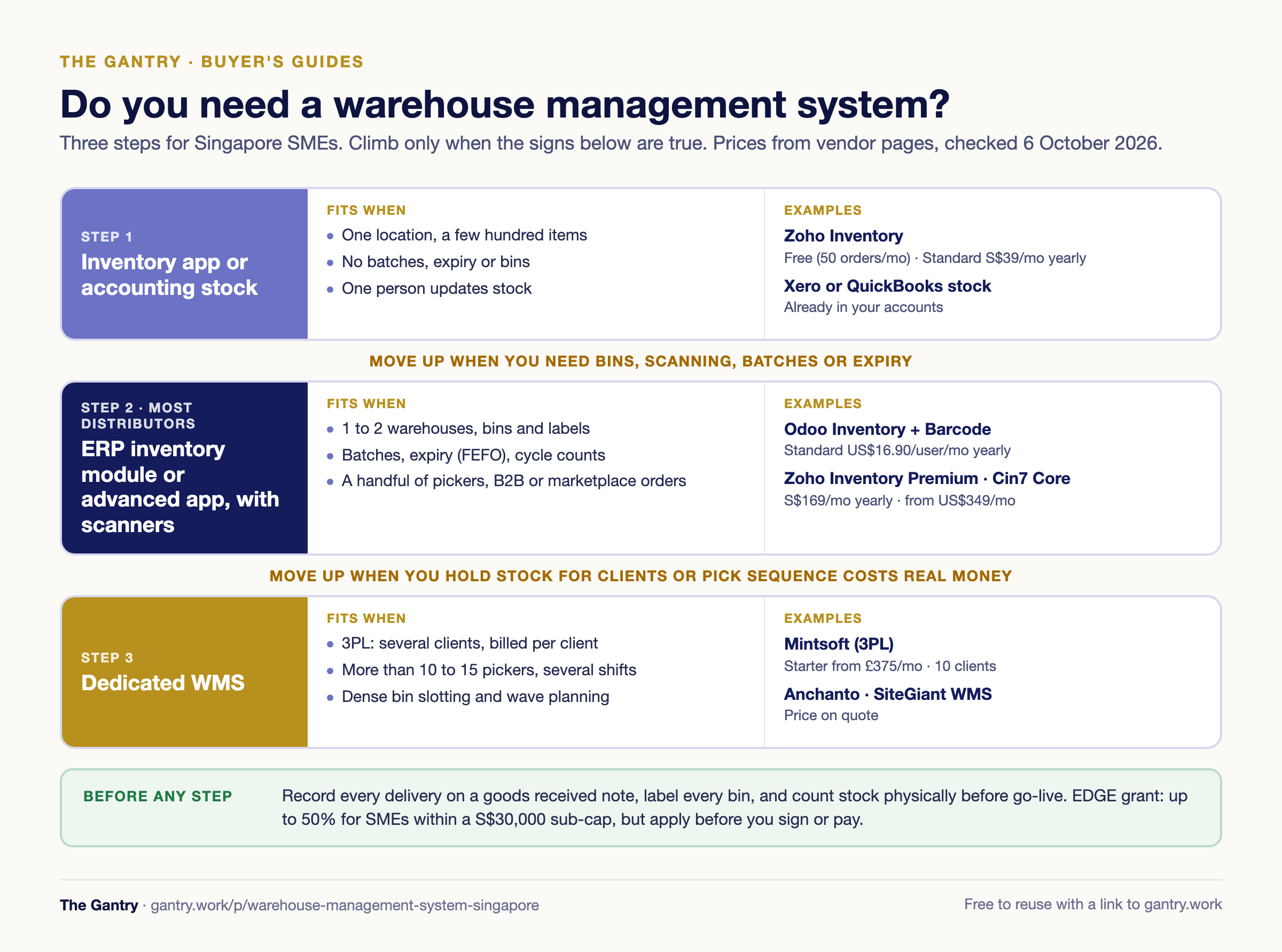
An inventory system records what you own and what it is worth; a WMS runs the floor: which bin, which picker, in what order. The full line is drawn in ERP vs WMS: what a warehouse or 3PL actually needs. Three tiers cover Singapore SMEs:
Inventory app or accounting stock module: one location, a few hundred items, no batches. See the best inventory software for small business.
ERP inventory module or advanced inventory app, with scanners: one or two warehouses, bins, batches and expiry, a handful of pickers. Most distributors belong here; see inventory management software in Singapore.
Dedicated WMS: a 3PL holding stock for several owners, or a high-volume floor where pick sequence is a measurable cost.
If you cannot say how many cartons arrived yesterday, fix receiving first with a proper goods received note.
Which WMS features actually matter?
Eight features separate a warehouse system from a stock list: bins, scanning, grouped picking, putaway rules, cycle counts, batch and expiry control, client billing and integrations.
Bin locations: every SKU has an address (rack, level, bin), so new staff can pick on day one.
Barcode or RF scanning: a scan confirms the right item and quantity at receipt, pick and count.
Wave and batch picking: batch picking collects several orders in one walk; wave picking splits order lines and regroups them by location.
Putaway rules: the system tells the receiver where stock goes, by product, category or storage type.
Cycle counts: count a slice of stock every day rather than shutting for a full stocktake.
Batch and expiry (FEFO): first expired, first out, for anything with a shelf life.
Multi-client billing: for 3PLs, storage and handling charged per client from the system's own activity log.
Carrier and marketplace integrations: orders in from Shopee, Lazada, Shopify or TikTok Shop, labels out to couriers. Trust only integrations a vendor lists on its own site.
Warehouse management software in Singapore: six options compared
Six products cover most Singapore SME cases, from free plans to quote-only, and each gets the same five attributes.
Zoho Inventory
Best for: small distributors and online sellers that want bins and stock counts cheaply.
Price from: Free (50 orders a month, 1 user). Standard S$39, Professional S$109, Premium S$169, Enterprise S$329 a month billed annually, as shown to a Singapore visitor. Extra users S$10 and extra locations S$12 a month.
Strengths: multi-warehouse, picklists that group several orders, putaway to bins and partial stock counts from mobile; batch and serial tracking from Professional; bins (2,000 per location) and stock counting from Premium.
Limits: Premium includes only 2 users; expiry-based picking is not stated on the pricing page, so test it.
Singapore notes: SGD pricing. Zoho's warehouse page names Shopify, WooCommerce and Zoho Commerce, with UPS, FedEx, Easyship and Envia for shipping; Shopee and Lazada are not listed.
Odoo Inventory with Barcode
Best for: firms where sales, purchasing, warehouse and accounts should run as one system.
Price from: One App Free (one app, unlimited users). Standard US$16.90 per user a month billed yearly, with a first-year rate of US$13.50 for initial users; all apps, including Inventory and Barcode, are included.
Strengths: storage locations, putaway rules, cycle counts, batch, cluster and wave transfers, and FIFO, FEFO and other removal strategies in the standard documentation. The Barcode app runs on USB scanners, mobile computers or a phone camera, and supports GS1 barcodes.
Limits: there is no standard per-client storage billing for 3PLs in the documentation I checked, and it needs a proper implementation, which costs more than the licences.
Singapore notes: Odoo 19 has Shopee and Lazada connectors that list Shopee.sg and Lazada.sg, syncing orders in and stock out. Ninja Van, J&T and SingPost are not among its native shipping connectors.
Cin7 Core
Best for: multi-channel brands and distributors running Xero or QuickBooks Online.
Price from: Standard US$349 a month (5 users, 6,000 sales orders a year, 2 integrations). Pro US$599 (10 users, 24,000 orders). Advanced US$1,199 (15 users, 120,000 orders). USD, excluding taxes.
Strengths: unlimited locations on every plan. Standard includes a warehouse app to pick, pack, restock and put away with barcode scanning, for one warehouse location.
Limits: advanced warehouse management (multiple warehouse locations, kitting picks, FIFO/FEFO pick enforcement) is listed separately from the standard warehouse app and is not part of Standard; ask Cin7 which plan or add-on you need and what it costs, as the add-on price is not published. 3PL connections run via API and partner solutions.
Singapore notes: priced in USD; its integrations page names Shopify, Amazon and WooCommerce but not Shopee or Lazada.
SiteGiant WMS
Best for: marketplace sellers who want orders, stock sync and picking in one tool.
Price from: price on quote. SiteGiant's Singapore pricing page shows ERP plans without prices and Omnichannel plans only as first-year prices after a grant subsidy (from S$133 a month), not as list prices.
Strengths: listed integrations with Shopee, Lazada, TikTok Shop, Zalora, Shopify and WooCommerce; picking by PDA or smartphone scan; picking modes chosen after an on-site audit.
Limits: ERP plans cap SKUs and warehouses: 500 SKUs on Mini, 12,000 on Value Plus, unlimited on Premium; one warehouse until Premium, which allows 3.
Singapore notes: ask whether the grant-subsidised prices still apply now that EDGE has replaced PSG, and get the full price in writing.
Anchanto WMS
Best for: marketplace-heavy brands and 3PLs fulfilling across Southeast Asia.
Price from: price on quote; no price is published.
Strengths: virtual racks, shelves and bins; wave picking, batch picking and pick by location; batch and expiry management; serialised items; per-customer billing reports for 3PLs. Its integrations page lists Shopee, Lazada, TikTok Shop, Qoo10, Shopify, Ninja Van and SingPost.
Limits: quote-only with no published entry plan, so you cannot size the cost before a sales call; it is a broader e-commerce suite than a single-warehouse distributor needs.
Singapore notes: Anchanto lists Singapore among its offices, and the local couriers and marketplaces are on its own integration list.
Mintsoft
Best for: small 3PLs that need client billing and a client portal at a published price.
Price from: Starter from £375 a month (3,000 orders a month, 10 clients), Medium £649 (5,000 orders, 15 clients), Large from £899 (7,500 orders, 20 clients).
Strengths: unlimited browser users, 3PL client portal and client billing on every plan, 131 standard integrations.
Limits: mobile app users need licences; modules and onboarding are priced separately.
Singapore notes: priced in pounds; check that your couriers and marketplaces are among those 131 integrations before you book a demo.
For larger 3PLs, Logiwa IO, a cloud WMS for 3PLs and brands, is quote-only, priced on fulfilment volume and complexity.
Which one should you pick?
Pick by who owns the stock and where orders come from, not by the longest feature list.
Distributor, 1 to 2 warehouses, B2B orders: Odoo if you also want sales, purchasing and accounts in one place; Zoho Inventory Premium if you want bins and counts at the lowest licence cost.
Online seller, mostly Shopee and Lazada: SiteGiant or Odoo with its marketplace connectors. Cin7 Core if Shopify and Amazon matter more.
Brand selling through many channels on Xero: Cin7 Core, confirming with Cin7 which plan gives you FEFO enforcement if you need it.
Small 3PL with several clients: Mintsoft or Anchanto, connected to an accounting system or ERP that carries the billing events.
Not sure which tier your warehouse needs? Bring your SKU count, pickers per shift and the spreadsheets you rebuild every week to a free 20-minute systems review. I will tell you whether you need a WMS, an inventory module, or just better receiving.
How much does a warehouse management system cost in Singapore?
From free plans and S$39 a month (Zoho Inventory Standard) to quote-only for Anchanto and Logiwa, before scanners, labels and setup.
Worked example: a 2,000-SKU distributor (illustrative)
A typical distributor: 2,000 active SKUs, one warehouse, 6 logins, about 400 orders a month (4,800 a year), and some products with expiry dates. Year-one licences at list price:
Zoho Inventory Premium: S$169 × 12 = S$2,028, plus 4 extra users × S$10 × 12 = S$480. Total S$2,508. Bins and stock counting included; test expiry handling.
Cin7 Core Pro: six logins is one more than Standard's 5 users, so Pro (10 users, 24,000 orders a year) is the published fit: US$599 × 12 = US$7,188. Advanced warehouse management, including FEFO pick enforcement, may cost more on top; Cin7 does not publish that price.
Odoo Standard: 6 × US$16.90 × 12 = US$1,216.80 at the regular yearly rate, before implementation.
Now the counting load. Split the 2,000 SKUs by value: 200 A items counted monthly, 600 B items quarterly, 1,200 C items twice a year. That is 200 + (600 ÷ 3) + (1,200 ÷ 6) = 600 counts a month, or about 27 a day over 22 working days. With bin addresses and a scanner, that is a small daily task for one person. Without them, counting drifts back into the annual shutdown stocktake you are trying to escape.
What does WMS implementation actually take?
Expect weeks of data and floor preparation before go-live; software setup is the smaller part.
The data you need:
A clean SKU master: code, unit of measure, carton quantity, weight and barcode.
A bin map: every rack, level and bin named consistently (for example A-01-03), with a label on each.
Opening stock by bin, with batch numbers and expiry dates where they apply.
Reorder rules, set from real lead times using safety stock and reorder points.
Item costs that include freight and duty, so margins are right from day one; see landed cost.
The hardware:
Scanners: phone cameras for a pilot, rugged Android handhelds for full shifts.
A thermal label printer for bin, product and carton labels.
Reliable Wi-Fi in every aisle.
Timeline, as rough planning ranges rather than promises: an inventory module or app with scanners in one warehouse takes weeks to a few months, mostly on the SKU master and labelling. A dedicated WMS integrated with an ERP takes longer, because integration and billing rules need testing.
Common pitfalls:
Labelling bins after go-live, so the first weeks of scans have no addresses.
Importing opening stock from the books instead of a physical count.
Skipping receiving discipline, so the system is wrong from the first delivery.
For 3PLs, finding after signing that billing events must be retyped into accounting.
Can the EDGE grant pay for a WMS?
Possibly, but no WMS is automatically covered: check eligibility with Enterprise Singapore and apply before you sign or pay anything.
The EDGE grant replaced PSG, EDG and MRA on 30 September 2026. Enterprise Singapore's EDGE FAQ says SMEs get up to 50% support, and that within the S$100,000 annual cap a company can use up to S$30,000 on single-function digital solutions, integrated enterprise systems and pre-scoped equipment. An integrated system must include at least 3 core functions. Processing takes about 1 week with a pre-approved vendor and 10 weeks with your own. Any work started or deposit paid before you apply makes the application retrospective, and it will not be supported.
As arithmetic only: if a project were approved with S$20,000 of qualifying cost, 50% would be S$10,000, inside the S$30,000 sub-cap. Run your numbers in the free EDGE grant calculator, and read the EDGE grant for ERP: what changed before you talk to vendors.
Stuck on a step? Tell me where you're stuck and you'll get the fix, or a free 20-minute review if it's worth one.
Frequently asked questions
What is a warehouse management system? Software that directs work inside a warehouse: where stock is put away, which bin to pick from, in what order, and how counts are done.
How much does a warehouse management system cost in Singapore? In this list, from S$39 a month (Zoho Inventory Standard) or US$16.90 per user a month (Odoo Standard) to quote-only for Anchanto and Logiwa, plus scanners, label printers and setup.
Is Odoo a WMS? Odoo Inventory covers most WMS features a small warehouse needs, including bins, putaway rules, wave picking, cycle counts and FEFO. It lacks standard per-client 3PL storage billing.
Which warehouse management software works with Shopee and Lazada? From this list, Odoo, SiteGiant and Anchanto name Shopee and Lazada on their own sites. Zoho Inventory and Cin7 Core do not list them on the pages checked.
Does the EDGE grant cover warehouse management software? It can support digital solutions and integrated systems up to the S$30,000 sub-cap, but eligibility depends on the activity and vendor. Confirm with Enterprise Singapore and apply before signing.
Related guides
ERP vs WMS · Best inventory software for small business · Inventory management software in Singapore · Goods received note · Safety stock and reorder point
Sources
All checked 6 October 2026.
Enterprise Singapore: EDGE grant FAQ: EDGE replaces EDG, MRA and PSG, launch 30 September 2026, 50% SME support, S$100,000 cap and S$30,000 sub-cap, 3 core functions, processing times, retrospective rule.
Zoho Inventory pricing and Zoho Inventory warehouse management: SGD plans, users, locations, bins per location, add-on prices; bins, putaway, picklists, counts, mobile scanning, listed integrations.
Odoo pricing: plans, first-year rate, apps included.
Odoo 19 Inventory docs, wave transfers, FEFO and Barcode: locations, putaway rules, cycle counts, batch, cluster and wave picking, removal strategies, scanner hardware, GS1.
Odoo 19 Shopee connector, Lazada connector and shipping connectors: Singapore marketplaces, synced data, native carrier list.
Cin7 pricing and Cin7 integrations: plans, users, order caps, Standard and Advanced warehouse management, 3PL connections, listed integrations.
SiteGiant Singapore pricing and SiteGiant WMS: plan limits, grant-subsidised prices, marketplace integrations, PDA picking, picking modes.
Anchanto WMS, Anchanto integrations and Anchanto about us: WMS features, 3PL billing reports, marketplace and courier integrations, Singapore office.
Mintsoft 3PL pricing: plans, order and client limits, inclusions, separately priced items.
Logiwa pricing: quote-only pricing and inclusions.
Want this handled properly? I do a free 20-minute systems review. No pitch, just your questions answered.
I'm Sayed. I work closely with business owners to automate their operations and build workflows that actually make sense. I write The Gantry about ERP and automation for SMEs.