

Search for ERP software in Singapore and you get vendor pages, each claiming to be the best ERP for SMEs, each with a form. What you will not find is what companies like yours actually run, what they paid, and which local details decided it. I implement these systems for Singapore firms of 10 to 100 people, so this is the guide I would want an owner to read before they fill in any of those forms.
What Singapore SMEs actually run
Setting aside the enterprise tier, the systems I see most in small and mid-sized Singapore companies, roughly in order of how often I meet them:
Xero or QuickBooks plus apps. Not an ERP, but the starting point for most firms, and the thing they are moving from. An inventory app, a job-costing tool, a CRM, and a spreadsheet that reconciles them.
Odoo. The most common single-database ERP among 10 to 100 person firms here in the last few years, because every module is included in one per-user licence and the implementation cost is a fraction of the mid-market suites. It is the one I implement.
SAP Business One. Long established in manufacturing, trading and distribution, often because a parent company or a major customer is on SAP. Partner-implemented, heavier, strong.
Microsoft Dynamics 365 Business Central. The default for firms that live in Microsoft 365 and expect audits and multi-entity consolidation.
NetSuite. Groups with several entities and currencies, priced accordingly.
Local and regional packages. Several Singapore-built accounting-and-ERP products serve specific sectors well. Ask to see the accounting side and the upgrade path before you are impressed by the local support.
ERPNext and other open-source options. For firms with a technical person on staff and simple statutory needs.
The wider comparison, by the situation a company is in, is in Odoo alternatives.
What it costs here
Two lines, always: licences and implementation. For a Singapore firm in 2026:
10 people, three modules: roughly S$8,000 to S$16,000 in year one.
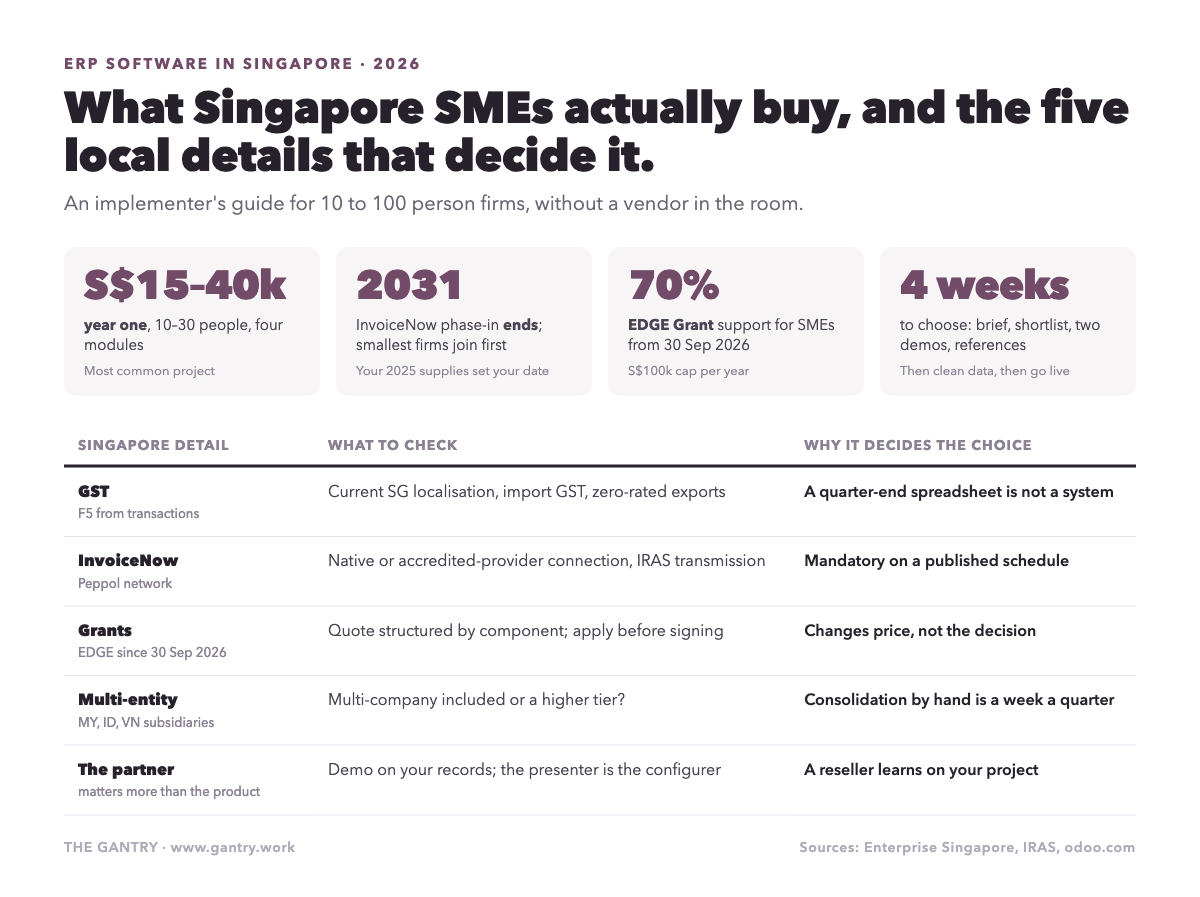
10 to 30 people, four modules, some data cleaning: S$15,000 to S$40,000 in year one. The most common project.
30 to 100 people, manufacturing or multi-entity: S$40,000 to S$110,000 in year one.
Year two drops to licences plus support. The line items, the factors that move the number, and a worked example are in my separate post on ERP implementation cost in Singapore, and the licence maths in what Odoo actually costs.
The five Singapore details that decide the choice
1. GST. The system must produce your GST F5 figures from the transactions, not from a spreadsheet built at quarter end, and handle import GST, zero-rated exports and exempt supplies correctly. Every serious system has a Singapore localisation; check that it is the current one and that your accountant has used it.
2. InvoiceNow. Every GST-registered business joins the national e-invoicing network on a phased schedule that runs to 2031, with the smallest firms first. Your ERP either connects to the network natively, through an accredited provider, or not at all. The InvoiceNow timeline shows how to find your own date, and it is a legitimate forcing function for the whole decision.
3. Grants. Singapore has funded a share of qualifying ERP and automation projects for years. The scheme was restructured on 30 September 2026 into the EDGE Grant, with up to 50 percent support for SMEs (30 percent for larger firms) on ERP and digital projects, a S$30,000 sub-cap for digital solutions and enterprise systems, and a S$100,000 annual cap across all activities. The 70 percent rate applies only to internationalisation and sustainability. It changes how quotes should be structured and when you apply, and I cover the mechanics in a separate post on the EDGE grant and ERP.
4. Multi-entity and multi-currency. A surprising share of Singapore SMEs run a second company in Malaysia, Indonesia or Vietnam, or a second Singapore entity. Consolidating by hand is a week a quarter. Check whether multi-company is included or a higher tier, and whether intercompany transactions are a workflow or a manual journal.
5. The partner. In Singapore, the implementation partner matters more than the product at this size. The market has a handful of strong partners per product and a long tail of resellers who learned the software on your project. The questions to ask are in how to choose an implementation partner, and the demo brief in how to run a demo that tells you something.
By kind of business
Trading and distribution: the decision is made by five flows, partial deliveries, landed cost, stock accuracy, pricing and collections. My post on ERP for trading and distribution tests each one.
Manufacturing: the bill of materials and the item master decide the project before the software does. See ERP for manufacturing SMEs, coming later this month.
Retail and F&B: from the second outlet, the point of sale has to share stock and accounting with the rest of the system. See ERP for retail and F&B, also later this month.
Services and contractors: projects with costs need job costing where purchases and stock hit the job; the construction version is in ERP for construction firms.
Very small firms: many do not need an ERP at all. The test is in is an ERP overkill for a 12-person firm?.
Cloud, managed or your own server
Almost every Singapore SME now runs its ERP as a subscription in the vendor's cloud. The exceptions are firms with genuine custom code, who use a managed platform, and firms with their own engineers or a data-residency rule, who run their own server. One question decides it: will you need custom code in the next two years? The full comparison is in the hosting post.
How to choose in four weeks
Week one: write down your five most retyped transactions and your two exceptions that never fit the textbook. That is your requirements document. It fits on one page.
Week two: shortlist two products and two partners. Send each partner the one-page brief and twenty real records.
Week three: two demos, run on your data, on your agenda. Score each against the five flows or the eight inventory capabilities, not the feature list.
Week four: reference calls with a client of similar size, a quote structured by component for the grant application, and a decision. If neither partner passed the demo, extend by two weeks rather than settling.
Then clean your data before the vendor's clock starts, go live on three or four modules, and set a kill date for the old system. The rest of this site is the detail behind each of those steps.
Which of the five Singapore details would break your current setup first?
The SME Systems Health Check scores your current setup out of twenty in about a minute. It is the fastest way to find out whether you should be reading this guide yet.
Want a second pair of eyes on your setup? Bring the process that keeps going wrong to a free 20-minute systems review. I'll tell you honestly what to fix first, or whether you need anything new yet.
I'm Sayed. I work closely with business owners to automate their operations and build workflows that actually make sense. I write The Gantry about ERP and automation for SMEs.
Working on something similar? Connect with me on LinkedIn and tell me what you are working on. I read and reply to every message, and the questions people send become the next guides.
How I test everything and how this site makes money: How The Gantry works.
Before comparing systems, check whether your business is ready for one. The free ERP Readiness Scorecard takes about three minutes and tells you what to fix first.

The free ERP readiness scorecard at work: a few honest answers and a score with what to fix first. Click the animation to try it.