

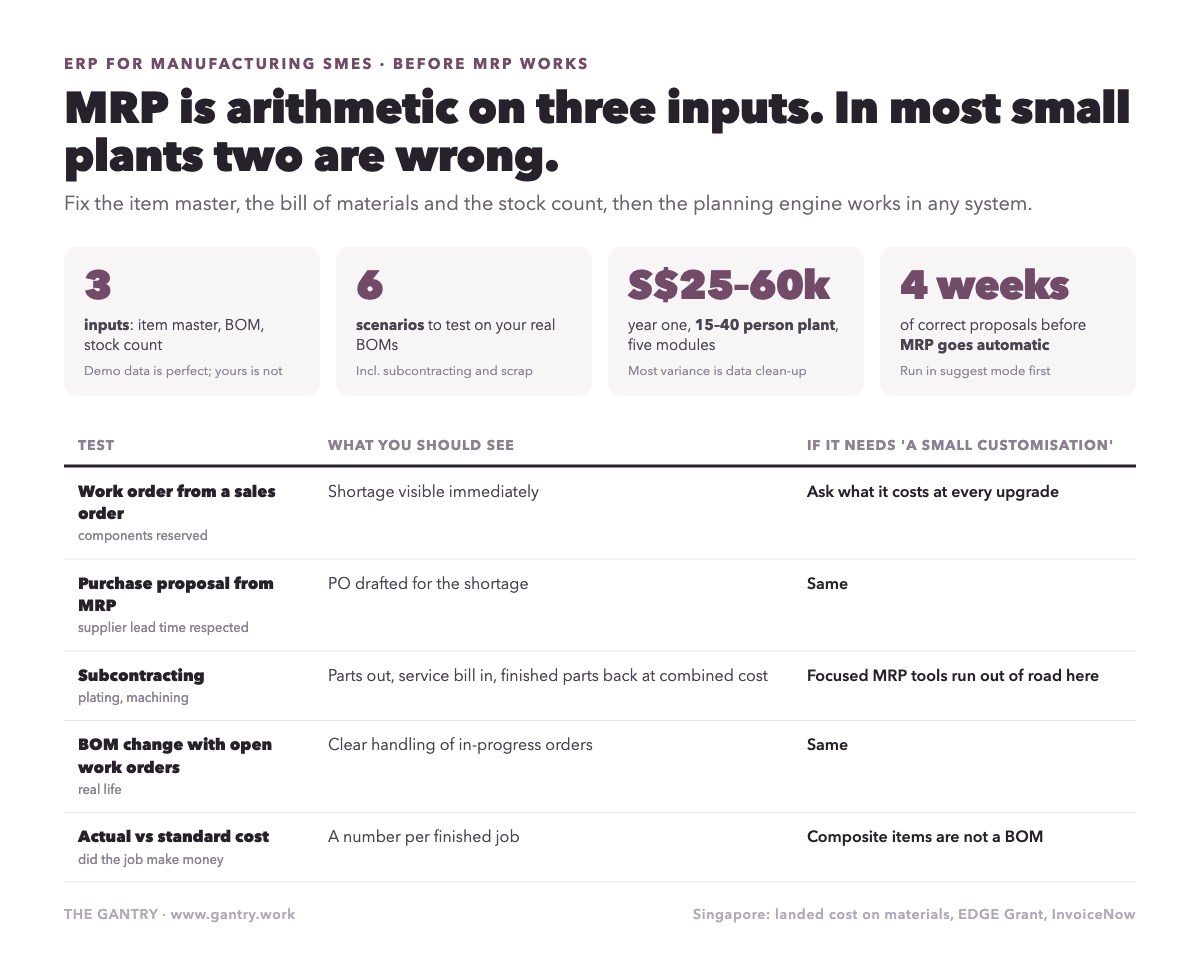
Every small manufacturer I meet wants the same thing from an ERP: to know what to make next week, what to buy for it, and whether the job made money. That is material requirements planning, MRP, and every serious system has it. The reason so many manufacturing implementations disappoint is not the planning engine. It is that MRP is arithmetic on three inputs, the item master, the bill of materials and the stock count, and in most 15 to 80 person plants at least two of the three are wrong.
This post is about getting those inputs right, what to test before you buy, and what it costs in Singapore in 2026.
The whole picture in under a minute
The short version: MRP is arithmetic on your item master, your bills of materials and your stock count, so a manufacturing project is mostly the work of getting those three right. The six demo tests, the costs and a 90-day plan are below.
MRP is arithmetic on three inputs
Material requirements planning takes demand (sales orders and a forecast), explodes it through the bill of materials to find what components are needed, subtracts what is in stock and on order, and proposes what to make and buy, when. Every product from the open-source ERPs to SAP does this competently.
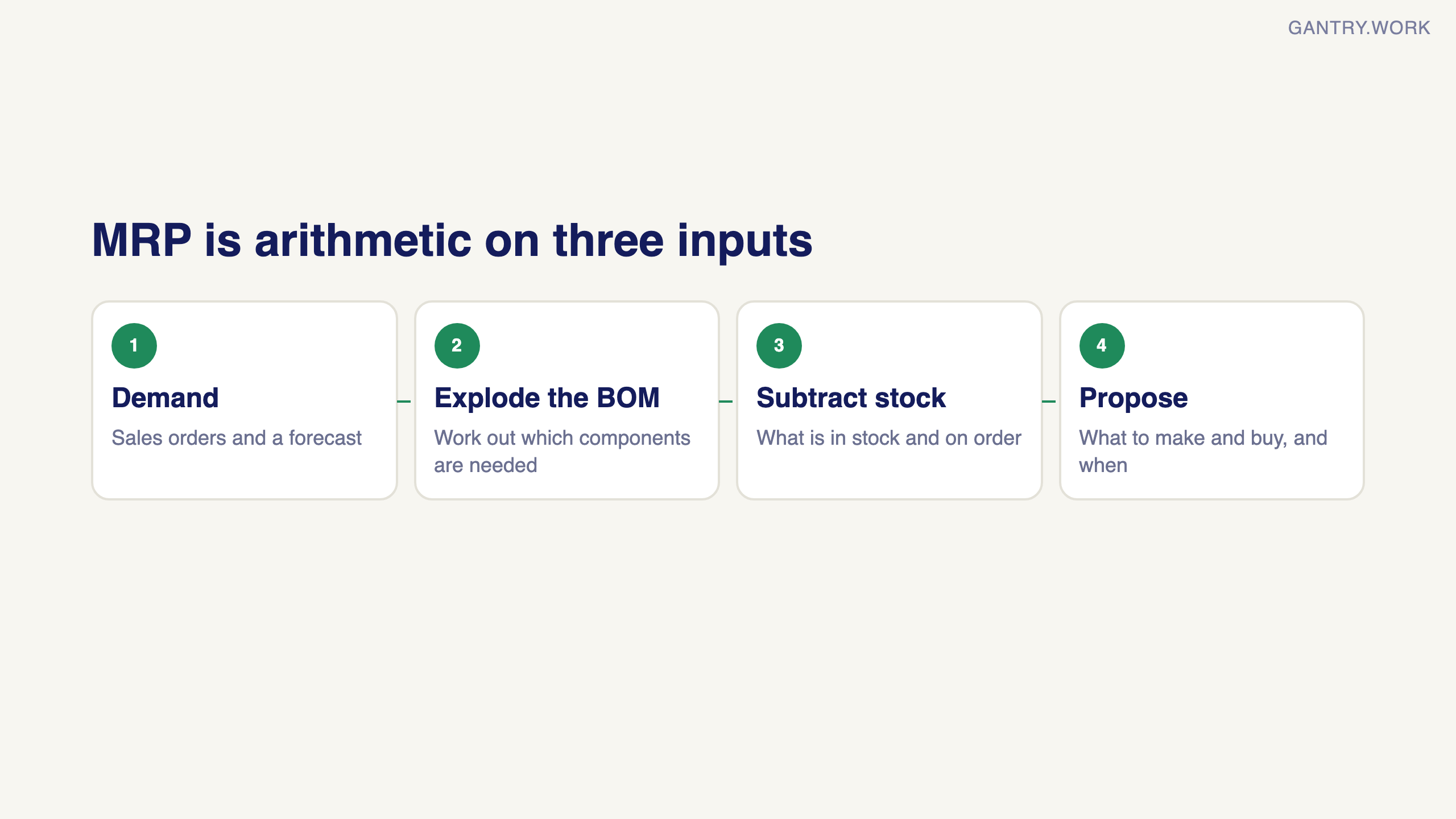
So the output is only as good as:
The item master. One code per item, correct unit of measure, lead time, supplier, cost, and whether it is made or bought. If "Bracket 12mm" exists three times under three codes, MRP will plan for all three.
The bill of materials. Every component with the right quantity and unit, scrap allowance, and the routing that says which work centre does what and how long it takes. If the BOM says 4 screws and the floor uses 5, you run out on the third batch.
The stock count. Physical quantities that match the system, by location, with lots where they matter. MRP subtracts what the system thinks you have. If that number is fiction, so is the plan.
A vendor demo with sample data will make MRP look effortless because the sample data is perfect. Your data is not, and cleaning it is the project.
From our projects: master data first
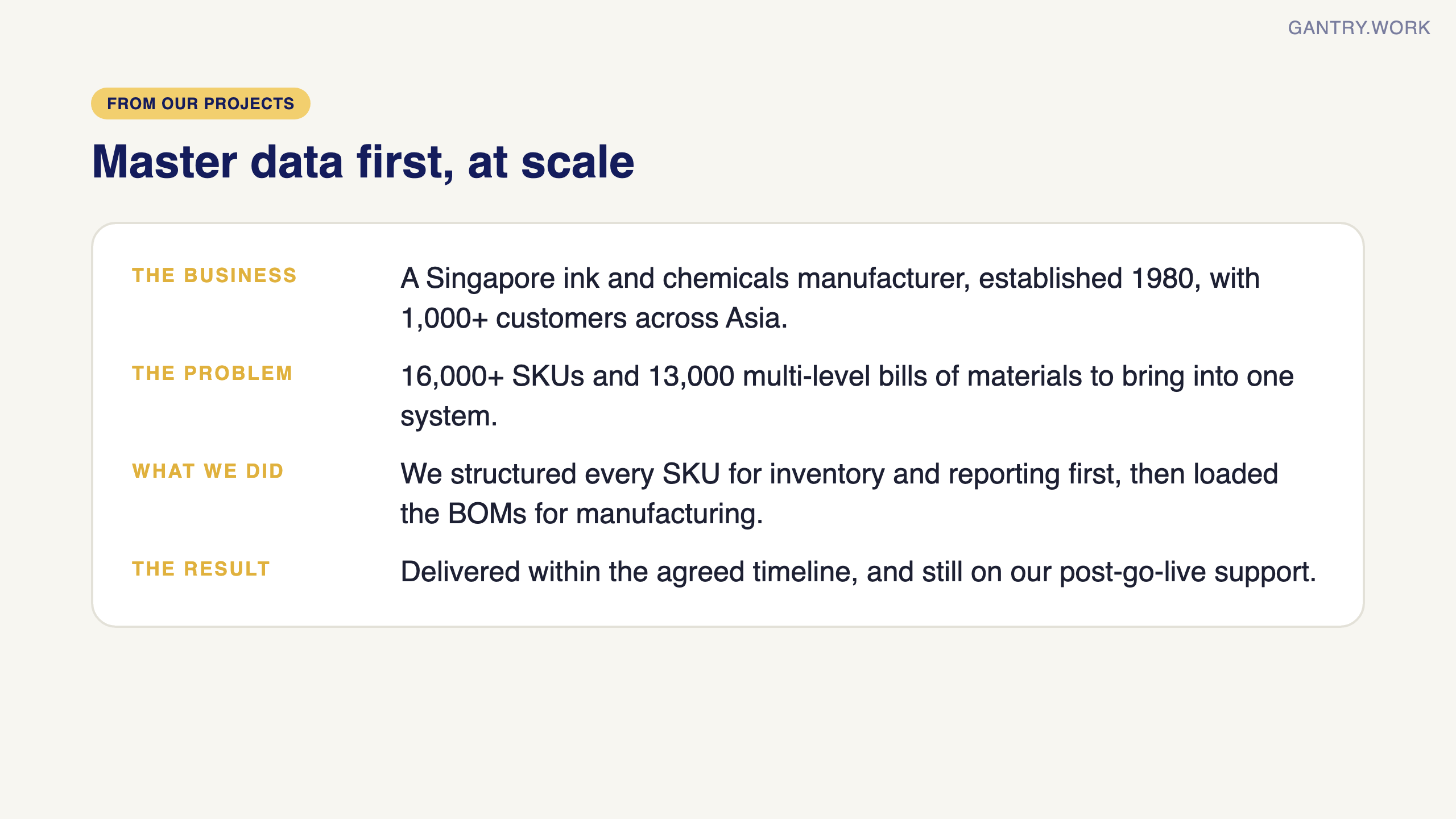
The biggest manufacturing data set we have taken live belonged to a Singapore ink and chemicals manufacturer founded in 1980: 16,000+ SKUs and 13,000 multi-level bills of materials, sold to more than 1,000 customers across Asia. We structured every SKU for inventory and reporting before configuring anything else, then loaded the BOMs for manufacturing. The project was delivered within the agreed timeline and is still on our post-go-live support. The order is the same at 15 people as at that scale: item master, then BOMs, then planning.
MRP tool or full ERP?
A focused manufacturing tool such as Katana or MRPeasy, connected to Xero or QuickBooks, gives you BOMs, work orders and basic planning without a full ERP. It is a legitimate choice for a small plant whose only real problem is production and whose finance is simple.
The limits arrive predictably. Stock valuation and cost of goods sold post to the ledger through a sync, so margin by job is an estimate. Purchasing approvals, multi-currency supplier bills and landed cost on imported material are thin. And subcontracting, where you send components out for plating or machining and get them back, is where the focused tools run out of road.
A single-database ERP with real manufacturing, Odoo, SAP Business One and Business Central at this size, does all of that in one place: the work order consumes components, posts the cost, and the finished goods arrive in stock valued at what they actually cost. The alternatives map covers when each is right; the short version is that a plant with subcontracting, imports or more than one product family is better served by the ERP from the start.
Zoho and the inventory apps are not on this list. Composite items are not a bill of materials, and you find out the difference the first time a component runs short mid-batch.
Watch it in a real ERP: from bill of materials to finished goods
I recorded this in Odoo's public demo in October 2026: a manufacturing order for 3 drawers takes its components from the bill of materials, reserves them on confirmation, and when it is marked done the components leave stock and the finished drawers arrive, each move on record with its lot number.
What to test in the demo
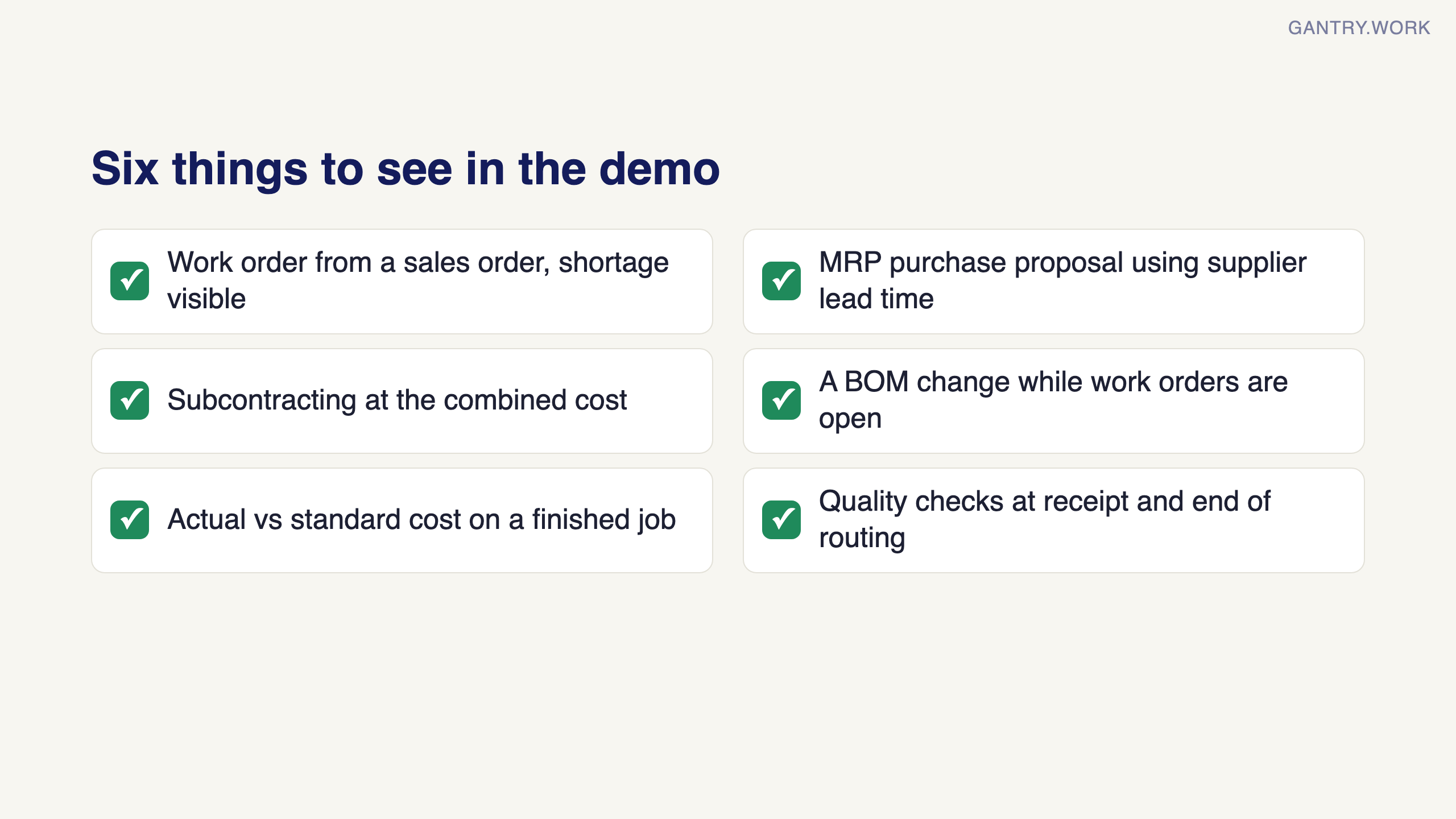
Send the partner three of your real bills of materials, including one with a subcontracted step and one with scrap, plus twenty real items and last month's sales orders. Then ask to see:
A work order from a sales order, with the components reserved and the shortage visible.
A purchase proposal from MRP for the shortage, with the supplier's lead time respected.
Subcontracting: components sent out, the service bill received, finished parts back in stock at the combined cost.
A change to a BOM while work orders are open, and what happens to them.
Actual versus standard cost on a finished job, so you can see whether it made money.
Quality checks at receipt and at the end of the routing, if your customers audit you.
If any of the six needs "a small customisation", find out what it costs and how it survives upgrades. The demo brief itself is in how to run a demo that tells you something.
Singapore specifics
Import GST and landed cost on materials from Malaysia, China and Europe, so that finished goods carry true cost. Multi-currency purchasing with exchange differences posted at payment. InvoiceNow for the sales side, on the published schedule. And the EDGE Grant, which from 30 September 2026 funds ERP and digital projects at up to 50 percent for SMEs, within a S$30,000 sub-cap for digital solutions and enterprise systems and a S$100,000 annual cap (the 70 percent rate is only for internationalisation and sustainability); the mechanics are in the EDGE grant and ERP. Manufacturing projects are the ones most likely to include process redesign, so structure the quote by component.
What it costs
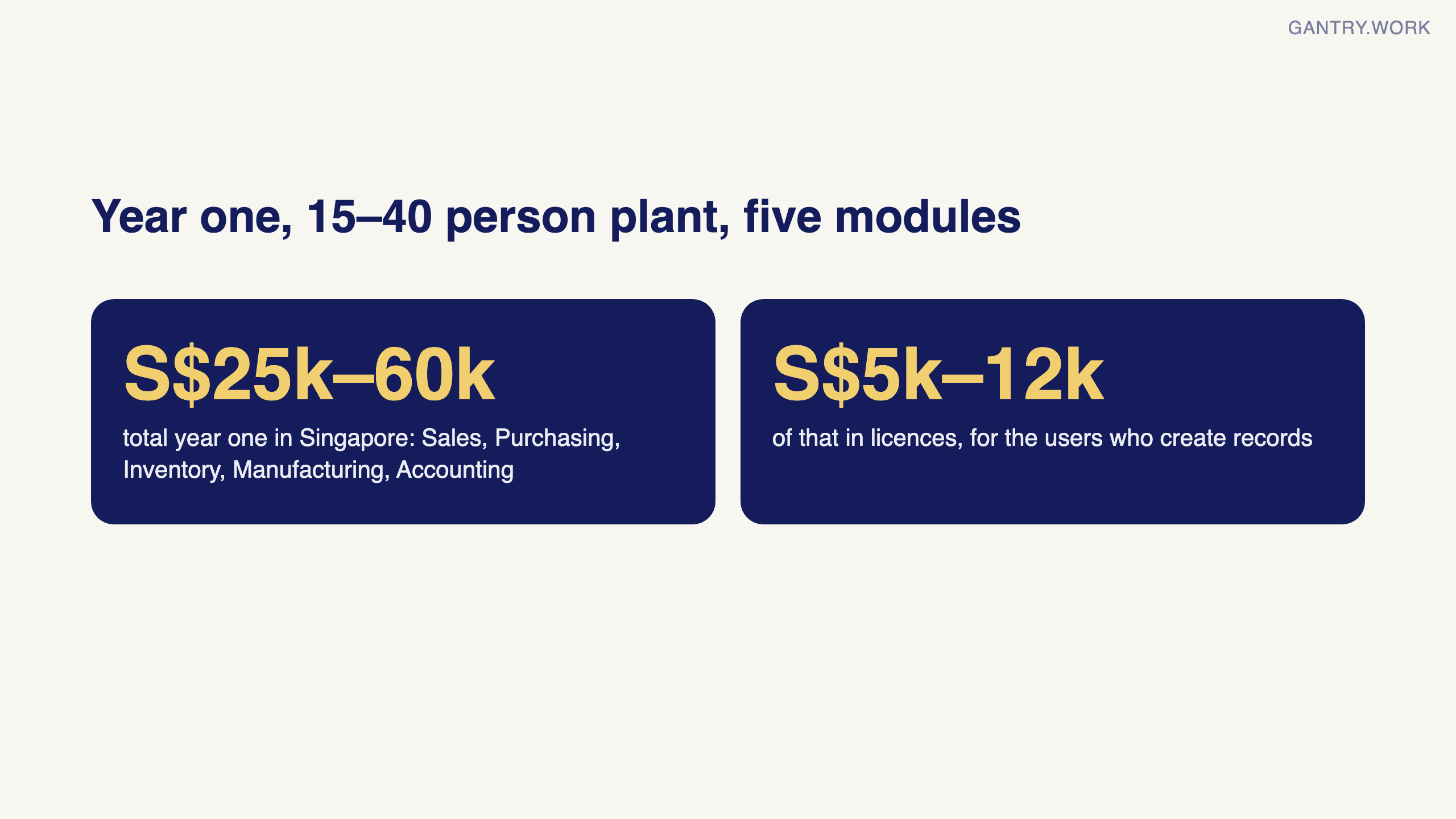
A 15 to 40 person plant going live with Sales, Purchasing, Inventory, Manufacturing and Accounting typically spends S$25,000 to S$60,000 in year one in Singapore: licences of S$5,000 to S$12,000 for the users who create records, and the rest in configuration, data, testing and training. Most of the variance is the BOM and item-master clean-up. The full ranges are in ERP implementation cost in Singapore.
Against that, count what a wrong stock figure costs you now: the rush freight, the line stopped for a S$40 part, the batch made twice because nobody knew the first one existed.
A 90-day plan for a small plant
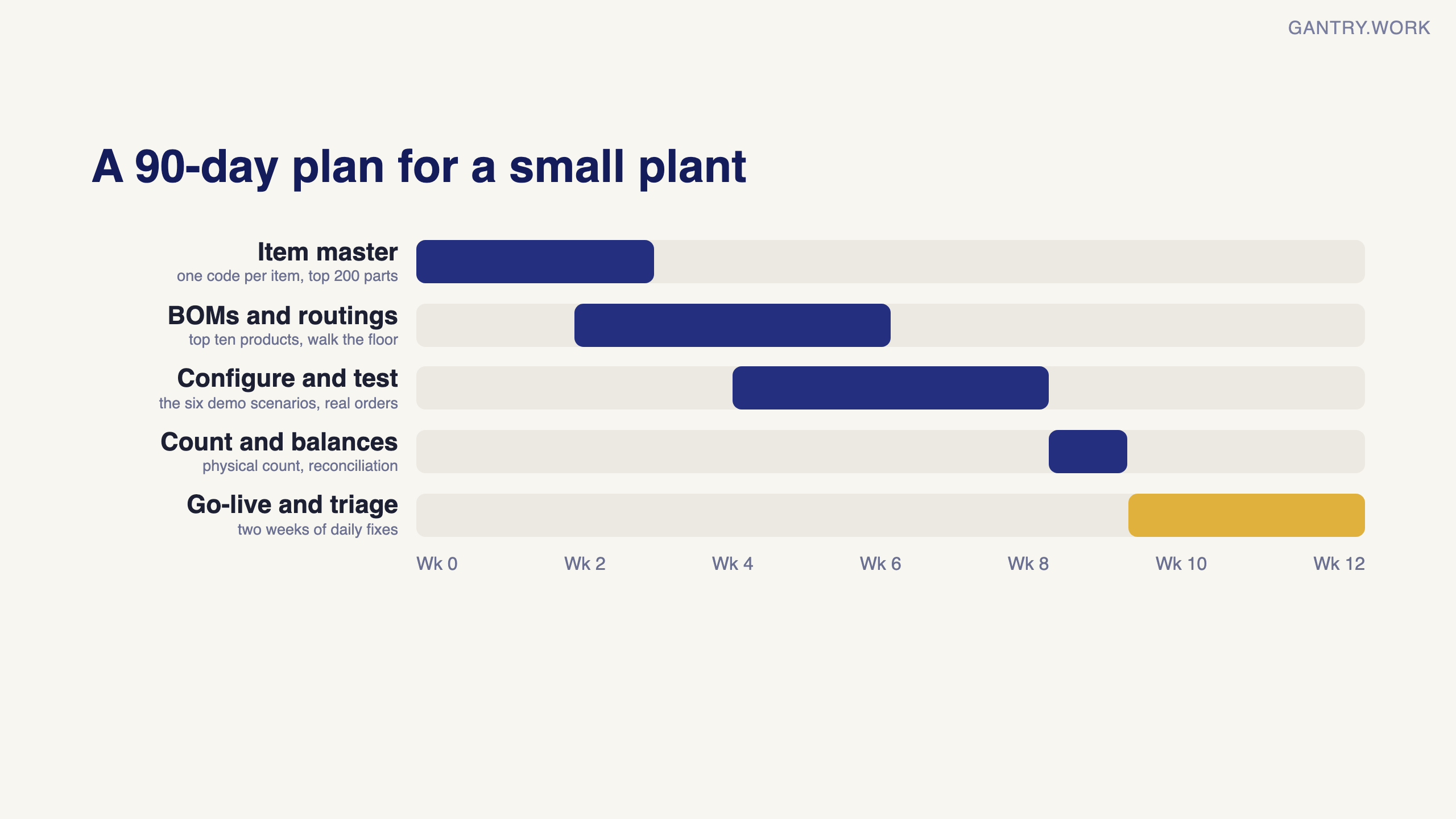
Weeks 1 to 3: the item master. One code per item. Correct units. Made or bought. Lead times and suppliers for the top 200 components. This is your production manager's work with the implementer alongside, not the implementer's alone.
Weeks 3 to 6: bills of materials and routings. Start with the ten products that make 80 percent of revenue. Walk the floor with the BOM in hand and count what is actually used, including scrap.
Weeks 5 to 8: configure and test the six demo scenarios on real orders. Sales, purchasing and inventory go live in the same wave as manufacturing, because they share every transaction.
Week 9: physical count, opening balances, and the migration reconciliation.
Weeks 10 to 12: go-live on a Monday with the old spreadsheets read-only, then two weeks of daily triage. The go-live checklist applies in full.
Run MRP for the first month in "suggest" mode, where it proposes purchases and work orders that a person confirms. Switch to automatic only when the proposals have been right for four weeks in a row. That is the point at which your three inputs are clean, and it is the point the whole project was about.
How many of your bills of materials would survive a walk across the floor with a clipboard?
If you are not sure, the ERP Readiness Scorecard has two questions on exactly this.
Want a second pair of eyes on your setup? Bring the process that keeps going wrong to a free 20-minute systems review. I'll tell you honestly what to fix first, or whether you need anything new yet.
I'm Sayed. I work closely with business owners to automate their operations and build workflows that actually make sense. I write The Gantry about ERP and automation for SMEs.
Working on something similar? Connect with me on LinkedIn and tell me what you are working on. I read and reply to every message, and the questions people send become the next guides.
How I test everything and how this site makes money: How The Gantry works.
Before comparing systems, check whether your business is ready for one. The free ERP Readiness Scorecard takes about three minutes and tells you what to fix first.

The free ERP readiness scorecard at work: a few honest answers and a score with what to fix first. Click the animation to try it.