

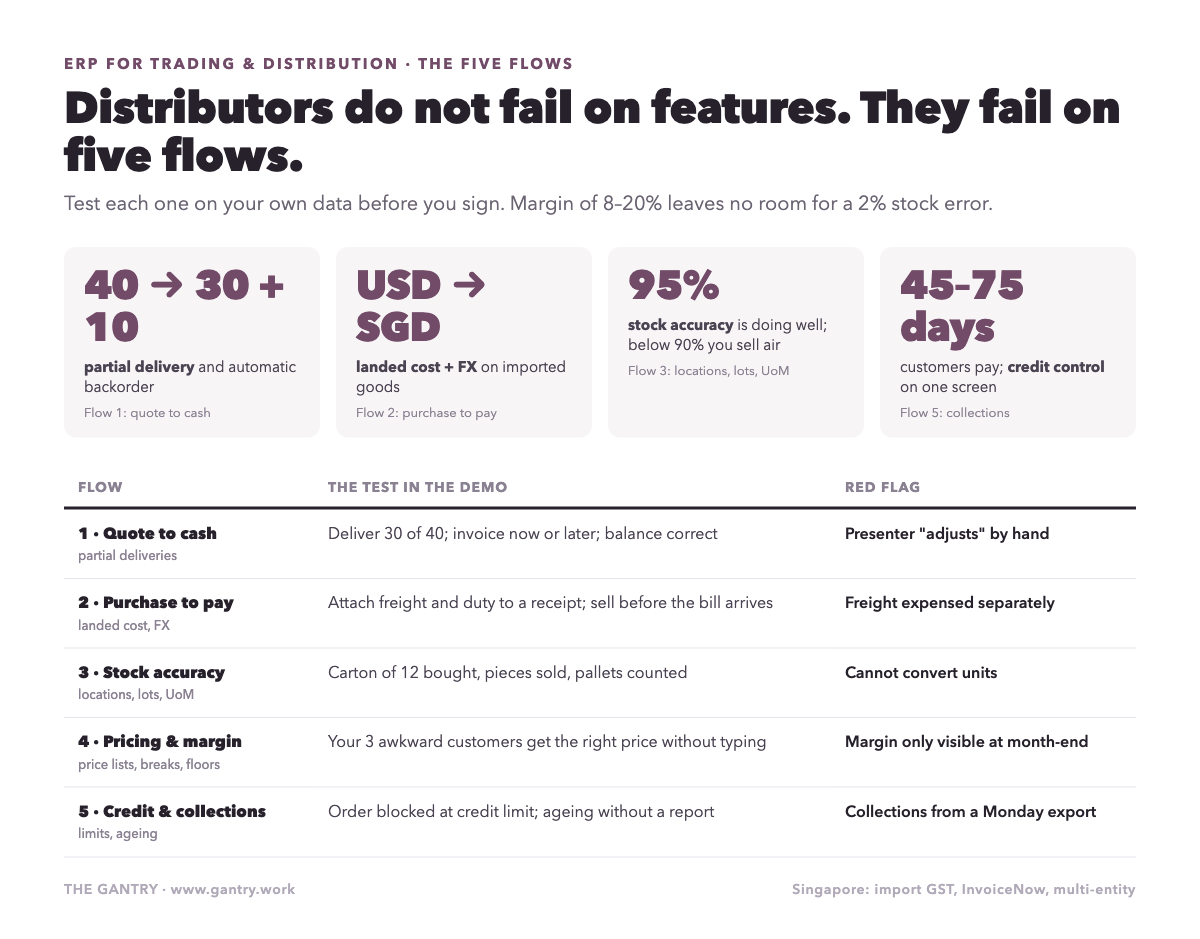
Most of the companies I work with buy and sell physical goods. They import from three countries, sell to two hundred customers, hold stock in one warehouse and a van, and run the whole thing on an accounting package, a spreadsheet and a WhatsApp group. When they start looking at ERP systems, the vendors show them dashboards. What decides whether the system works is five unglamorous flows, and this post is about testing each one before you sign.
Short answer: Five flows decide the system: quote to cash with partial deliveries, purchase to pay with landed cost and foreign currency, stock accuracy across locations, pricing and margin, and credit control. Test each on your own data in a demo; a single-database ERP such as Odoo, SAP Business One or Business Central handles all five if configured properly.
Key facts
Gross margin in distribution is often 8 to 20 percent, so a 2 percent error in stock value or a forgotten freight bill is the profit.
Demo test for partial deliveries: confirm an order for 40, deliver 30, and the system should create a backorder for 10 automatically.
A distributor with 95 percent stock accuracy is doing well; below 90 percent, sales promise goods that do not exist.
Customers pay at 45 to 75 days while suppliers want 30, so the system should hold a credit limit per customer and warn or block breaches.
Accounting software with an inventory app handles flows one and three adequately, flow four partially, and flows two and five badly.
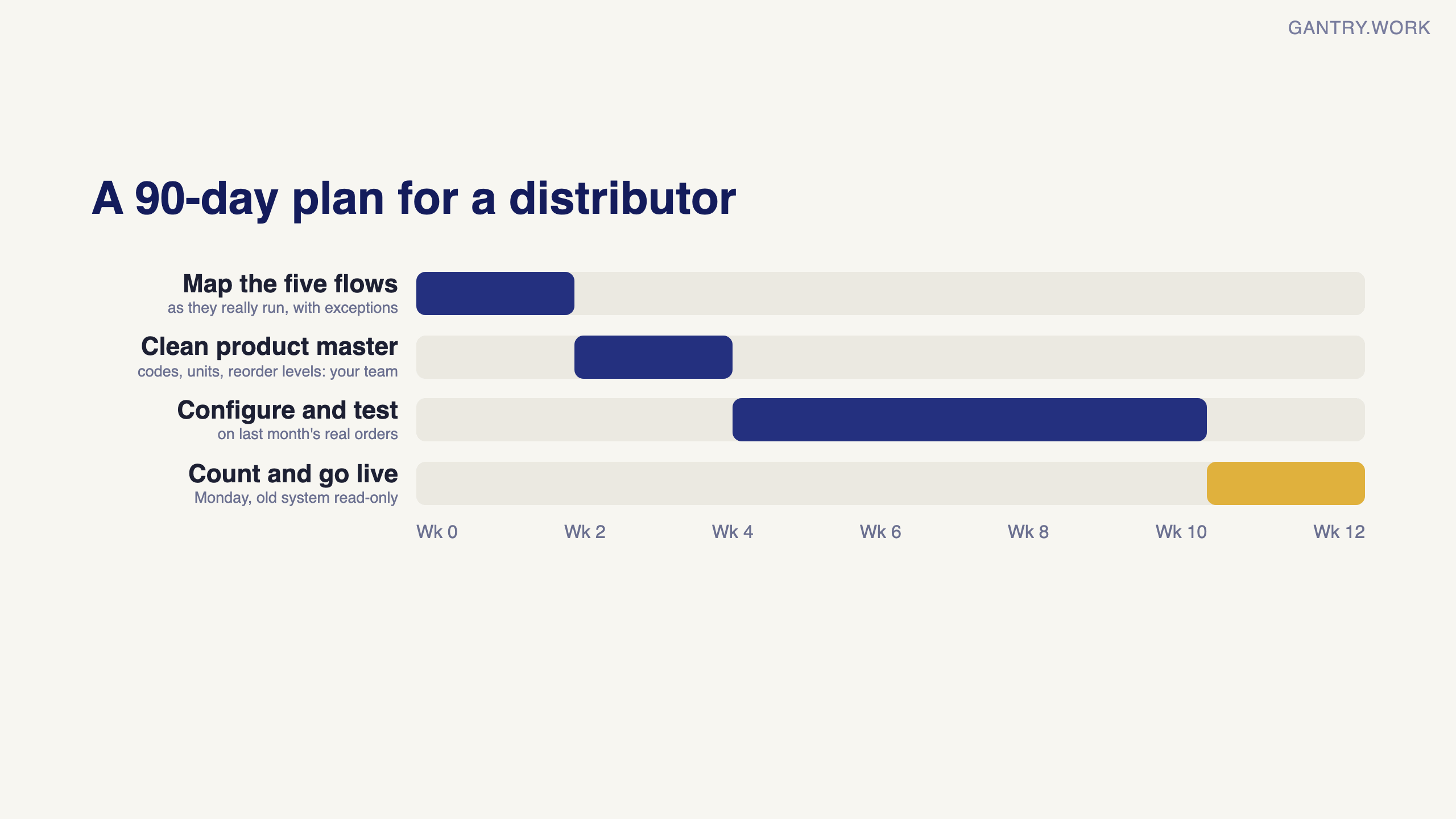
A 90-day plan: weeks 1–2 map the flows, 3–4 clean the product master, 5–10 configure and test, 11–12 count stock and go live.
Sources: the article names no external sources; the figures are the author's working benchmarks from implementation projects.
The five flows in 55 seconds
The short version: partial deliveries, landed cost with foreign currency, stock accuracy, pricing and collections decide whether an ERP works for a distributor. Each one can be tested in a demo on your own data, and the sections below show how.
Why distributors are different
A services firm can run on a ledger and a calendar. A manufacturer lives on the bill of materials. A distributor lives in the gap between what was ordered, what was received, what was shipped and what was paid, and that gap is where money leaks. Margin in distribution is thin, often 8 to 20 percent gross, so a 2 percent error in stock value or a forgotten freight bill is not a rounding difference. It is the profit.
That is why the evaluation cannot be a feature checklist. It has to be the five flows, run on your own data, with your own exceptions.
Flow one: quote to cash with partial deliveries
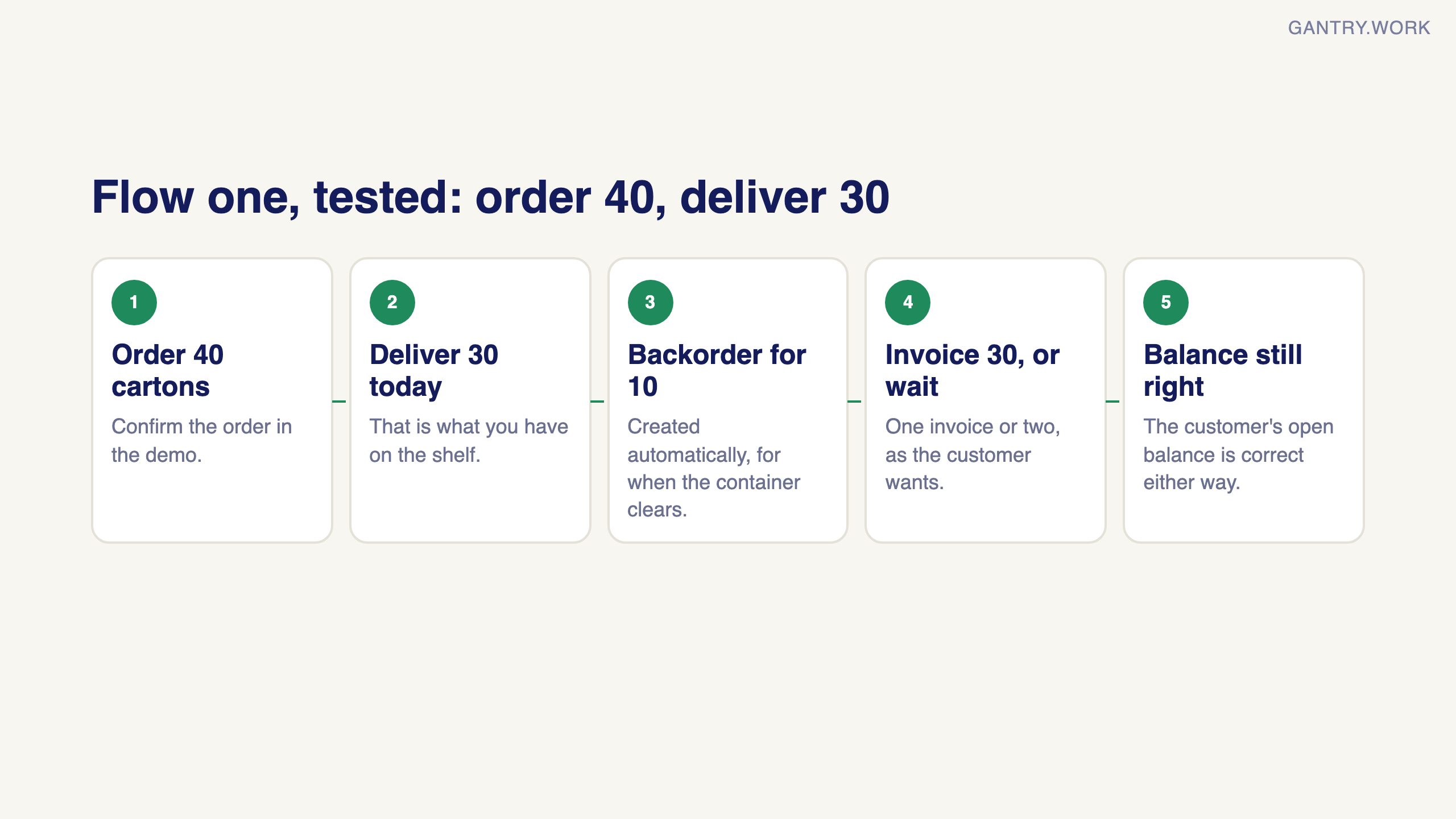
The textbook flow is quote, order, delivery, invoice, payment. The real flow is a customer ordering 40 cartons, receiving 30 today because that is what you have, 10 next week when the container clears, and wanting one invoice, or two, depending on who is asking.
Test this in the demo: confirm an order for 40, deliver 30, and watch what happens. The system should create a backorder for 10 automatically, let you invoice the 30 now or wait, and show the customer's open balance correctly either way. If the presenter has to "adjust" anything by hand, that adjustment is what your team will do forty times a month. I described how to structure that demo in how to get an ERP demo that actually tells you something.
Flow two: purchase to pay with landed cost and foreign currency
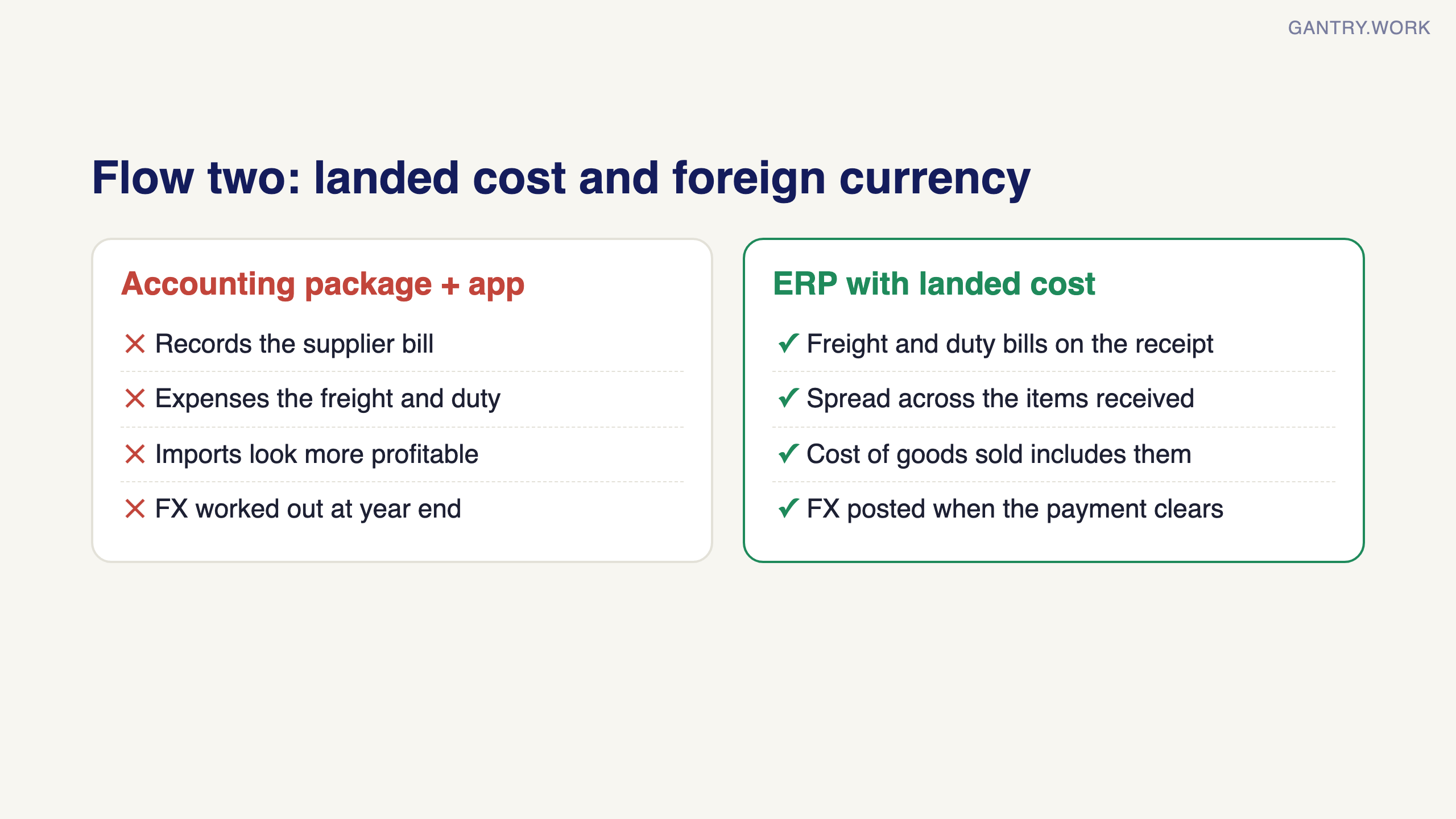
You order from a supplier in Guangzhou in US dollars, pay a deposit, receive the goods six weeks later, and get bills from the forwarder, the insurer and Singapore Customs in between. The true cost of each carton is the supplier price plus its share of all of that, converted at the right rate.
Most accounting packages record the supplier bill and expense the freight. That makes every imported product look more profitable than it is and makes your margin reports fiction. The system you want lets you attach the freight and duty bills to the receipt and spreads them across the items, so cost of goods sold at the point of sale includes them. Ask to see landed cost applied to a receipt, and ask what happens when the freight bill arrives after the goods have already been sold.
Foreign currency is the second half. Supplier bills in USD, customer invoices in SGD, a bank account in each. The system should post exchange differences when the payment clears, not leave someone to calculate them at year end. This is the point where the Xero or QuickBooks plus an app arrangement usually breaks, because the app does not carry landed cost or FX into the ledger cleanly.
Flow three: stock accuracy across locations
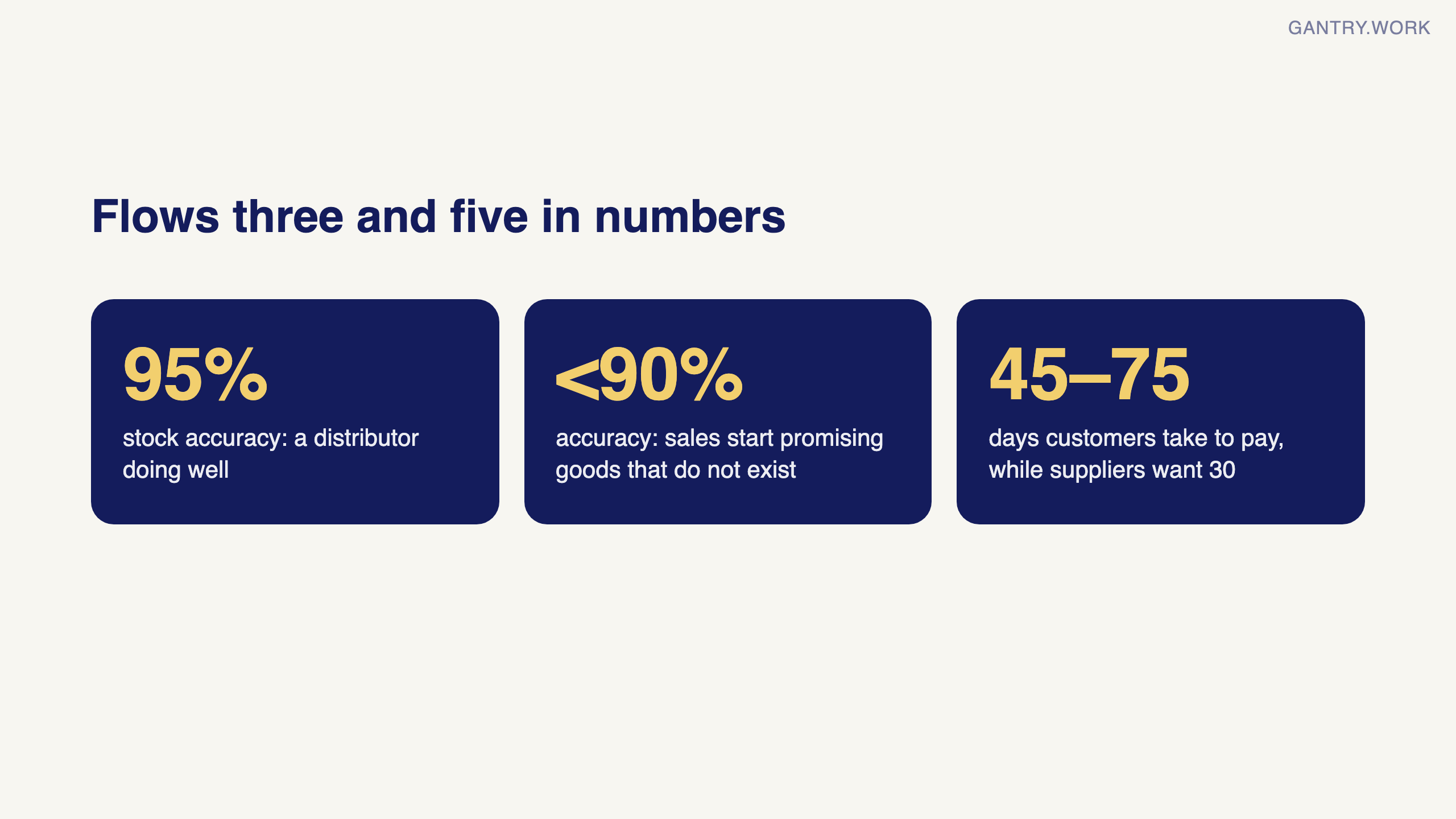
A distributor with 95 percent stock accuracy is doing well. Below 90 percent, sales are promising goods that do not exist and purchasing is reordering goods that do. The capabilities that move accuracy are unexciting: locations that are real records, not free text; transfers between them as documents with a status; lots and expiry where the product needs them; and cycle counts by scanner rather than an annual shutdown.
Check units of measure with particular care. Buying in cartons of 12, selling in pieces, and stocking in pallets is normal in this business, and a system that cannot convert between them will give you a wrong stock value from day one. The full capability list is in the inventory software guide; for a distributor, the eight items there are all mandatory.
Flow four: pricing and margin
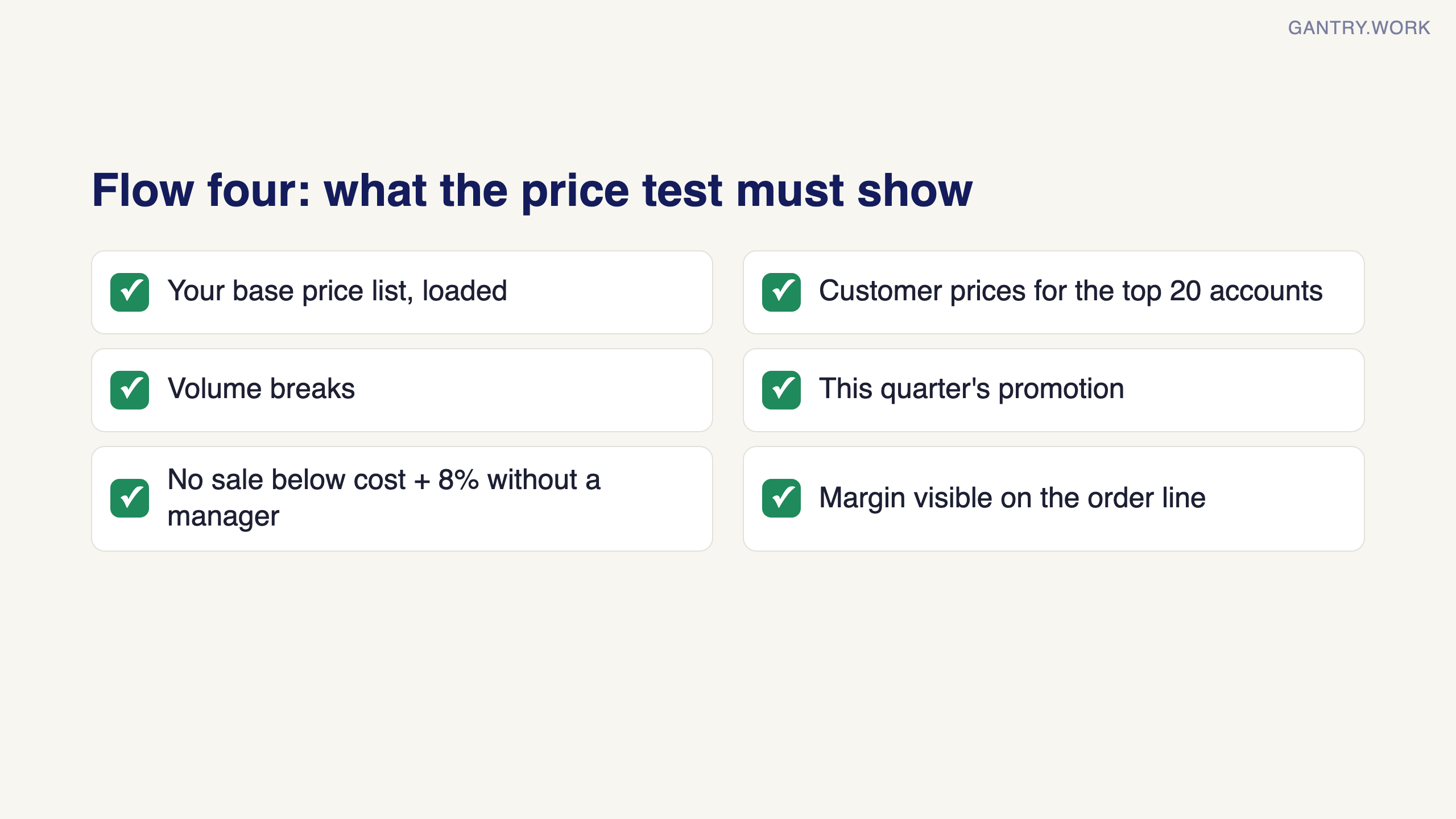
Distributors run on price lists. A base list, customer-specific prices for the top twenty accounts, volume breaks, a promotion this quarter, and a rule that says nobody sells below cost plus 8 percent without a manager. Today that logic lives in the head of the sales manager and a spreadsheet column marked "special".
The test is to load your real price list and your three most awkward customers, then raise a quote for each and see whether the right price appears without anyone typing it. Then check that margin is visible on the order line before it is confirmed. A salesperson who can see that a line is at 4 percent margin behaves differently from one who finds out at month-end.
Flow five: credit control and collections
Cash is the constraint in distribution. Customers pay at 45 to 75 days, suppliers want 30, and the container has to be paid before it ships. The system should hold a credit limit per customer, warn or block when an order would breach it, age receivables by customer without a report being built, and let the collections person work from one screen rather than a spreadsheet exported on Monday.
The reason this matters more than it sounds is that the pattern of a customer's payments is becoming part of how a business itself gets credit. I wrote about that shift in why your books are becoming your credit score. Clean receivables are no longer only an internal matter.
Singapore specifics
Three local details to check on any shortlist. GST on imports, including the treatment of import GST paid to Customs and the Major Exporter Scheme if you are on it. InvoiceNow, which every GST-registered business will need on a published schedule; confirm the system can send and receive on the network rather than relying on a workaround. And multi-entity, because a surprising number of trading firms here run a Singapore company and a Malaysian or Indonesian one, and consolidating them by hand is a week a quarter.
Which systems handle the five flows
Honest summary, by tier. Accounting software with an inventory app bolted on handles flows one and three adequately, flow four partially, and flows two and five badly. A single-database ERP such as Odoo, SAP Business One or Business Central handles all five if configured properly, with Odoo generally the least expensive to implement at this size and the mid-market suites stronger on multi-entity consolidation. NetSuite handles all five and is priced for companies larger than most of the firms reading this. The wider comparison is in Odoo alternatives.
A 90-day plan for a distributor
Weeks 1 to 2: map your five flows as they actually run today, with the exceptions. Count how many times one order is retyped between email, quote, order, delivery, invoice and courier portal.
Weeks 3 to 4: clean the product master. One code format, correct units, supplier prices, reorder levels for the top 200 SKUs. This is your team's work, not the vendor's.
Weeks 5 to 10: configure and test the five flows on last month's real orders, including the partial deliveries and the late freight bill.
Weeks 11 to 12: physical count, opening balances, go-live on a Monday, with the old system read-only and a kill date in the calendar. The go-live checklist is the detailed version.
If a vendor cannot show you all five flows on your data, the dashboards do not matter.
Which of the five flows leaks the most money in your business today?
The ERP & Automation ROI calculator will put a number on the retyping and the stock errors in about three minutes.
Want a second pair of eyes on your setup? Bring the process that keeps going wrong to a free 20-minute systems review. I'll tell you honestly what to fix first, or whether you need anything new yet.
I'm Sayed. I work closely with business owners to automate their operations and build workflows that actually make sense. I write The Gantry about ERP and automation for SMEs.
Working on something similar? Connect with me on LinkedIn and tell me what you are working on. I read and reply to every message, and the questions people send become the next guides.
How I test everything and how this site makes money: How The Gantry works.
Before comparing systems, check whether your business is ready for one. The free ERP Readiness Scorecard takes about three minutes and tells you what to fix first.

The free ERP readiness scorecard at work: a few honest answers and a score with what to fix first. Click the animation to try it.