

The Smart Industry Readiness Index (SIRI) is a free framework from Singapore's Economic Development Board that scores a factory on 16 dimensions, in six bands from 0 to 5. A small manufacturer can self-assess in half a day with the published Assessment Matrix, then fix three or four weak dimensions first. An official assessment adds benchmarks and a roadmap.
Why this matters after ITAP 2026
Industrial Transformation Asia-Pacific (ITAP) 2026 ran on 21 and 22 October at Suntec Singapore, relaunched under a partnership between the Singapore Manufacturing Federation (SMF) and Deutsche Messe. AI was the headline theme. On the first day, Enterprise Singapore announced its Catalytic AI Solutions initiative, with more than S$45 million over three years to help manufacturing SMEs adopt ready-made AI tools. IndiplomacyNews reported that SMF also signed day-one agreements with Republic Polytechnic on SME and talent transformation, launched sustainability marks with Gprnt and APGA, and signed an MOU with the China Electronics Enterprises Association. The next edition moves to Marina Bay Sands on 20 to 22 July 2027.
SIRI has a history with this event: the international body that runs it signed a SIRI partnership with the Philippines' Department of Trade and Industry at ITAP 2022.
I covered what Catalytic AI Solutions means and the records to clean up first in S$45m to help factories use AI: what to fix before you apply. This piece answers the question that comes before it: how do you know where your factory actually stands, and which fix comes first? That is what SIRI is for.
What SIRI is
SIRI was launched by EDB in 2017, developed with TÜV SÜD and an advisory panel from industry and academia. Since 2021 it has been managed by the International Centre for Industrial Transformation (INCIT), a not-for-profit set up to take it international. By 2022, nearly 600 manufacturers in 30 countries had completed an official SIRI assessment.
It gives you three things:
A framework: what "Industry 4.0" actually covers, broken into 16 dimensions.
An Assessment Matrix: a description of what each band looks like in each dimension, so you can place yourself.
A way to prioritise: the Prioritisation Matrix, which weighs your cost structure, your key KPIs and the gap to the best performers in your industry.
The framework document and the band definitions are published free by EDB. You do not need a consultant to read them.
The 3 building blocks, 8 pillars and 16 dimensions
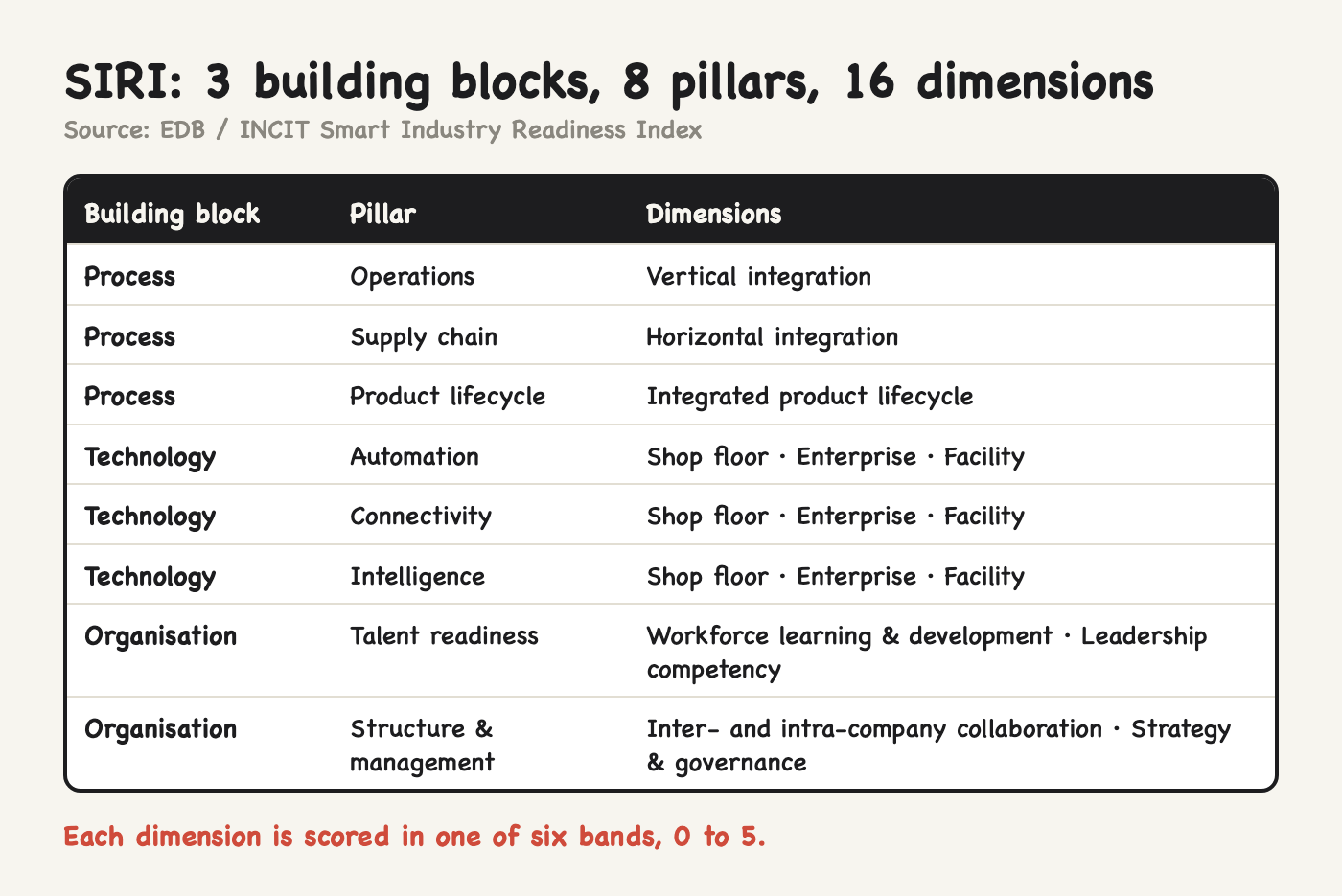
Process has three pillars (operations, supply chain, product lifecycle), each with one dimension: vertical integration, horizontal integration and integrated product lifecycle.
Technology has three pillars (automation, connectivity, intelligence), each scored separately for the shop floor, the enterprise (the office systems) and the facility. That is nine dimensions.
Organisation has two pillars: talent readiness (workforce learning and development, leadership competency) and structure and management (inter- and intra-company collaboration, strategy and governance).
The six bands
Every dimension is scored from band 0 to band 5. For the three process dimensions, EDB's whitepaper names them Undefined, Defined, Digital, Integrated, Automated and Intelligent. In plain terms:
Band 0: nobody has written the process down.
Band 1: the process is defined, but run on paper, whiteboards and phone calls.
Band 2: people use digital tools, but each department has its own and data is retyped between them.
Band 3: the systems are formally linked, though people still move much of the data across.
Band 4: data moves between systems automatically, with little human intervention.
Band 5: systems analyse the data and react to it.
The technology dimensions use their own band names (for enterprise intelligence, for example: none, computerised, visible, diagnostic, predictive, adaptive), but the logic is the same.
In projects I've worked on with 20 to 200 person manufacturers, the process dimensions usually sit at band 1 or 2: a quoting spreadsheet, an accounting package, a whiteboard for the floor, and a stock list that is right on the day of the stock take. That is normal. The whitepaper itself says companies should not feel they must reach band 5 everywhere; aim higher only where it pays.
How to run a SIRI self-assessment in half a day
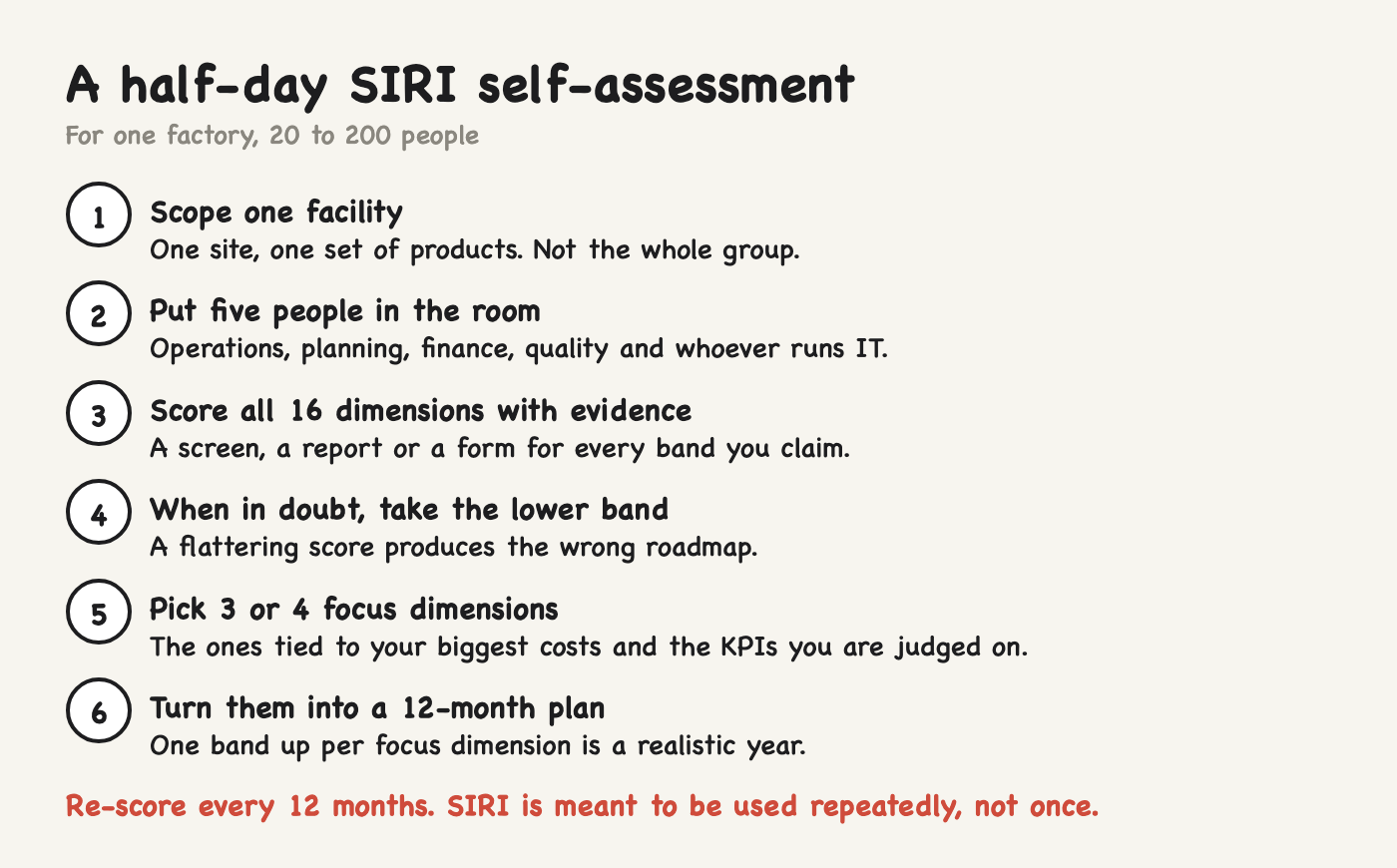
Scope one facility. One site, one product family if you make very different things. Group-wide averages hide the problems.
Put five people in the room. Operations, planning, finance, quality and whoever looks after IT. The owner should be there for the organisation dimensions.
Score all 16 dimensions with evidence. For every band you claim, someone should be able to show a screen, a report or a form. "We could do that" is not band 3.
When in doubt, take the lower band. A generous score produces a roadmap for a factory you don't have.
Pick three or four focus dimensions. Borrow the Prioritisation Matrix logic: which weak dimensions sit behind your biggest cost lines (material, labour, scrap, inventory) and the KPIs you are judged on (on-time delivery, margin per job)?
Turn them into a 12-month plan. One band up on each focus dimension is a realistic year for a small factory.
Five questions that settle most arguments
When a sales order is confirmed, does anyone retype it to plan production or buy material? (Horizontal integration)
Does a work order exist in a system before work starts, and are time and output booked back against it? (Vertical integration)
If an engineer changes a drawing, does the bill of materials change with it? (Integrated product lifecycle)
Does any system warn you about a late job, a cost overrun or a stock-out before a person notices? (Enterprise intelligence)
If your two most experienced people left, could someone else run planning next week? (Workforce learning and development)
If the honest answer to the first two is "yes, we retype" and "no", your process dimensions are at band 1 or 2, whatever the machines on the floor look like.
What SIRI scores mean for your ERP, MES and data
SIRI is deliberately technology-neutral. It tells you where you are, not what to buy. The mapping below is my own practice, not part of SIRI.
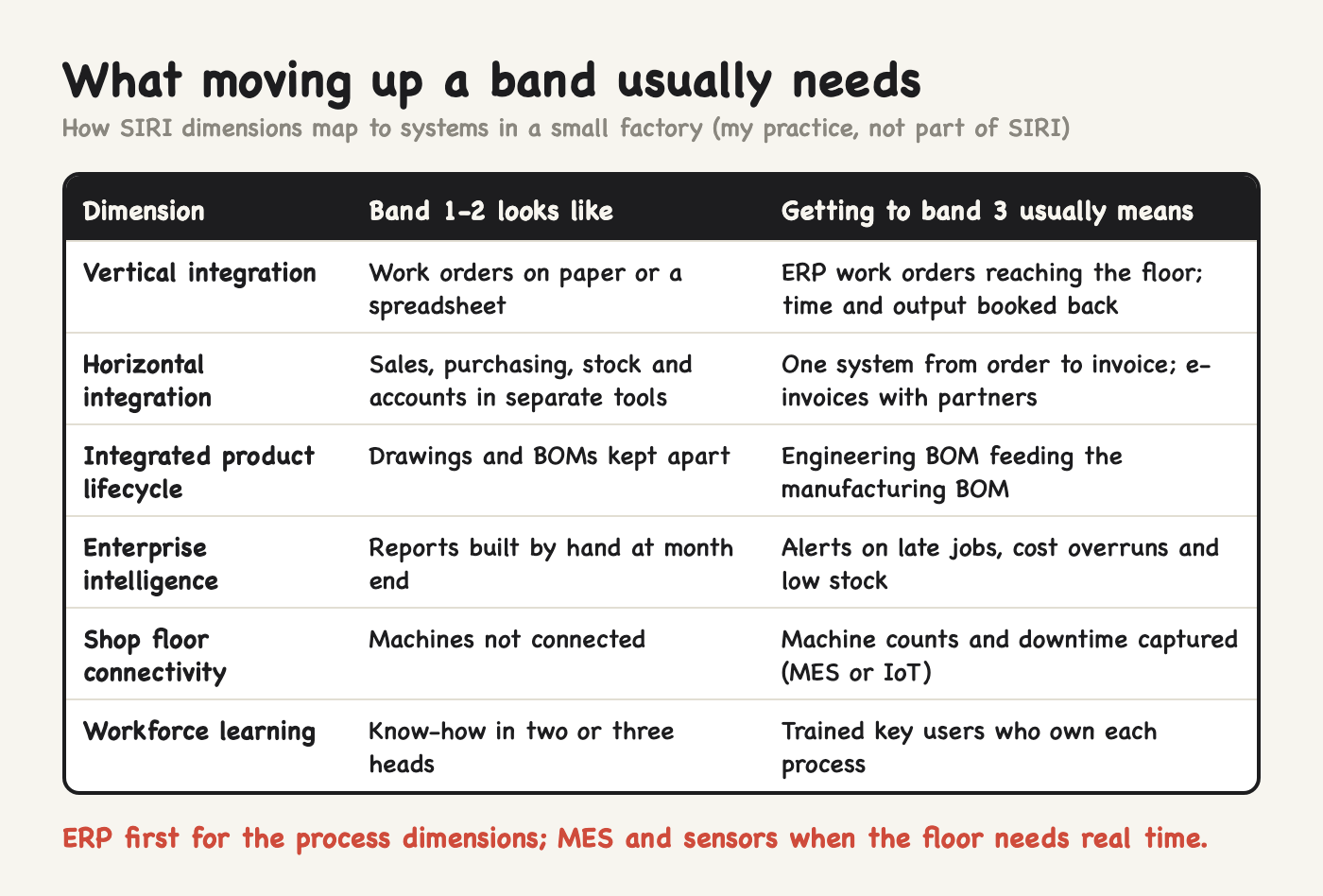
ERP first for the process dimensions
Vertical and horizontal integration are mostly about one thing: whether sales orders, bills of materials, work orders, purchasing, stock and accounts live in one connected record. In a small factory, that is an ERP with a manufacturing module. Moving from band 2 to band 3 usually means getting bills of materials and routings into the system, releasing work orders from it, and booking material and time back against each job.
MES when the floor needs real time
A manufacturing execution system (MES) manages and records what happens on the floor: which machine, which operator, when, how many good and how many scrapped. For many 20 to 200 person factories, an ERP's work-order screens on a shop-floor tablet cover the basics. A dedicated MES earns its place when you need machine data in real time, live overall equipment effectiveness, or detailed lot traceability for regulated customers. That is where the shop floor connectivity and intelligence dimensions move.
Data before AI
The enterprise and shop floor intelligence dimensions are where AI sits. A system can only predict a late job or a cost overrun if the jobs, times and costs were recorded in the first place. That is why I'd expect most small factories to see more return from moving the process dimensions from band 1 to band 3 than from any AI tool bought this year. INCIT has a separate index for industrial AI readiness (AIMRI) if you want to assess that specifically.
Official SIRI assessment vs self-assessment
An Official SIRI Assessment is run by a Certified SIRI Assessor, an independent consultant who has completed 40 hours of approved training and passed INCIT's exam. INCIT describes three phases: planning that starts three to four weeks ahead, two to three days on site (walkthroughs, interviews, shop-floor observation and a validation workshop), and a debrief of about an hour. You get a score for each dimension, benchmarks against peers, and a roadmap built around four focus dimensions.
INCIT does not publish a price, so ask assessors for quotes. An official assessment is worth it when you are about to commit to a multi-year investment, when a customer or parent company asks for a recognised benchmark, or when you want to compare your factory with peers. For a first plan in a small factory, an honest self-assessment is usually enough.
Paying for the fixes: the EDGE grant
If your focus dimensions point to an integrated system, the EDGE grant is the main support. It replaced PSG, EDG and MRA, which closed on 29 September 2026. As checked on 28 October 2026:
General support is up to 50% for SMEs and 30% for non-SMEs. The 70% rate applies only to internationalisation and sustainability activities.
For the integrated ERP activity, the qualifying cost is capped at S$60,000, so the most an SME can receive is S$30,000 (S$18,000 for a non-SME). The solution must cover at least three functions, such as financial, manufacturing and supply chain management.
Single-function digital solutions, integrated enterprise systems and pre-scoped equipment share a S$30,000 a year sub-cap, inside an overall S$100,000 a year cap that resets each 1 April.
You need at least 30% Singaporean or PR ownership. An SME is a group with turnover up to S$100 million or up to 200 workers.
Do not start work or pay a deposit before you apply. Claims for ERP projects open from 1 January 2027.
Example (illustrative figures, not a real project): a 60-person precision engineering SME scores band 1 on horizontal and vertical integration. It scopes an ERP covering finance, inventory, purchasing and manufacturing at S$72,000. The qualifying cost is capped at S$60,000, so the maximum grant is 50% of that, S$30,000. That uses the whole S$30,000 sub-cap for the grant year, so a separate single-function tool would have to wait until the cap resets.
Catalytic AI Solutions is a separate initiative and its co-funding rules were not published when I checked. The EDGE grant guide for ERP explains what changed, and the free EDGE grant calculator works out your figure.
FAQ
What is a SIRI assessment?
It is an evaluation of one factory against SIRI's 16 dimensions, placing each in one of six bands from 0 to 5. You can do it yourself with EDB's published Assessment Matrix, or commission an Official SIRI Assessment from a Certified SIRI Assessor.
Is the Smart Industry Readiness Index free?
The framework and the Assessment Matrix are published free by EDB. The official assessment is a paid service from certified assessors, and INCIT does not publish a standard price.
How long does an official SIRI assessment take?
INCIT describes planning that starts three to four weeks before, two to three days on site, and a debrief of about an hour.
What SIRI band should a small manufacturer aim for?
There is no target band for every dimension. Pick the three or four dimensions tied to your biggest costs and KPIs, and move each up one band in a year. For most small factories, getting the process dimensions to band 3 matters more than anything else.
Is SIRI only for Singapore companies?
No. It started in Singapore but is used internationally through INCIT, including a national partnership with the Philippines.
The bottom line
ITAP 2026 was about AI, and the money for AI tools is coming. SIRI is the cheapest way to find out whether your factory can use them: half a day, five people and honest evidence. Most small manufacturers will find that the first fix is not AI. It is getting orders, materials, work orders and costs into one connected system.
If you have scored your factory and want a second opinion on what to fix first, I do a free 20-minute systems review.
Grant details are as published by Enterprise Singapore on 28 October 2026 and can change; check the EDGE activity page before you apply. The example uses illustrative figures.
Sources (checked 28 Oct 2026): EDB (The Smart Industry Readiness Index whitepaper; the Prioritisation Matrix whitepaper; Manufacturing Transformation Insights Report 2022); INCIT (SIRI and the Official SIRI Assessment); MTI (MOS speech at the INCIT and Philippines DTI signing, ITAP 2022, 19 Oct 2022); Enterprise Singapore (EDGE Grant page and FAQ); ITAP official site and Deutsche Messe/SMF release, 18 Aug 2026 (dates and venue); IndiplomacyNews, 27 Oct 2026 (day-one agreements); The Star and Malay Mail, 21 Oct 2026 (Catalytic AI Solutions).
I'm Sayed. I help business owners automate their operations and set up the systems behind them: ERP, accounting, inventory, CRM and workflows. I write The Gantry about what actually works.