

On 21 October, Minister of State for Energy, Trade and Industry Gan Siow Huang announced that more than S$45 million will be set aside over the next three years to help small and medium-sized manufacturers adopt AI. The money sits under Enterprise Singapore's new Catalytic AI Solutions initiative, part of the national AI strategy and the advanced manufacturing AI mission announced at Budget 2026.
"We want AI to be accessible not just to large manufacturers, but also to our SMEs," she said at the Industrial Transformation Asia-Pacific (ITAP) event.
If you run a factory or workshop with 10 to 200 people, this is worth paying attention to. But not for the reason most people think.
What was announced
More than S$45 million over three years, aimed at SMEs in advanced manufacturing.
Ready-to-deploy AI solutions, not custom builds. Enterprise Singapore will work with trade associations, chambers and qualified vendors to offer a suite of tools, including solutions developed by the AI Centre of Excellence for Manufacturing.
Co-funding for eligible SMEs. Enterprise Singapore will co-fund adoption for companies that qualify.
Logistics and wholesale trade are next. Similar initiatives are being developed for those sectors, with details to come.
What we don't know yet
The co-funding percentage, the eligibility rules and the application process haven't been published. Enterprise Singapore said some firms have already confirmed their interest, so the vendor line-up is forming now.
If you're interested, watch Enterprise Singapore's announcements and your trade association. The Singapore Manufacturing Federation co-organised ITAP, where this was announced. And don't sign anything with a vendor until the rules are out: with most Singapore grants, committing before you apply makes the cost ineligible.
The five areas, in plain English
Product and component design. AI that suggests or checks designs faster. It needs your existing drawings, specs and the bills of materials behind them.
Requests for quotation. Tools that read incoming RFQ documents and draft a quote. They need your past quotes, your bills of materials and your real cost per job. Without those, the tool can only read the email faster.
Machine processes and quality inspection. Cameras or sensor data that spot defects or drift. They need defect and rework records, with reasons, and your process settings.
Energy monitoring. Real-time energy use per machine or line. It needs metering, and production records to compare against.
Production scheduling and predictive maintenance. Planning jobs around real capacity and flagging machines before they fail. It needs routings with real operation times, work-centre capacity and machine maintenance history.
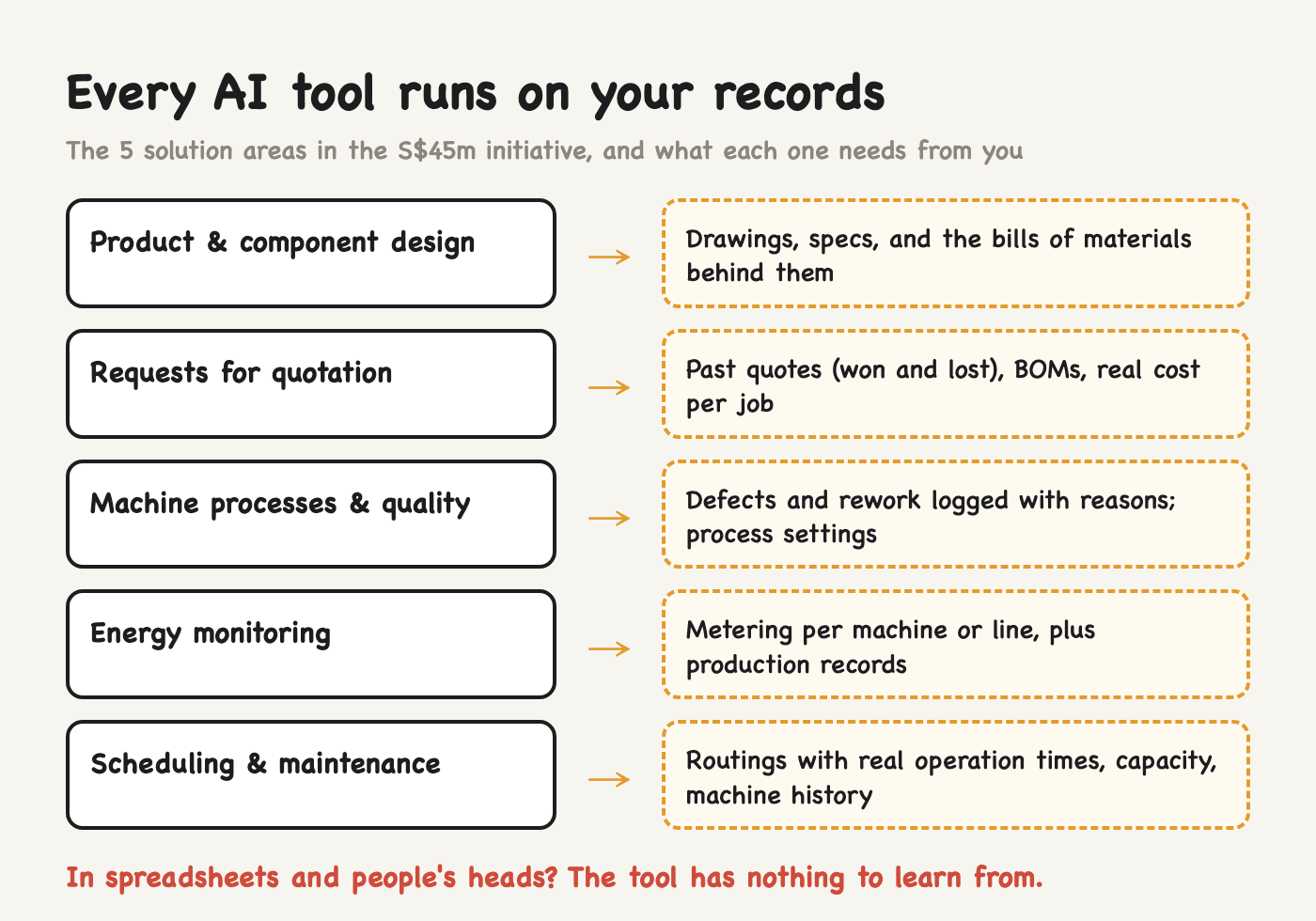
The catch: AI runs on records most small factories don't keep
Look at that list again. Every tool needs history: what you quoted, what it actually cost, how long each operation really took, what failed and why.
In most 10 to 100 person workshops I work with, that history lives in three places: a quoting spreadsheet, a whiteboard job board, and the heads of two or three senior people. That's the same pattern behind the SME AI pilot problem: plenty of interest, stuck at pilot stage, because the data isn't ready.
A quotation tool can only quote accurately if it can see that the last ten work tables actually cost S$520 each to make, not the S$450 someone remembers. A scheduling tool can only plan welding properly if it knows welding takes 95 minutes per table, not the 60 on the original quote.
A 30-day readiness checklist
Put your top 20 products' bills of materials into one system, with current material costs. If you're not sure what that should look like, start with bills of materials and routings.
Add routings: each operation, the work centre it runs on, and the time it should take.
Start recording actual time per job and per operation. Even two weeks of real data changes the conversation.
Log scrap and rework with a reason, against the job that caused it.
Keep every quote, won or lost, linked to the job it became.
Do those five things and you'll be ready for any of the tools in the initiative. You'll also know your true cost per unit, which is worth having whether or not you ever apply.
How this fits with the EDGE grant
Catalytic AI Solutions is separate from the EDGE grant, which since 30 September supports up to 50% of qualifying costs for eligible SMEs, within a S$30,000 cap for digital solutions and enterprise systems. Getting your bills of materials, routings and job records into an integrated system is the kind of project EDGE was designed for, and it's the foundation the AI tools sit on.
Whether the two can be combined hasn't been stated. Assume one cost, one grant, until Enterprise Singapore says otherwise. The EDGE grant guide and the EDGE grant calculator cover the rules that are already published.
The bottom line
The S$45 million will make the AI tools cheaper. It won't make your data ready. The factories that benefit first will be the ones whose costs, routings and job times are already recorded somewhere a tool can read.
Is your factory's data ready for AI, or is it still in spreadsheets?
Sources: The Straits Times and The Business Times, 21 October 2026; TNGlobal, 21 October 2026. Co-funding levels and eligibility will be set by Enterprise Singapore.
I'm Sayed. I help business owners automate their operations and set up the systems behind them: ERP, accounting, inventory, CRM and workflows. I write The Gantry about what actually works.