

An employer of record in Singapore, or anywhere else, is a company that legally employs your worker for you: it signs the contract, runs payroll, pays CPF or the local equivalent and handles leave and termination, while you direct the work. For a Singapore SME hiring one to a few people abroad, an EOR costs from US$599 per employee per month on Deel (checked 6 October 2026) on top of salary and employer contributions, and it beats a contractor or your own entity only in a common middle case.
Part of The Gantry's automation guides. Prices checked on the vendors' pages on 6 October 2026.
General information from official pages, not legal or tax advice. Confirm with the provider and a local adviser before you hire.
I implement ERP systems for SMEs (Odoo, mostly), so I judge an EOR on two things: does it hold up legally, and does the monthly invoice land cleanly in the books?
Quick verdict: which EOR fits which company?
Deel: best for the lowest published monthly price (from US$599) with no annual commitment and EOR in 130+ countries.
Remote: best for paying in Singapore dollars (S$800 per employee per month billed annually), with its own Singapore entity.
Oyster: best for startups that qualify for its EOR discount.
Rippling: worth a quote if you already run Rippling; I found no published EOR price.
A contractor platform instead: best when the person genuinely runs their own business on defined projects.
Your own entity instead: best for several long-term staff in one country, or a foreigner based in Singapore.
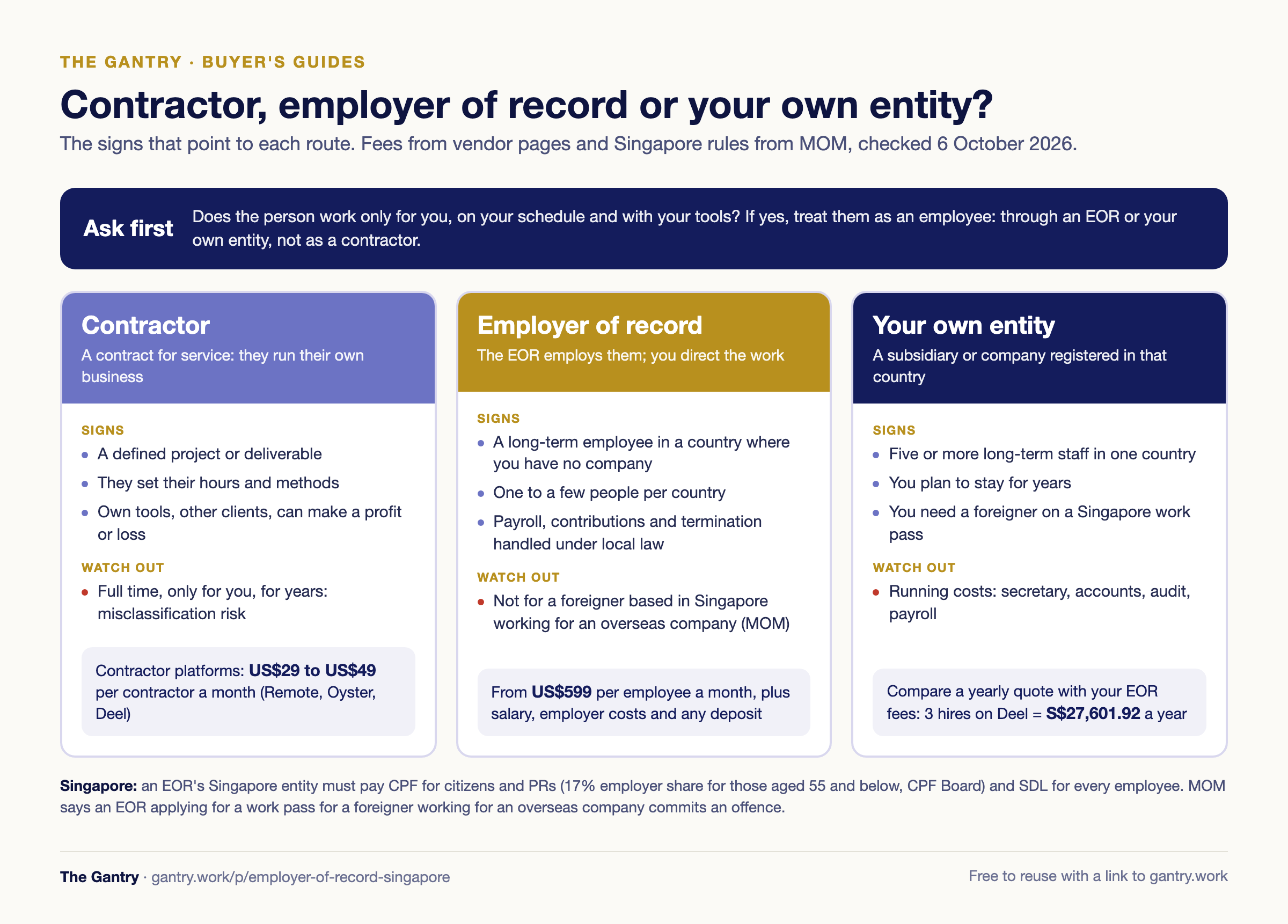
What does an employer of record do?
An EOR becomes the legal employer, so you can hire in a country where you have no company.
Its local entity signs the contract, runs payroll, pays tax and social contributions and handles leave and termination under local law. You choose the person, direct the work and pay one monthly invoice for salary, employer costs and the fee.
There are two directions for a Singapore reader:
A Singapore SME hiring abroad, say a developer in Kuala Lumpur, an accountant in Manila or a sales rep in Jakarta, Ho Chi Minh City or Bengaluru, without registering a company there.
A foreign company hiring in Singapore through an EOR's Singapore entity, often a first salesperson.
Contractor vs EOR: where misclassification starts
If the person works only for you, on your schedule, with your tools, they probably look like an employee, whatever the contract calls them.
The Ministry of Manpower (MOM) draws the Singapore line: a contract of service is an employer-employee relationship; a contract for service engages an independent contractor for a fee to carry out an assignment or project, with no statutory benefits. MOM says there is no single conclusive test and lists the factors: who controls the work and its timing, who provides tools and workplace, and whether the person trades on their own account with a chance of profit or loss.
Each country applies its own test, but MOM's questions are a good sense check. A full-time "contractor" who has worked only for you for two years, on your laptop, is the classic risk: back-dated benefits, contributions and penalties. An EOR removes it by making the person a real employee; a contractor platform only makes paying them easier.
Employer of record Singapore: what MOM and CPF require
An EOR's Singapore entity carries the same duties as any Singapore employer, and one MOM rule limits whom it can hire.
Employment Act: MOM says it covers all employees under a contract of service, local and foreign, except seafarers, domestic workers and civil servants (updated 24 July 2025). Part 4 (hours, overtime) covers only lower-paid staff, not managers or executives.
Paperwork: written key employment terms within 14 days of starting, for contracts of 14 days or more, and itemised payslips.
Annual leave: after 3 months' service, 7 days in year one, rising a day a year to 14.
CPF for citizens and PRs only: for employees aged 55 and below earning over S$750 a month, 17% from the employer and 20% from the employee (CPF Board, updated 11 August 2026). Senior workers' rates rise from 1 January 2027.
Skills Development Levy (SDL): for every employee in Singapore, foreigners included: 0.25% of monthly wages, minimum S$2, maximum S$11.25 above S$4,500, collected by the CPF Board.
The MOM rule on EORs and work passes
MOM says an EOR in Singapore may not apply for a work pass for a foreigner to be based in Singapore while working for an overseas company, and that doing so is an offence (FAQ updated 9 July 2024). Its suggested routes for a company with no local presence: a representative office under Enterprise Singapore's scheme, or incorporating with ACRA.
So a foreign company can use a Singapore EOR to hire citizens and PRs, who need no pass, but not foreigners on an Employment Pass or S Pass. For reference, MOM says EP candidates need at least S$5,600 a month (updated 27 August 2026) and new S Pass candidates at least S$3,300 (updated 18 September 2026), after advertising on MyCareersFuture. Some EOR guides still talk about sponsoring passes or quote older salary figures, so check MOM's pages.
How much does an employer of record cost?
The fee, from US$599 per employee per month on the big platforms, plus salary, employer contributions and, on some platforms, a deposit.
Employer of record fees: what sits on top
Fees are flat per employee per month; Deel's is a "starting at" figure, so confirm yours. Watch three extras:
Deposits: Oyster takes a refundable deposit per EOR employee. Deel's help centre describes a standard deposit of one to one and a half months of all monthly charges, more if you remove probation or extend notice. Remote collects reserve payments only in rare, high-risk cases.
Currency: Oyster bills in USD, EUR, GBP or CAD, with a conversion fee if you pay in another currency than the contract's. Remote offers SGD billing at its own FX rate.
Extras: bonuses, allowances, medical cover and equipment.
Worked example: hiring in Singapore through an EOR (illustrative)
An overseas software company hires a Singapore citizen sales manager, aged 40, at S$6,000 a month through Remote, billed in SGD yearly.
Salary: S$6,000 × 12 = S$72,000.
Employer CPF at 17%: S$1,020 × 12 = S$12,240. The CPF Board's own example uses an S$8,000 Ordinary Wage ceiling, so all S$6,000 attracts CPF.
SDL: 0.25% of S$6,000 is S$15, capped at S$11.25; × 12 = S$135.
Remote fee: S$800 × 12 = S$9,600.
Total: S$72,000 + S$12,240 + S$135 + S$9,600 = S$93,975 a year, the fee being about 10%.
The employee's 20% CPF comes out of the S$6,000, so it adds nothing. On Deel the fee is US$599 × 12 = US$7,188, about S$9,200.64 at S$1.28 to the US dollar (mid-market, 6 October 2026), total S$93,575.64. On Oyster's monthly price, US$8,388 (about S$10,736.64), total S$95,111.64. A bonus adds CPF as Additional Wages.
Worked example: a Singapore SME hiring abroad (illustrative)
For one developer in Malaysia or the Philippines, the fee alone is US$7,188 a year on Deel or Remote's yearly plan (S$9,600 if Remote bills in SGD), before the local salary and employer contributions your EOR itemises.
The lower the salary, the heavier the fee: on a role paying the equivalent of S$2,500 a month, US$599 (about S$766.72) adds about 31%. Contractor plans cost far less: Deel US$49 a month (US$588 a year), Remote and Oyster US$29 (US$348). That gap is why people misclassify, and why the test above matters more than price.
When should you set up your own entity instead?
When you expect several long-term employees in one country, or need a foreigner based in Singapore.
Three hires on Deel cost 3 × S$9,200.64 = S$27,601.92 a year in fees; five cost S$46,003.20. Ask a local corporate service provider to quote a year of running a subsidiary: incorporation, company secretary, accounting, any audit, payroll. If the quote is well below your EOR fees and you plan to stay for years, the entity wins, and payroll alone gets cheaper (Remote's Payroll plan is US$29 per employee per month for companies with their own entity). If you are choosing systems for that entity, start with choosing an ERP or business system for an SME.
EOR vs PEO: what is the difference?
An EOR is the sole legal employer and needs no entity of yours; a PEO is a co-employer alongside your own entity.
A professional employer organisation (PEO) takes over payroll, benefits and compliance admin while your company stays the employer. It is mainly a US product: Deel's "US PEO" is US$125 per employee per month, and Remote's PEO, from US$99, is US-only with USD billing and a US bank account. Oyster's Singapore page notes that a PEO requires an existing Singapore entity. Without one, an EOR is the realistic option; with one, you would normally use a payroll provider.
Deel vs Remote vs Oyster (and Rippling)
Deel is cheapest monthly, Remote matches it yearly and bills in SGD, and Oyster costs more but discounts for startups.
Deel
Best for: month-to-month EOR with no annual commitment, across many countries.
Price from: EOR US$599 per employee per month ("starting at" on Deel's Singapore page); contractors US$49; Contractor of Record US$325.
Strengths: EOR in 130+ countries; its Xero app creates a bill for each Deel invoice when payment is processed.
Limits: a deposit of one to one and a half months of charges as standard; no published yearly discount.
Singapore notes: Deel in Singapore runs through a wholly owned local entity, Deel says, and its Singapore page lists 17% CPF and 0.25% SDL as employer costs.
Remote
Best for: Singapore companies that want to pay in SGD and can commit yearly.
Price from: EOR US$699 per employee per month, or US$599 billed annually; in SGD, S$940 monthly or S$800 billed annually. Contractors US$29; Contractor of Record from US$325.
Strengths: no deposits in standard cases; 12 billing currencies including SGD; its Xero app syncs EOR invoices as draft supplier bills.
Limits: EOR in 90+ countries, fewer than Deel or Oyster; monthly billing is the dearest option here in SGD.
Singapore notes: Remote states it owns its Singapore entity.
Oyster
Best for: startups and impact-focused companies eligible for Oyster's discounts.
Price from: EOR US$699 per employee per month; annual seats at an unpublished reduced fee; contractors US$29 after a 30-day free trial.
Strengths: EOR in 120+ countries; startups save up to US$1,200 on EOR fees; no setup or offboarding charges; its Xero app creates a bill when you approve an invoice, mapped by cost type or department.
Limits: a refundable deposit per EOR employee; no SGD billing.
Singapore notes: its Singapore guide (updated 22 June 2026) quotes EP and S Pass salaries below MOM's current figures.
Rippling
Best for: companies already on Rippling's HR and payroll platform.
Price from: not published on any Rippling page I could load on 6 October 2026; get a written quote.
Deel vs Remote
Monthly, Deel is US$1,200 a year cheaper per employee (US$599 against US$699). Yearly, both are US$599, and Remote bills S$800 in SGD and rarely takes deposits.
Deel vs Oyster
Deel's fee is US$1,200 a year lower (US$7,188 against US$8,388). Oyster can close the gap with its startup discount or annual seats, so get it in writing. Both take deposits.
Who should NOT use an employer of record?
A foreign company wanting a foreigner based in Singapore: MOM forbids the EOR route.
Anyone with an entity in that country: use local payroll.
Genuinely independent project work: a contract for service is cheaper and correct.
Low-salary roles, where a US$599 fee adds a third to the cost.
Five or more long-term staff in one country: price the entity first.
How EOR payroll lands in Xero or Odoo
Book the EOR invoice as a supplier bill, not payroll. Deel, Remote and Oyster each have a Xero app that creates the bill with its PDF and maps lines to accounts, so set up separate accounts for salary cost, employer contributions and EOR fees. Hold any deposit as a receivable, not an expense. In Odoo I post the same split as a vendor bill on one EOR vendor, with analytic tags per country or team so headcount costs report cleanly. If you are billed in US dollars, pay from a multi-currency account; our business account comparison covers the options.
My recommendation
For one to a few long-term hires abroad, use an EOR and choose on billing: Remote for SGD invoices on a yearly commitment, Deel for month-to-month. For true project work, use a contractor agreement. For five or more people in one country, or any foreigner based in Singapore, set up your own entity.
Hiring your first person abroad and not sure which route fits? Book a free 20-minute hiring setup check. Bring the country, role and salary; we will compare contractor, EOR and entity costs.
Stuck on a step? Tell me where you're stuck and you'll get the fix, or a free 20-minute review if it's worth one.
Frequently asked questions
How much does an employer of record cost? From US$599 per employee per month on Deel, US$599 yearly or US$699 monthly on Remote, and US$699 on Oyster (checked 6 October 2026). Salary, employer contributions and any deposit come on top.
Can an employer of record in Singapore sponsor an Employment Pass? Not for a foreigner working for an overseas company. MOM says that is an offence; the company needs a representative office or its own Singapore company.
What is the difference between EOR and PEO? An EOR is the sole legal employer and needs no entity of yours. A PEO co-employs alongside your own entity and is mainly a US product.
Is Deel or Remote cheaper? Monthly, Deel (US$599 against US$699). Yearly, both are US$599, and Remote can bill S$800 in SGD.
Related guides
Best business account in Singapore · Odoo vs Xero in Singapore · Small business automation: start here
Sources
All checked on 6 October 2026.
Deel pricing: EOR US$599 per employee per month, contractors US$49, Contractor of Record US$325, US PEO US$125, EOR in 130+ countries, month-to-month terms.
Deel: hire employees in Singapore: "starting at" US$599, employer costs of 17% CPF and 0.25% SDL.
Deel: employer of record in Singapore (updated 8 September 2026): wholly owned Singapore entity.
Deel: about EOR deposit calculations: standard deposit and what increases it.
Remote pricing: EOR US$699 monthly or US$599 billed annually, S$940 or S$800 in SGD, contractor, payroll and PEO prices, deposit policy, FX policy, 90+ countries.
Remote country explorer: Singapore: Remote owns its Singapore entity.
Oyster pricing: EOR US$699, annual seats, refundable deposit, billing currencies, contractor plan, startup savings, 120+ countries.
Oyster: employers of record in Singapore and Oyster: PEOs in Singapore: pass salaries quoted, PEO needs a Singapore entity.
Xero App Store listings for Deel, Remote and OysterHR: what each integration syncs.
MOM: can EORs apply for work passes for foreigners working for overseas companies? (updated 9 July 2024).
MOM: who is covered by the Employment Act, contract of service vs contract for service, key employment terms, itemised payslips and annual leave.
MOM: Employment Pass (updated 27 August 2026) and S Pass (updated 18 September 2026): qualifying salaries, advertising requirement.
CPF Board: how much CPF contributions to pay (updated 11 August 2026), what payments attract CPF and Skills Development Levy.
Want this handled properly? I do a free 20-minute systems review. No pitch, just your questions answered.
I'm Sayed. I work closely with business owners to automate their operations and build workflows that actually make sense. I write The Gantry about ERP and automation for SMEs.