

Some links on this page are affiliate links. If you sign up through them, The Gantry may earn a commission at no extra cost to you. I only recommend tools I would use on a client project. How I test tools and how this site makes money.
A good receipt template has seven parts: a receipt number, the date of payment, your business details, who paid, what the payment was for, the amount received, and how it was paid with a reference. Copy the plain-text receipt template below, or make a PDF with your logo and a PAID stamp in a minute with the free Receipt Generator.

The free document makers at work (quotation shown): your details once, then receipts, invoices and quotes as PDF in seconds. Click the animation to try it.
Part of The Gantry's automation guides. Updated October 2026.
The whole picture in 45 seconds
The short version: number it, date it the day the money arrived, say who paid and for what, and record how it was paid with a reference. The template, the GST rules and a worked example are below.
A receipt template you can copy
Replace the parts in square brackets and delete any line that does not apply.
RECEIPT
Receipt no.: [RCT-0001]
Date of payment: [2 October 2026]
From: [Your business name], [address], UEN [your UEN]
GST reg. no.: [only if you are GST-registered]
Received from: [customer's name]
For: [what was paid for, e.g. "Payment for invoice INV-0412"]
Amount received: [S$436.00]
Paid by: [cash / PayNow / bank transfer / card / cheque]
Payment reference: [PayNow or transfer reference, or cheque number]
Balance outstanding: [S$0.00, or what is still owed]
Received by: [name and signature]
[If GST-registered:] Price payable includes GST
That is the whole document. A receipt does not need terms, a due date or bank details; it confirms money that has already arrived.
How to write a receipt
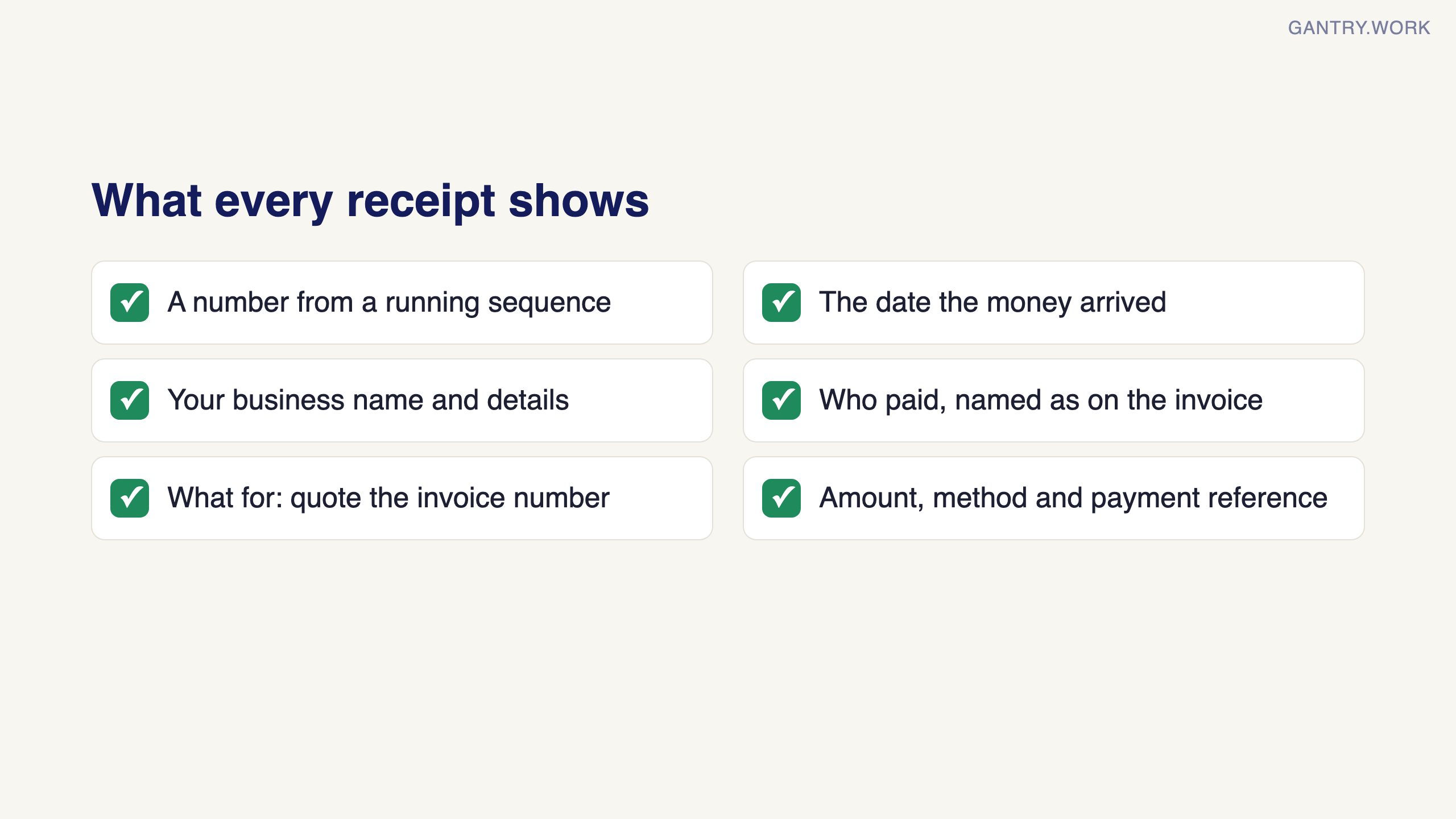
Number it from a running sequence (RCT-0001, RCT-0002). Never reuse or skip a number.
Date it the day the money arrived, not the invoice date.
Name who paid, the same way they appear on the invoice.
Say what the payment was for. Quote the invoice number if there was one.
Write the amount received with the currency. On a handwritten cash receipt, write it in words too, so nobody can add a digit later.
Record how it was paid and the reference, so the payment can be traced.
Keep a copy of every receipt you issue.
If the customer has paid only part of an invoice, say so: "Part payment for invoice INV-0412", with the balance still owed on the next line.
What a receipt must show in Singapore
There is no single legal format for every business, but three rules shape it:
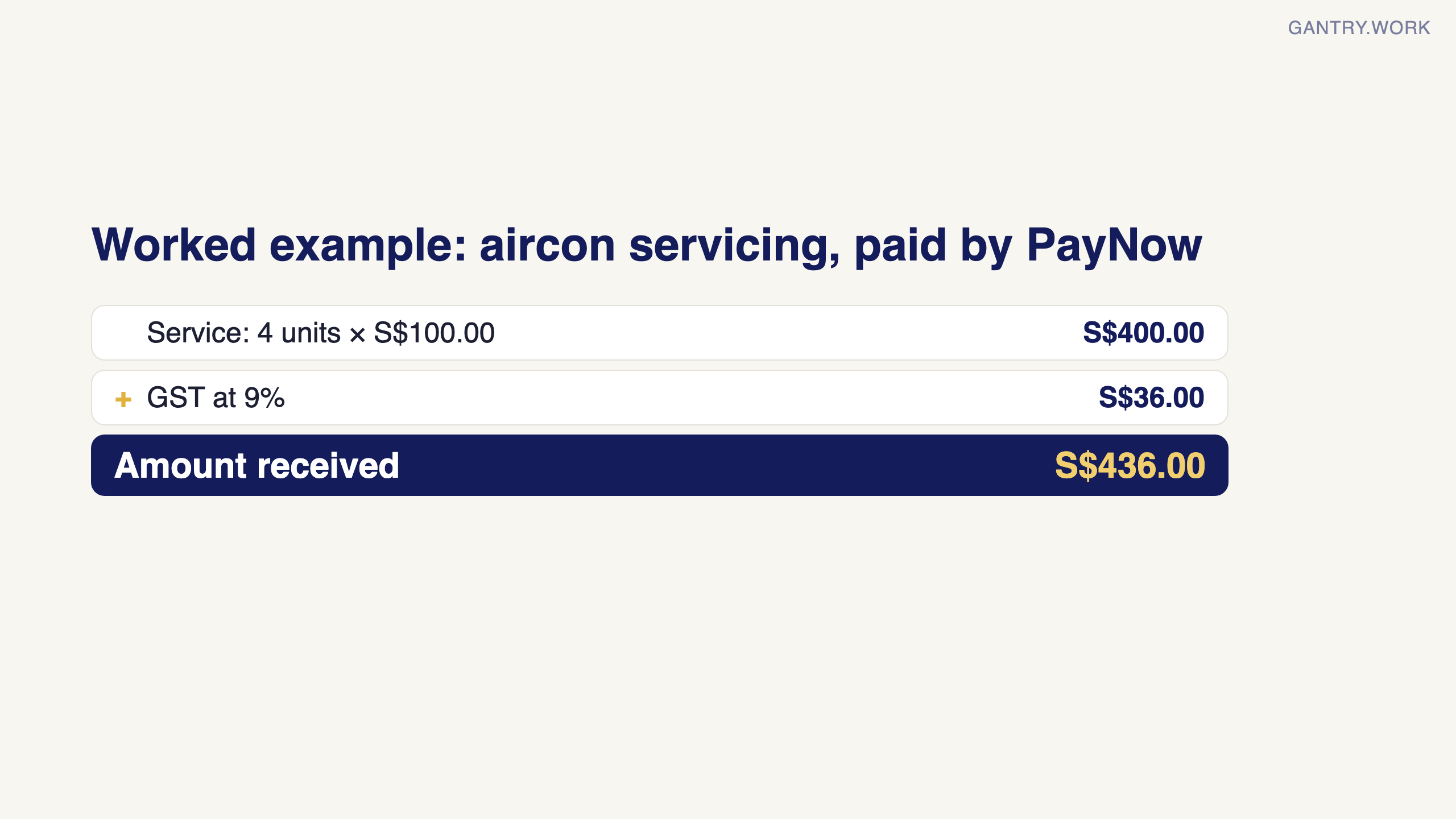
GST-registered businesses: IRAS says a receipt must be serially printed and show the date of issue, your business name and GST registration number, the total amount payable including GST, and the words "Price payable includes GST". You must also keep a duplicate of each receipt you issue.
Companies: ACRA requires a company's name to appear on its receipts, and its registration number on its invoices and statements. Putting your UEN on receipts too costs nothing and saves questions.
Not GST-registered: do not show GST at all. Only GST-registered businesses can charge it.
Cash receipt template vs PayNow and bank receipts
Cash receipt template
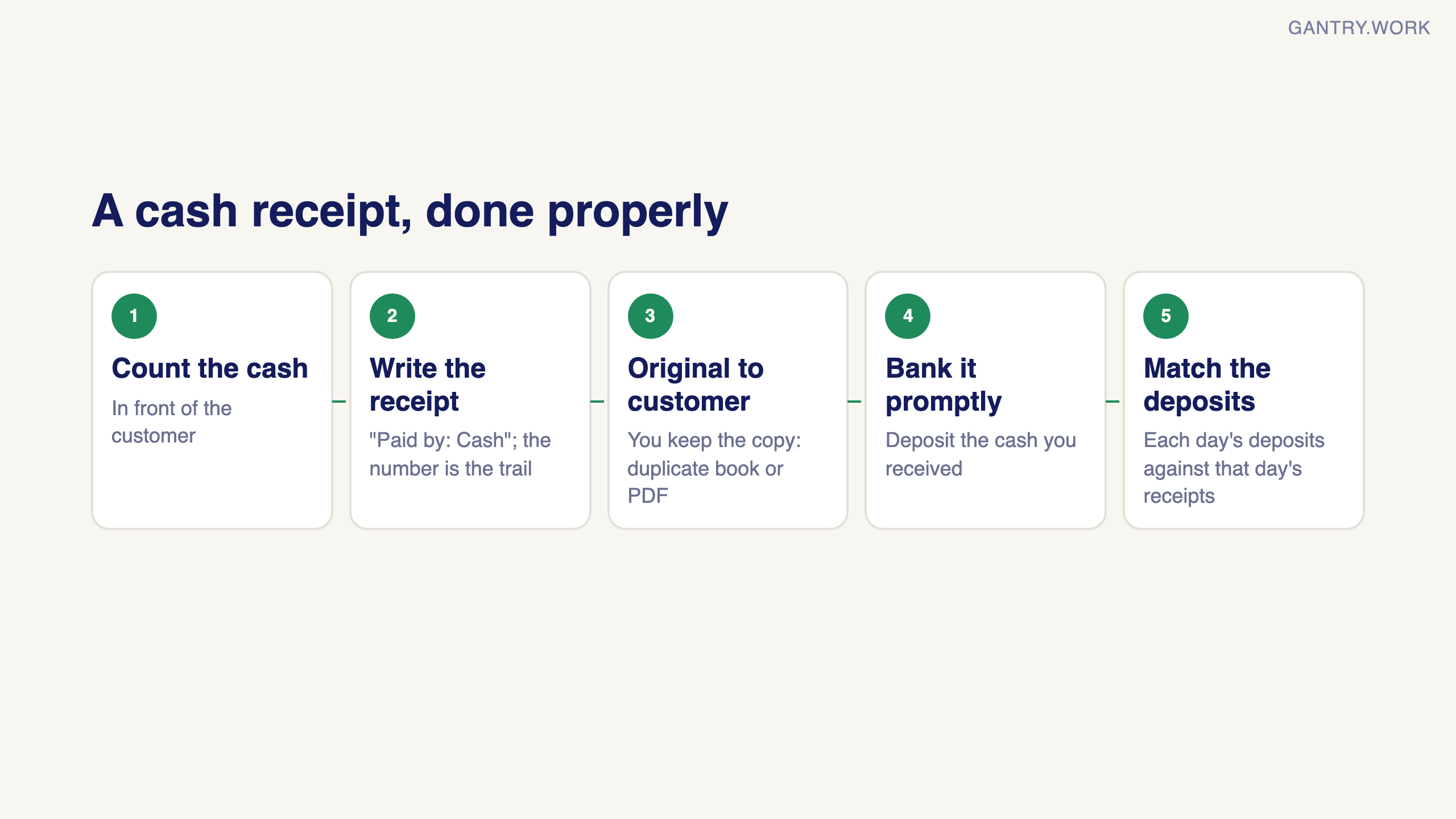
Cash is where a receipt matters most, because it is the only proof either side has. Count the money in front of the customer, write the receipt there and then, and give them the original while you keep the copy (a duplicate receipt book or a PDF). Use the template above with "Paid by: Cash" and no reference; the receipt number becomes the trail. Bank the cash promptly and check that each day's deposits match that day's receipts.
Payment receipt template for PayNow, bank transfer, card or cheque
For electronic payments the bank already holds a record, so the receipt is mainly for the customer's files, and many trade customers never ask for one. Always put the transaction reference and the invoice number on it, and date it the day the money reached your account. For a cheque, write the cheque number and "subject to clearance"; for GST purposes IRAS treats a cheque as received on the date you bank it in.
GST and receipts in Singapore
Customer not GST-registered: if you are GST-registered, IRAS allows you to issue a receipt instead of a tax invoice, as long as it carries the details listed above.
Customer GST-registered: they need a tax invoice to claim the GST back, or a simplified tax invoice if the total including GST is S$1,000 or less. A receipt on its own is not what their accountant needs, so check the document you give them has everything on IRAS's list.
Choosing not to issue receipts: IRAS does not require approval for this, but you must still keep proper records of every sale, and you must issue a receipt if a customer asks for one.
The GST inside a GST-inclusive amount: multiply by 9/109. S$436.00 × 9/109 = S$36.00.
Keep receipts for five years
IRAS requires GST-registered businesses to keep their records, including receipts and cash register tapes, for at least 5 years from the end of the accounting period. Companies must keep their source documents, receipts included, for at least 5 years from the relevant Year of Assessment. They can be kept on paper or electronically.
In practice: save every receipt PDF in a shared folder by month, or attach it to the payment in your accounting software, so anyone can find it later. Keep the receipts you receive for business purchases too; they support your expense and GST claims.
A worked example
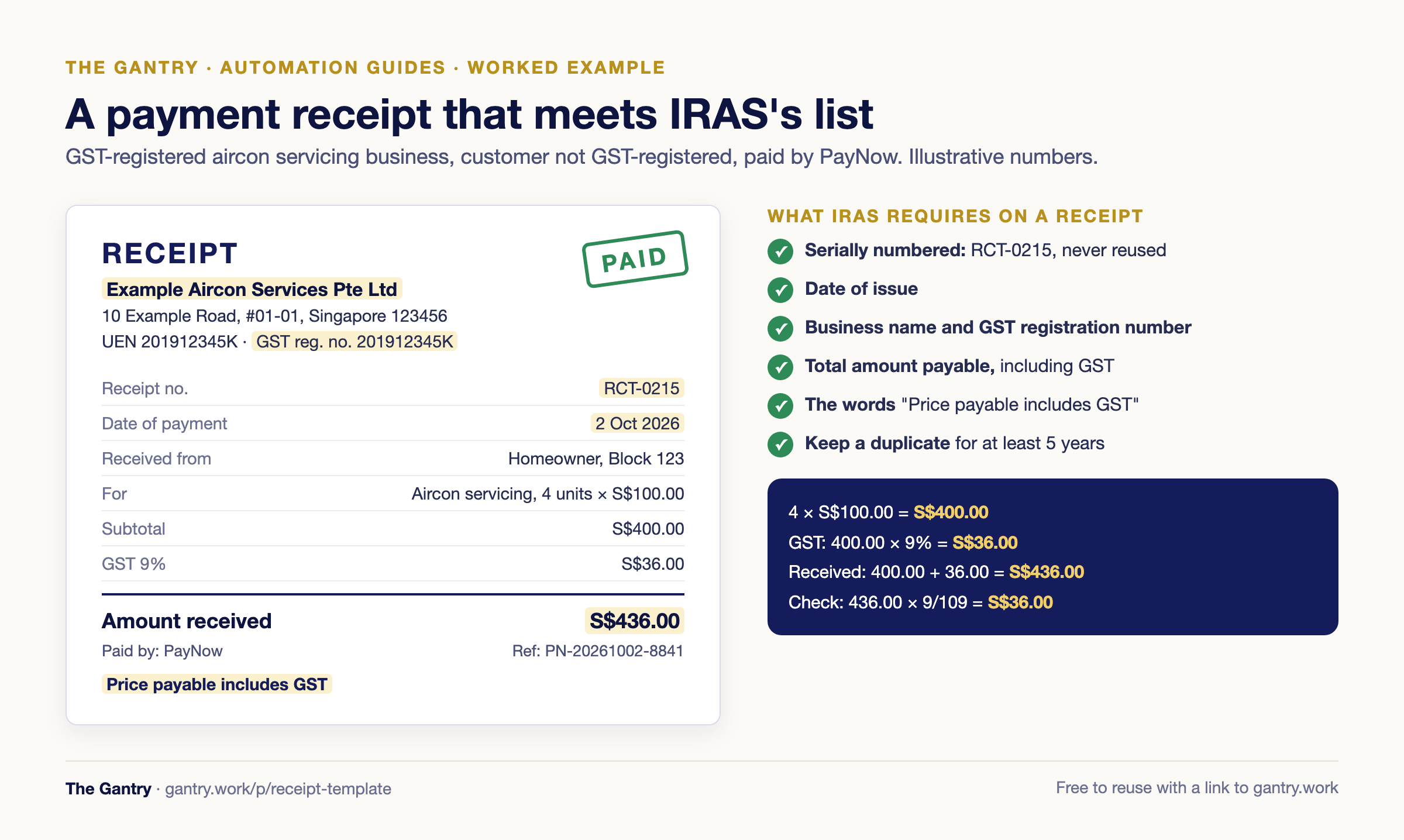
A typical aircon servicing business, GST-registered, services four units at a customer's home. The customer is a private individual, not GST-registered, and pays by PayNow on the spot.
Service: 4 units × S$100.00 = S$400.00
GST at 9%: 400.00 × 0.09 = S$36.00
Amount received: 400.00 + 36.00 = S$436.00
Check the GST inside the total: 436.00 × 9/109 = S$36.00
The receipt is numbered RCT-0215, dated 2 October 2026, shows the business's name, UEN and GST registration number, "Paid by: PayNow" with the transaction reference, and the line "Price payable includes GST". Because the customer is not GST-registered, this receipt can stand in for a tax invoice.
Part payment: if a trade customer pays S$500.00 towards a S$1,340.70 invoice, the receipt says "Part payment for invoice INV-0412: S$500.00" and "Balance outstanding: S$840.70" (1,340.70 − 500.00).
Do it in a minute with the free Receipt Generator
The free Receipt Generator fills in the template for you:
Your business details and logo are entered once and saved in your browser.
Numbering follows on from your last receipt, starting at RCT-0001.
"Paid by" offers PayNow, bank transfer, cash, card, cheque or other, with a field for the payment reference, and the PDF carries a PAID stamp.
GST: with "Add GST to prices", entering 4 units at 100.00 gives S$436.00 received. Add "Price payable includes GST" to the note line yourself.
From an invoice: in the Invoice Generator, "Turn into receipt" carries the customer and items over and notes the invoice number. For a part payment, change the amount to what was actually received.
Sending: download the PDF and attach it, or use "Copy as text" to paste a summary into WhatsApp.
It keeps a list of recent receipts in your browser so you can reopen one, but that is not record keeping: save the PDFs somewhere shared. Nothing is uploaded.
Make it automatic
If most payments arrive by PayNow, bank transfer or Stripe, writing receipts by hand is the wrong job. A free Make scenario can pick up each payment, record it against the invoice in your accounting software or a Google Sheet, and email the customer a receipt, without anyone opening a template. Where that fits in the bigger picture of quote, order, invoice and cash is in the order-to-cash process. For the other direction, bills arriving from suppliers by email, supplier invoice email to sheet reads each PDF into a checked sheet (that one is built in n8n).
Stuck on a step? Tell me where you're stuck and you'll get the fix, or a free 20-minute review if it's worth one.
Frequently asked questions
What should be on a receipt? A receipt number, the date of payment, your business name and details, who paid, what for, the amount received, and how it was paid with a reference. GST-registered businesses add their GST registration number and "Price payable includes GST".
Is a receipt the same as an invoice? No. An invoice asks for payment; a receipt confirms you have received it. For trade customers you usually issue the invoice first and a receipt only if they ask.
Can I write a receipt by hand? Yes. Use a pre-numbered receipt book so every receipt is serially numbered, which IRAS expects of GST-registered businesses, and keep the carbon copy.
Do I need to issue a receipt for every sale in Singapore? IRAS does not require approval if you choose not to issue receipts, but you must keep proper records of every sale and issue a receipt whenever a customer asks for one.
How long should I keep receipts? At least 5 years. IRAS sets this for GST records and for companies' source documents, and electronic copies are acceptable.
Related guides
Order-to-cash process · Payment reminder email templates · Supplier invoice email to sheet · Month-end shouldn't take three weeks
Payments landing in three apps and nobody sure what has been paid? I do a free 20-minute systems review. No pitch, just your questions answered.
I'm Sayed. I work closely with business owners to automate their operations and build workflows that actually make sense. I write The Gantry about ERP and automation for SMEs.
Working on something similar? Connect with me on LinkedIn and tell me what you are working on. I read and reply to every message, and the questions people send become the next guides.
How I test everything and how this site makes money: How The Gantry works.