

A Singapore quotation should show your company name, UEN and contact details, the word "Quotation", a quote number, date and validity date, the customer's details, each line with quantity, unit price and amount, a subtotal, GST shown clearly (only if you are GST-registered, with your GST registration number), the total, payment terms, lead time, exclusions and assumptions, and a line for the customer to accept. It is not a tax invoice and should never be titled as one.
That is the short answer. The rest is what decides whether the quote gets accepted and whether it causes trouble later: what IRAS says about GST on quoted prices, quotation vs pro-forma vs tax invoice, a worked example, and the five mistakes I see most often. Where the quotation sits against the pro-forma invoice, the tax invoice and the receipt is covered below.
The fields, block by block
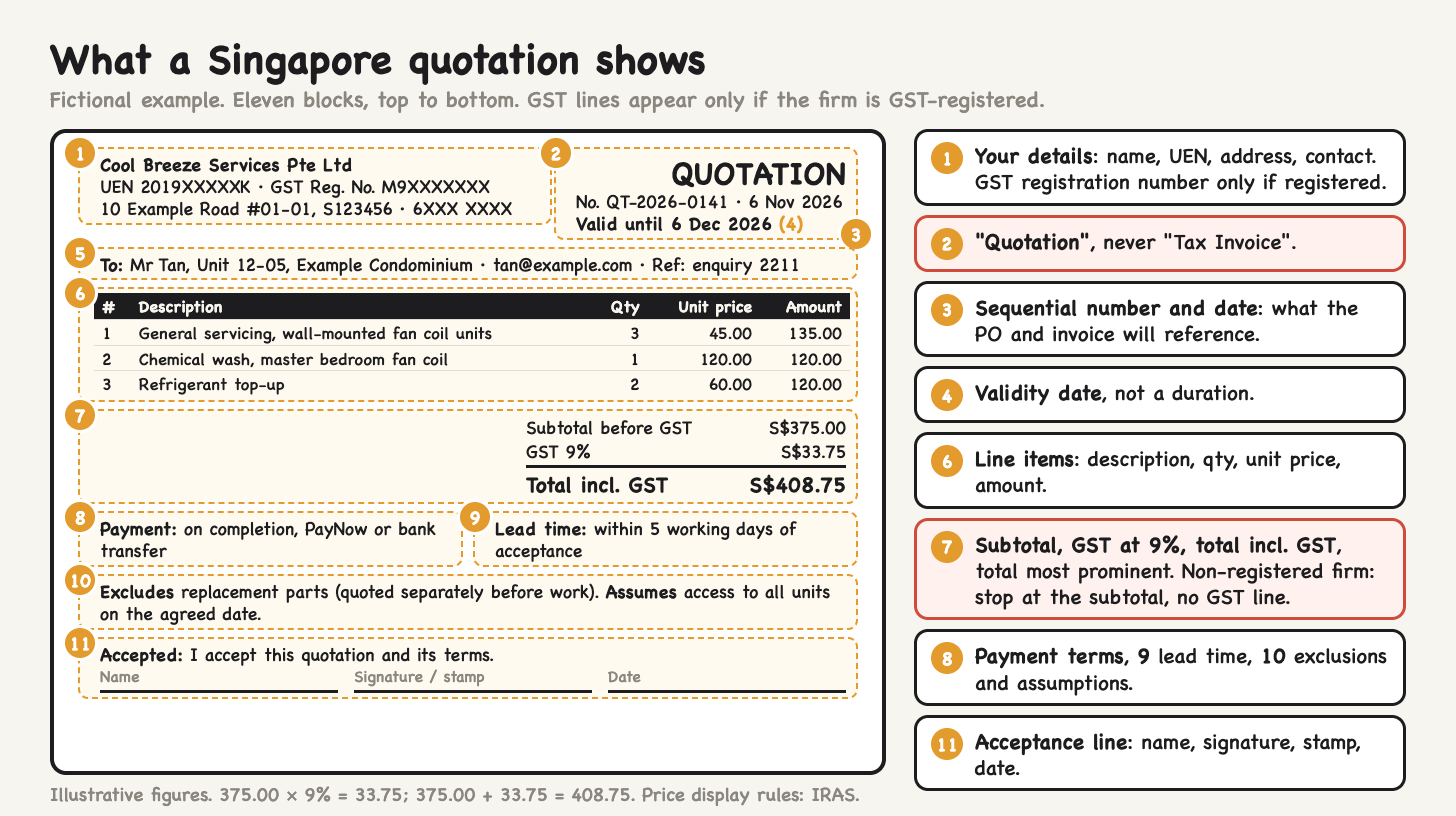
Your details. Registered company name, UEN, address, phone and email. Add your GST registration number if you are GST-registered. If you are not, GST does not appear anywhere on the document.
The title "Quotation". Never "Tax Invoice", which is a defined document under GST rules.
Quote number and date. A unique, sequential number (QT-2026-0141) and the issue date. The customer's purchase order and your invoice will both reference it.
Validity. "Valid until 6 December 2026" beats "valid for 30 days", because nobody has to count.
Customer details. Company name, address, the person you are quoting to, their contact, and their enquiry reference if they gave one.
Line items. A description in the customer's language (what they get, not just a part code), quantity, unit, unit price and line amount.
GST treatment, shown clearly. Subtotal before GST, GST at 9%, total including GST. If your prices already include GST, say so.
Totals. Subtotal, any discount, GST, grand total.
Payment terms. Deposit (how much, when), balance terms, accepted payment methods.
Lead time. Tied to an event you control: "within 5 working days of deposit".
Exclusions and assumptions. What the price does not cover (extra parts, after-hours work, permits, disposal) and what you assumed (site access, power available, quantities confirmed by the customer).
Acceptance. Name, signature, company stamp and date under "I accept this quotation and its terms". On email, a written "accepted" against the quote number does the same job.
GST on a quotation: registered vs non-registered firms
If you are not GST-registered
Keep GST off the quotation completely: no GST line, no "plus GST", no registration number. IRAS is direct about this: only GST-registered businesses can charge GST, and non-GST registered businesses are not allowed to charge or claim GST.
The penalty is not small. IRAS describes charging GST while not registered as a serious offence, with a penalty of three times the amount collected or attempted to be collected, a fine of up to S$10,000, imprisonment of up to three years, or a combination. In one published case, a trading company that was not GST-registered charged GST on 102 sales invoices; its director was ordered to pay three times the tax shown plus a S$51,000 fine.
If customers keep asking "is this plus GST?", add one line under the total: "Not GST-registered. No GST charged."
If you are GST-registered
Two points from IRAS shape how GST appears on your quote.
The rate is 9%, and has been since 1 January 2024. Check old templates: I still see 7% and 8% quotes.
Quoted prices to the public must be GST-inclusive. IRAS's price display rules require a GST-registered business to display and quote prices inclusive of GST to the public, and this covers written and verbal quotations as well as price tags, price lists, advertisements and websites. If you show both figures, the GST-inclusive price must be at least as prominent as the exclusive one. "$109 w/GST ($100 w/o GST)" is acceptable; "$100 + GST" alone is not, and neither is "prices subject to GST" without the inclusive figure. Non-compliance can mean a fine of up to S$5,000. The one exception is hotels and F&B outlets that impose a service charge, which must instead display a prominent statement that prices are subject to GST and service charge.
The simplest way to be right every time, whoever the customer is, is to show three figures on every quote: subtotal before GST, GST at 9%, and the total including GST, with the total the most prominent. A business customer gets the figure they budget on, a consumer sees the final price, and the quote cannot be read two ways.
Quotation vs pro-forma invoice vs tax invoice
A quotation is an offer: a price for a defined scope, valid until a stated date. It is not a bill, it does not trigger GST, and it is not recorded as a sale.
A pro-forma invoice looks like an invoice but is issued before the supply, usually to request a deposit or let the customer raise a purchase order. IRAS's GST General Guide says that sales orders, pro-forma invoices, statements of account and letters of claim are not considered invoices for determining the time of supply, because they are not billings for payment. A pro-forma is not a tax invoice, so your customer cannot claim input tax on it.
A tax invoice is what a GST-registered customer needs to claim input tax. IRAS lists its contents: the words "Tax Invoice" prominently, your name and address, your GST registration number, the date of issue, an identifying number, the customer's name and address, a description of the goods or services, the GST rate, the total excluding GST, the GST amount and the total including GST. It must be issued to a GST-registered customer within 30 days of the time of supply, which is generally the earlier of invoice issued or payment received.
So: quote first, take any deposit against a pro-forma, and issue the tax invoice when you supply or get paid, whichever comes first. If you are heading into Singapore's e-invoicing phases, InvoiceNow: when your business must covers what changes at the invoice stage; the quotation stage is untouched.
A worked example (fictional)
The firm, the customer and the prices are invented to show the arithmetic. This is not a real quote.
Cool Breeze Services Pte Ltd (GST-registered) quotes a condominium owner for an aircon service visit:
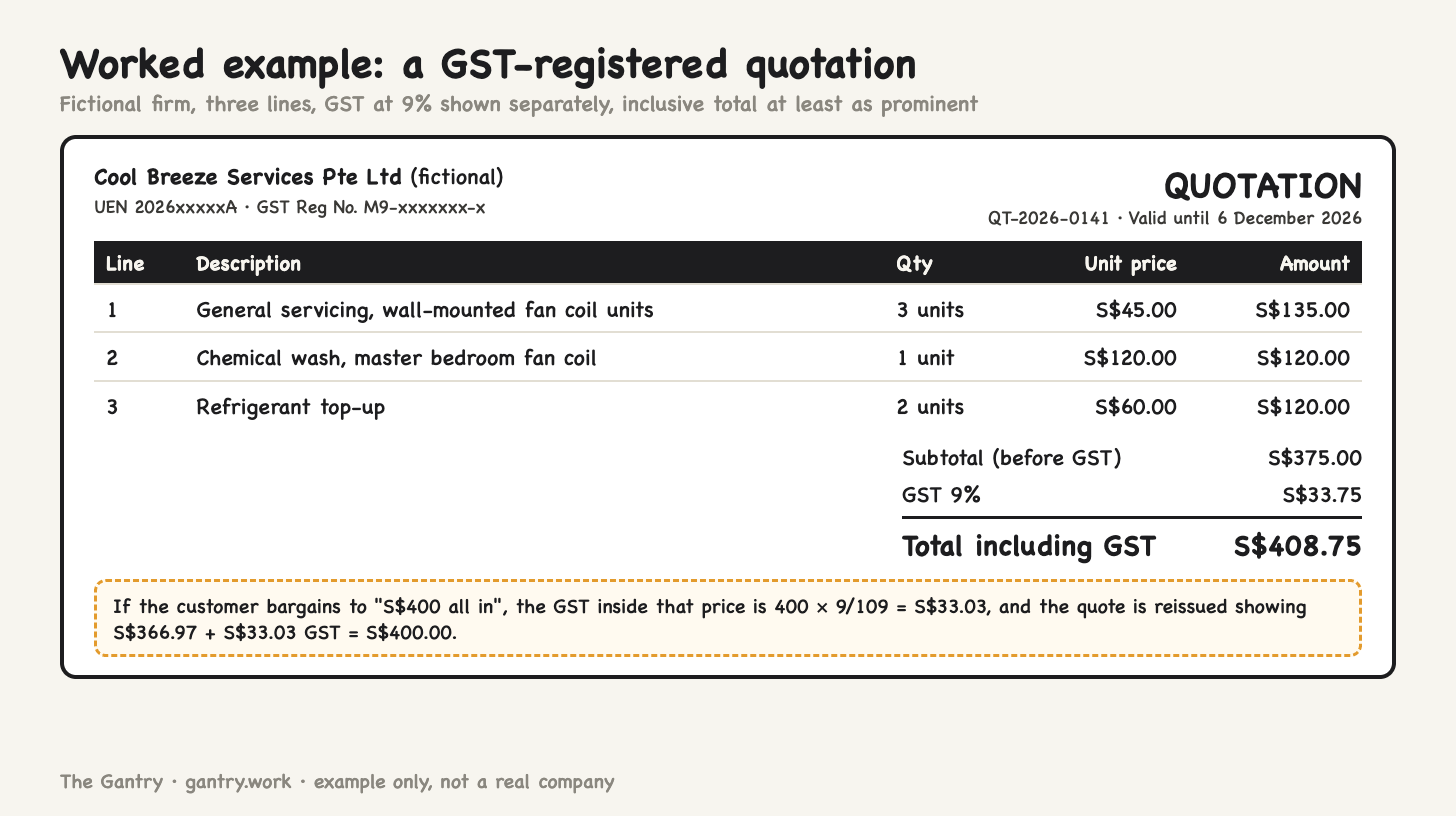
Subtotal before GST: S$375.00 GST at 9%: S$33.75 (375.00 × 0.09) Total including GST: S$408.75
Under the totals: "Quotation QT-2026-0141, valid until 6 December 2026. Payment on completion by PayNow or bank transfer. Excludes replacement parts, which will be quoted separately before any work proceeds. Assumes access to all units on the agreed date."
Two checks. If the customer bargains you down to a GST-inclusive S$400, the GST you account for is the tax fraction 9/109 of what they pay, S$33.03, not 9% on top of S$400. And if Cool Breeze were not GST-registered, the quote would stop at S$375.00 with no GST line.
Validity and revisions
Thirty days is the usual validity for general trades and services; shorter where material prices move weekly. Put a date on the document, not a duration.
When a customer comes back after the date, do not re-send the old quote with a new date. Issue a revision: the same number with a suffix (QT-2026-0141 Rev 1), today's date, a new validity date, and one line saying what changed. Keep the superseded version on file; the revision trail is what settles a later argument about what was agreed.
If costs move inside the validity period, you honour the quote. That is what the date is for. Price the risk into the period instead: 14 days on anything with imported parts is better than a 30-day quote you regret.
Five mistakes that cost the job
No exclusions. The customer assumes the price covers everything, you assumed it did not, and the argument happens on site.
GST shown wrong. "Plus GST" with no inclusive figure, an old rate, or GST from a firm that is not registered. Each either breaches IRAS rules or signals that you do not know your own numbers.
No validity date. Six months later the customer accepts at last year's prices and you have no basis to refuse.
Quoting from memory. Prices drift between quotes for the same item, or fall behind your supplier's latest increase. Quote from a maintained, dated price list.
No acceptance line. A quote with nowhere to sign gets "noted" rather than accepted. An acceptance line with a deposit term next to it turns a yes into an order the same day.
From a Word template to a system
A Word or spreadsheet template is fine for a handful of quotes a month. The cracks appear at volume: duplicate quote numbers because two people edited the same file, an accepted quote retyped into an invoice with a line missed, and nobody able to say which quotes are still open.
What a system changes, whichever one you choose:
One number sequence. Every quote takes the next number automatically, with revisions tracked under it.
A price list behind the quote. Lines are picked from maintained items at current prices, so everyone quotes the same job the same way.
GST set once. The item or customer carries the GST treatment, and subtotal, GST and total are computed the same way on the quote and the later invoice.
No retyping. An accepted quotation becomes a sales order, then a delivery order or job sheet, then the invoice, each carrying the same lines and the quote number.
Follow-up you can see. Open quotes listed by validity date, which is where most lost jobs actually sit.
If you are deciding whether a system is worth it at your size, business systems: start here works through that question before any tool gets named.
If you need a clean quotation today, the free quotation generator runs in your browser with no signup: your details and logo, the customer, line items, an optional GST line (added on top or included in prices), a discount, a validity date that defaults to 30 days, terms and a signature space, with a PDF download and a "turn into invoice" step that carries the same lines across. Your entries stay in your browser.
I'm Sayed. I help business owners automate their operations and set up the systems behind them: ERP, accounting, inventory, CRM and workflows.