

A proforma invoice is a preview of a sale: it tells the buyer what they will be charged, so they can pay a deposit, arrange a letter of credit or get approvals. A tax invoice is the document that bills them and, for a GST-registered supplier, lets a GST-registered customer claim the GST back. In Singapore, IRAS does not treat a pro forma invoice as an invoice for GST purposes, so issuing one does not trigger GST and your customer cannot claim input tax on it. Payment can trigger GST, though: if a deposit is paid against a pro forma, you account for GST on the deposit and issue a tax invoice.
Here is how the two documents differ, what happens with deposits, how customs treats a pro forma, and how it compares with a sales order.
Proforma invoice vs tax invoice at a glance
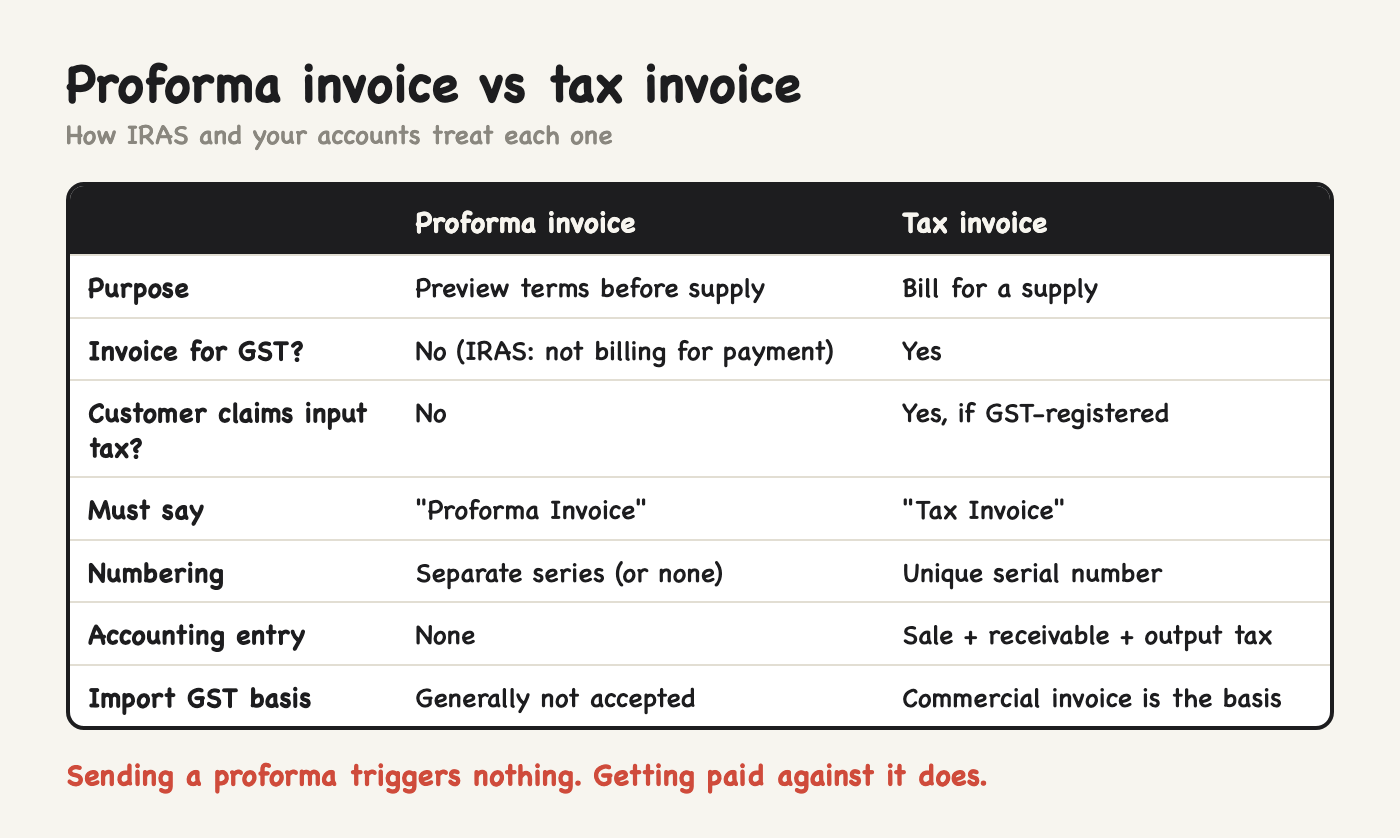
The short version:
Purpose. A proforma confirms terms before supply. A tax invoice bills for a supply that has happened, or is being paid for.
GST status. IRAS lists pro forma invoices, sales orders, statements of account and letters of claim as documents that are generally not treated as invoices for GST, because they don't normally bill for payment. A tax invoice is the GST document.
Input tax. Your GST-registered customer needs a valid tax invoice (or an import permit for imports) to claim input tax. A proforma won't do.
Wording. A tax invoice must carry the words "Tax Invoice". A proforma should say "Proforma Invoice" clearly, so nobody mistakes it for a bill.
Numbering. Tax invoices need a unique serial number. Use a separate number series for proformas, or none, so your tax invoice sequence has no gaps.
Accounting. A proforma creates no sale and no receivable. A tax invoice creates both.
Where each document sits in a sale
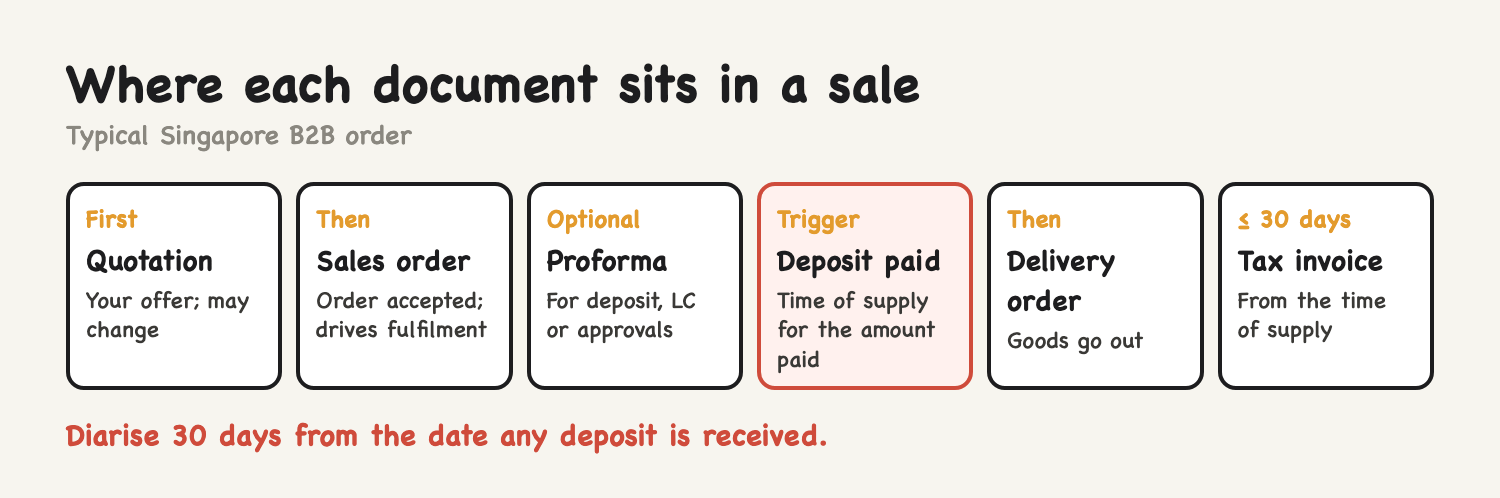
A typical B2B sale in a Singapore trading or contracting business runs like this:
Quotation. Your offer: items, prices, validity, terms. Nothing is agreed yet. (If you need one, the free quotation generator makes a clean one.)
Customer purchase order or acceptance.
Sales order. Your internal confirmation that the order is accepted, which drives picking, purchasing or production.
Proforma invoice (optional). Sent when the buyer needs to pay before delivery, open a letter of credit, get an internal approval, or apply for an import permit in their country.
Deposit or full prepayment (optional).
Delivery order when the goods go out.
Tax invoice, generally within 30 days of the time of supply.
The proforma is optional. Many local B2B sales on 30-day terms never need one. It earns its place when money or paperwork has to move before the goods do.
Deposits: where most of the confusion comes from
For most supplies, IRAS treats the time of supply as the earlier of two events: an invoice being issued, or payment being received. Because a pro forma is not treated as an invoice, sending it starts nothing. But when the customer pays against it, payment received is the trigger, for the amount paid.
So if a customer pays a deposit that is part of the price:
You account for output tax on the deposit in the GST return for the period you received it.
You issue a tax invoice to a GST-registered customer, generally within 30 days of that time of supply.
The balance is taxed when it is invoiced or paid, whichever comes first.
A genuinely refundable security deposit is usually treated differently from a part payment, so if your deposits are refundable, check the treatment with your tax adviser.
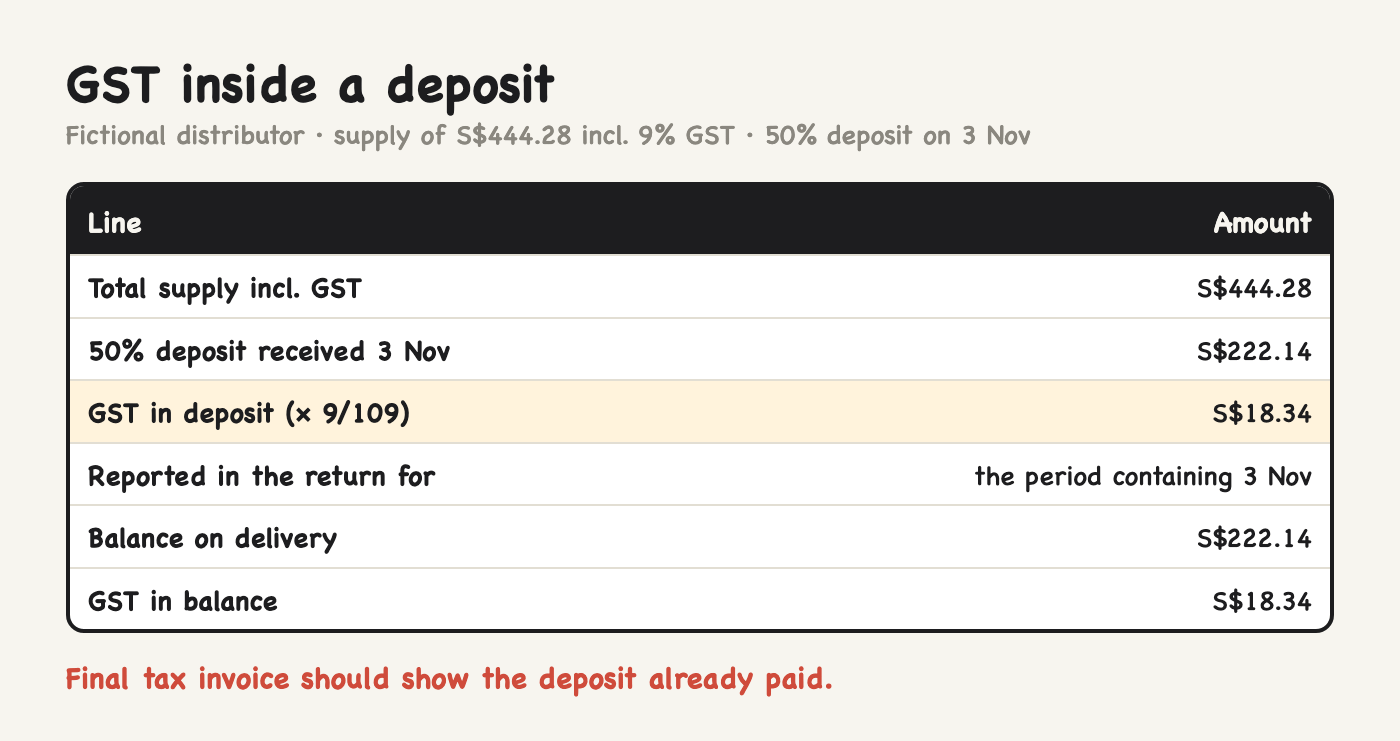
Worked example. A Singapore distributor quotes a café group S$444.28 including 9% GST for a delivery of cooking oil, rice and sardines. The café asks for a proforma to approve the spend and pays a 50% deposit of S$222.14 on 3 November.
GST inside the deposit is S$222.14 × 9/109 = S$18.34. That goes into the return for the period containing 3 November.
The distributor issues a tax invoice for the deposit (or for the full supply, showing the deposit received) within 30 days.
On delivery, the balance of S$222.14, with GST of S$18.34, is invoiced.
If you want to double-check the GST arithmetic for any amount, the free GST calculator does both directions.
What the tax invoice looks like in a system
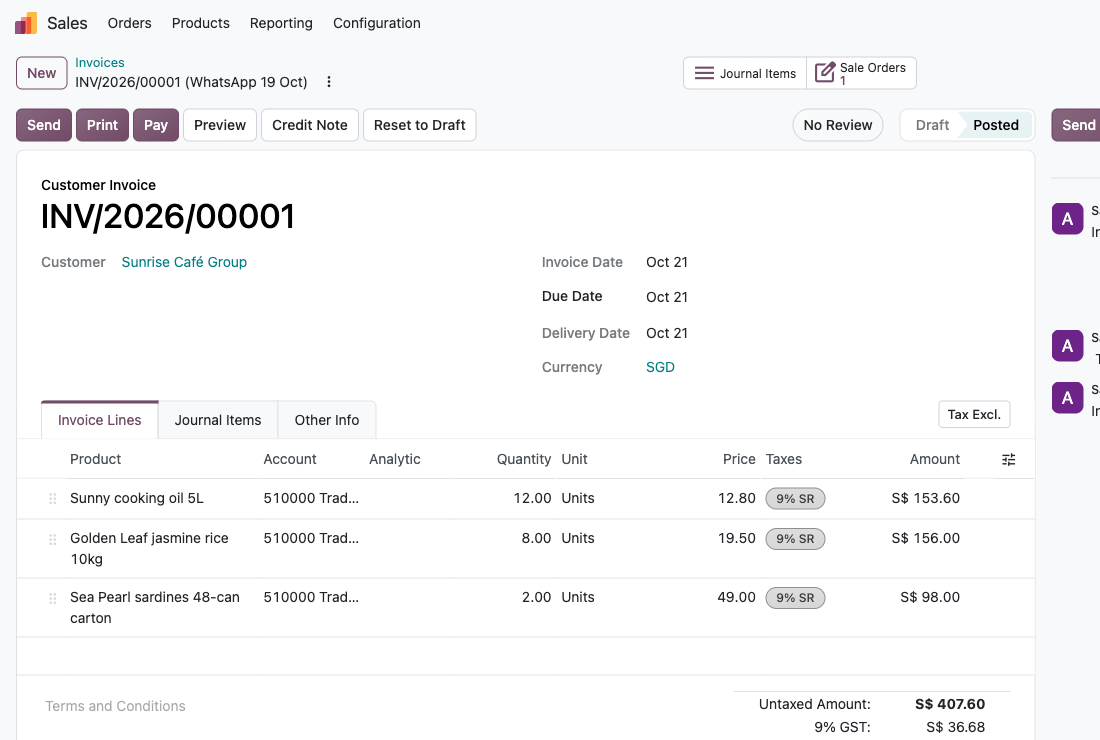
This is a posted tax invoice in a fictional trading company's system: three products, an untaxed amount of S$407.60, 9% GST of S$36.68 and a total of S$444.28. The invoice number comes from a protected sequence, the GST is calculated per line from the tax code, and the journal entry posts automatically.
That is the main practical argument for producing both documents from the same system. When the proforma, sales order, delivery order and tax invoice all come from one record, the numbers can't drift between them, the deposit is matched to the order, and the tax invoice sequence stays clean.
What a Singapore tax invoice must show
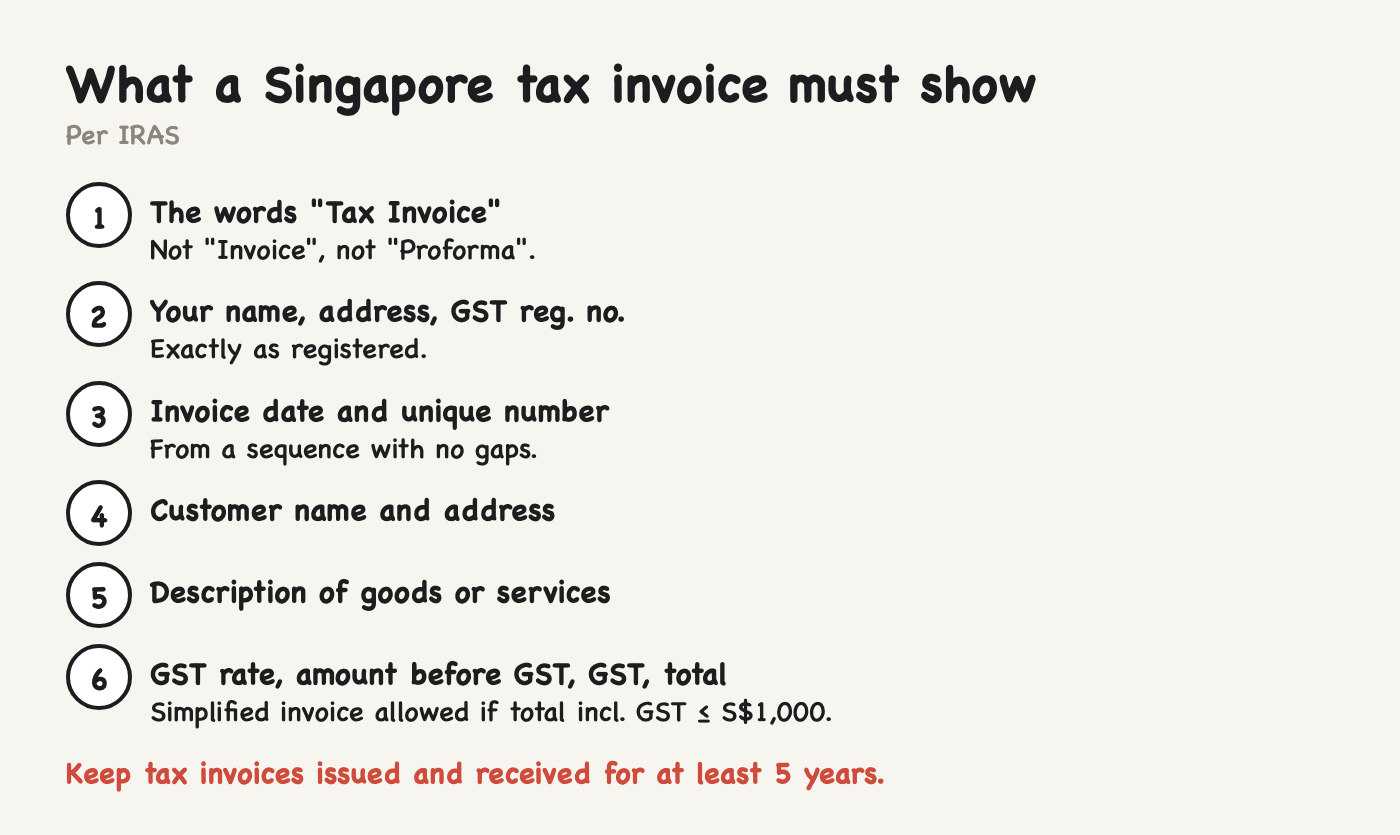
Per IRAS, a tax invoice must show:
the words "Tax Invoice"
your name, address and GST registration number
the invoice date and a unique invoice number
your customer's name and address
a description of the goods or services
the GST rate, and the amounts before GST, the GST charged, and the total including GST
A simplified tax invoice is allowed when the total payable, including GST, does not exceed S$1,000. You only have to issue a tax invoice to GST-registered customers; for customers who are not GST-registered, a receipt can be issued instead. Keep tax invoices issued and received for at least 5 years.
If you are moving to e-invoicing, IRAS's e-Tax Guide on the GST InvoiceNow requirement also groups pro forma invoices with sales orders and statements of account as documents that don't serve as a bill for payment. My guide to InvoiceNow and when your business must comply covers the rest.
Proforma invoices and Singapore Customs
For imports, GST is paid on the value of the goods, and the basis is the commercial invoice: the supplier's final invoice for the goods. Singapore Customs has said that a pro forma invoice is generally not acceptable as the basis for paying import GST, because the supplier has not confirmed the value.
In practice: ask your overseas supplier for the commercial invoice before the shipment arrives, and give your freight forwarder the commercial invoice, packing list and bill of lading or air waybill together. If you are the exporter, your customer's customs authority may accept a proforma for some purposes (an import licence application, for example) but will normally want a commercial invoice to clear the goods.
Proforma invoice vs sales order, and vs quotation
Proforma vs sales order. A sales order is your internal record that you have accepted an order; it drives fulfilment. A proforma is sent to the customer and shows what the invoice will look like. Many systems create the proforma from the sales order, which is the right way round.
Proforma vs quotation. A quotation is an offer that may change. A proforma usually follows agreement and reflects the final terms, so it should match the eventual tax invoice.
Proforma vs commercial invoice. In cross-border trade, the commercial invoice is the final invoice used for customs and payment. The proforma comes before it.
Five habits that keep this clean
Put "Proforma Invoice" in large letters at the top, and never "Tax Invoice".
Use a separate number series for proformas.
Record deposits against the sales order, not as unexplained receipts.
Diarise the 30-day tax invoice deadline from the date a deposit is received.
Make sure the final tax invoice shows the deposit already paid, so the customer's AP team doesn't pay twice.
The free invoice generator produces a correctly labelled tax invoice if you only need one occasionally. If you raise dozens a week, this belongs in your order-to-cash system; my explainer on the order to cash process shows where each document fits.
Do your customers ever pay against a proforma? How do you track the GST on those deposits today?
General information based on IRAS and Singapore Customs guidance as of October 2026, not tax advice. Check your specific case with IRAS guidance or your tax adviser. Screens come from a demo system with fictional companies.
I'm Sayed. I help business owners automate their operations and set up the systems behind them: ERP, accounting, inventory, CRM and workflows. I write The Gantry about what actually works.