

HSBC announced a Global AI Centre of Excellence in Singapore on 27 July 2026, opening by the second half of the year with more than 100 AI specialists, and on 15 October said it will open an AI research institute in Hong Kong from early 2027 while doubling its Hong Kong AI team from 150 to 300. A 30-person Singapore company cannot copy the headcount. It can copy the three decisions the bank made first: each centre has a named list of use cases, the data those use cases run on already exists in one system, and one executive owns the result.
That is the whole argument. The rest is what the announcements actually say, why the sequence matters more than the budget, and a worked example of the same three decisions at a firm with a fraction of one per cent of HSBC's staff.
What was announced, in order
Singapore, 27 July 2026. HSBC said it would set up a Global AI Centre of Excellence in Singapore by the second half of 2026 as part of more than 200 new roles across AI and wealth. The centre is to employ more than 100 AI specialists and starts with three stated areas of work: conversations with customers about their wealth, agentic treasury solutions, and AI-enabled digital payments. The bank also said its technology spend in Singapore would double over five years, and reminded readers that its Quantum Centre of Excellence opened in Singapore in 2025.
Hong Kong, early October 2026. The Financial Times reported that the Hong Kong Monetary Authority had asked HSBC why the AI hub went to Singapore rather than Hong Kong. HSBC's public line was that it has senior leaders in both London and Hong Kong.
Hong Kong, 15 October 2026. Group chief executive Georges Elhedery said HSBC would set up a global AI research institute in Hong Kong, expected to start operating in early 2027, with an initial focus on AI application cases, post-quantum cryptography and blockchain. David Liao, co-chief executive for Asia and the Middle East, said the bank's 150 AI specialists in Hong Kong would double over the next two to three years. Business Times carried the Hong Kong institute as the follow-on to the Singapore launch.
Two centres, two mandates, two headcount plans, announced ten weeks apart. Whatever you think of the politics behind the second one, the structure of both announcements is the same, and that structure is the useful part.
The three decisions that came before the building
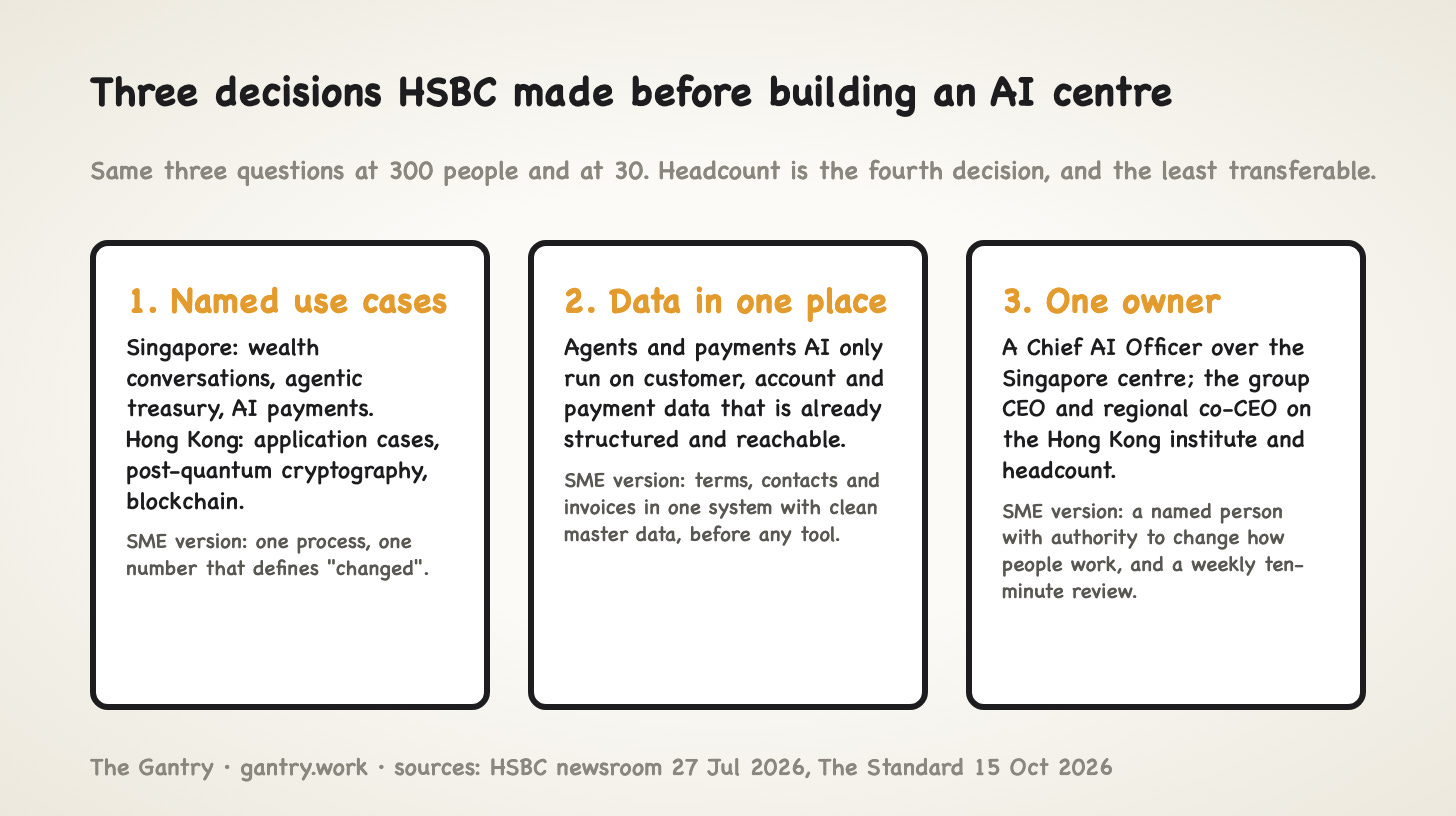
Read the two statements again and strip out the numbers. Three things are present in both.
1. A named list of what the AI is for. Singapore: wealth conversations, treasury, payments. Hong Kong: application cases, post-quantum cryptography, blockchain. Nobody announced "we are doing AI". Each centre opens with a short list of processes it is expected to change. That list is what lets a bank hire 100 people and know on day one what they are working on.
2. Data that already lives in one place. Agentic treasury and AI-enabled payments only work if the bank's payment, customer and account data are already structured, consistent and reachable from one platform. A bank that still kept client balances in a spreadsheet per relationship manager would not be announcing agents; it would be announcing a data programme. The centre is the top of a stack that was built for years before it.
3. One person who owns the outcome. HSBC named its first Chief AI Officer earlier in 2026 and put the Singapore centre under that role. In Hong Kong the institute was announced by the group chief executive and the headcount plan by the regional co-chief executive. There is a name against every number.
Budget is the fourth thing, and it is the one most SME owners fixate on. It is also the least transferable. The first three cost almost nothing and are where most small-company AI projects go wrong, because they are skipped.
Why this matters for a company with 30 staff
Singapore's own data on SME AI says the same thing from the other side. When we looked at the pilot-stage trap for Singapore SMEs, the pattern was consistent: pilots start with a tool, not a process, and stall on data that is spread across WhatsApp, Excel and two apps that do not talk. The gap between AI adoption and AI capability is mostly a data and ownership gap wearing an AI costume.
So the question for an owner is not "which AI should we use". It is the three HSBC questions, scaled down:
Which single process do we want changed, and what would "changed" look like in numbers?
Does the data that process needs exist in one system, with the master data clean enough to trust?
Who in the company owns the result, with the authority to change how people work?
If the answer to the second question is no, the right project is not an AI project yet. It is the systems project that makes one possible, and it is a much better use of this year's budget.
A worked example (fictional)
Take a 30-person building-materials distributor in Singapore. The owner has been pitched three AI tools in a month: one to draft quotes from WhatsApp messages, one to forecast stock, one to chase late payers.
Run the three decisions.
Use case. Late payment is the one that moves cash. Debtor days are 58 against 30-day terms. "Changed" means 45 days by March, which on S$4.2 million of annual credit sales frees roughly S$150,000 of working capital (4.2 million divided by 365, times 13 days).
Data. Invoices live in the accounting system, but due dates are keyed by hand and customer contact details sit in the sales team's phones. A chasing agent would send reminders to the wrong person on the wrong date. The fix is not the agent; it is two weeks of work: invoice terms set per customer in the system, payment terms and contacts moved into the customer record, and an ageing report the system produces on the 1st of each month.
Owner. The finance executive, not the owner, with a weekly ten-minute review of the ageing report.
Only after that does the AI tool get a fair trial, and by then half the gain has already arrived from the data fix. That is the sequence HSBC followed at a scale of 300 people; it works the same at 30.
What this does not say
Nothing in either announcement says a small company needs an AI centre, a data scientist or a chief AI officer. It says the bank decided what AI was for, built the data to run it on and named an owner, and then hired. Most SME owners can finish the first three decisions in an afternoon. The honest outcome of that afternoon is often "our data is not ready", which is not a failure; it is the plan.
If you want to check where your own company sits before any tool gets named, the free systems readiness check takes ten minutes and gives you a score on exactly these three questions. And if you are deciding whether a system is worth it at your size, business systems: start here walks through that question first.
I'm Sayed. I help business owners automate their operations and set up the systems behind them: ERP, accounting, inventory, CRM and workflows.