

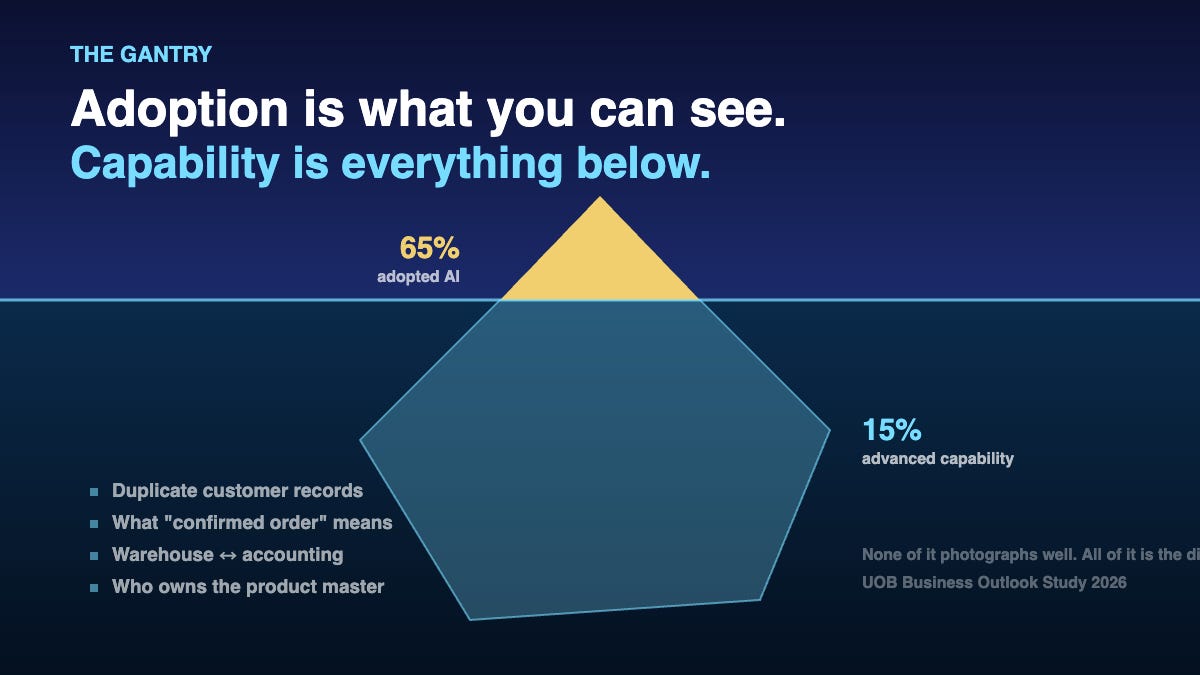
Kearney has been arguing that Indonesia needs to build a broad AI ecosystem rather than simply adopt AI tools. Shirley Santoso, who heads Kearney Indonesia, put it plainly: the country has significant opportunities in the AI economy, but long-term success will depend on more than just technology adoption.
Their argument is that countries will compete on four things — the quality of their people, the strength of their innovation ecosystem, their digital infrastructure, and their ability to convert technical capability into actual economic results.
That last one is the whole ball game, and it is the one everybody skips.
The argument in 45 seconds
The short version: 65% of businesses have adopted AI and 15% have reached advanced capability. The gap is not access to tools. It is clean data, connected systems and named owners, which is why the sequence below starts there.
Shrink it from a country to your company
The four things become four questions you can ask about your own business today.
People. Does someone here own this process and understand it?
Infrastructure. Is your data clean and are your systems connected?
Ecosystem. Are your vendors, integrator and bank able to work together?
Conversion. Did any of it reach the P&L?
Ask those four about your last technology purchase. Most businesses can answer yes to one.
The number that proves the point
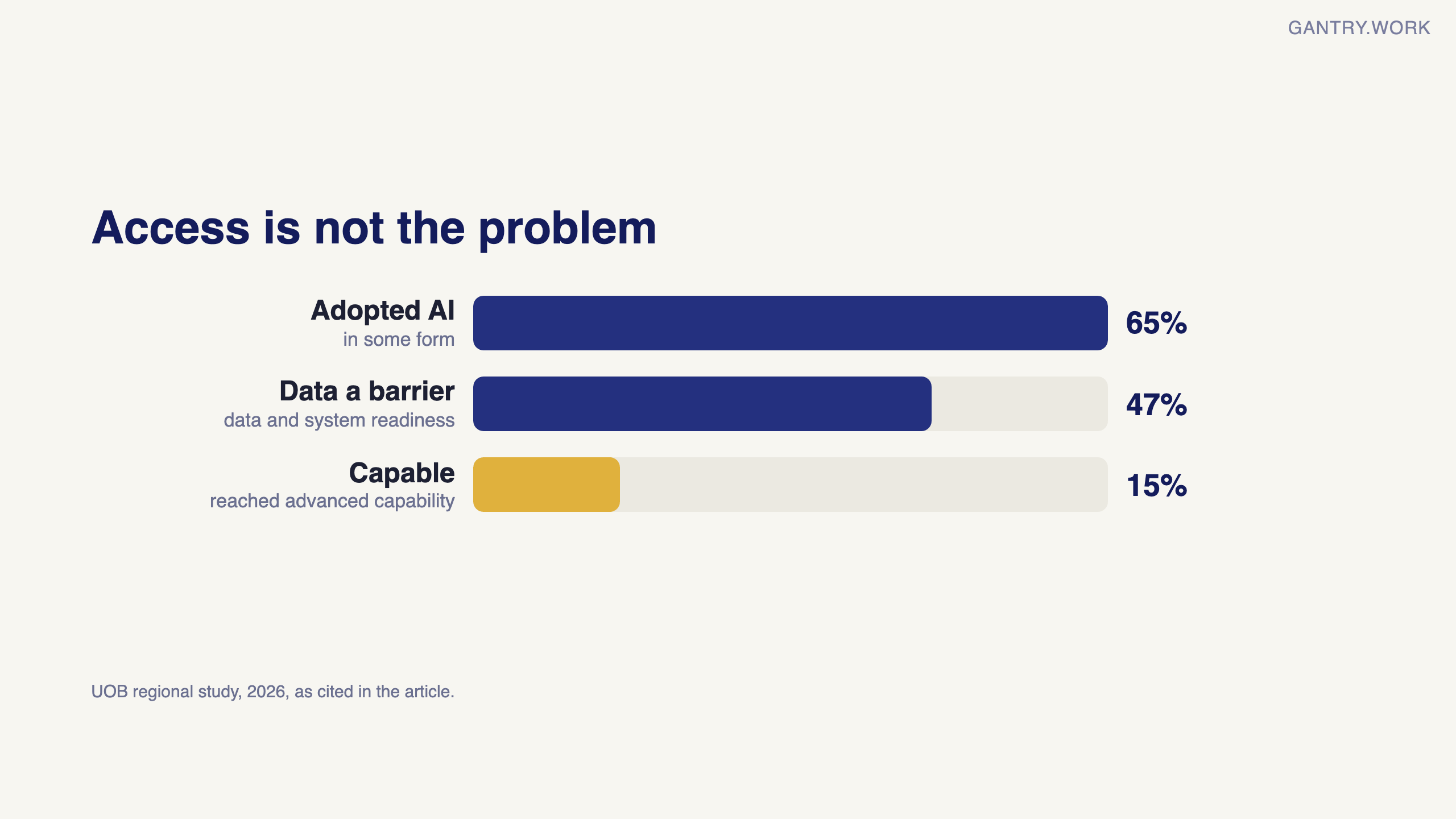
UOB’s regional study this year found 65% of businesses have adopted AI in some form, and 15% have reached advanced capability.
That is not a gap in access. Everyone in that survey has access to the same tools — they are a browser tab away and mostly cost less than a phone bill. The 50-point difference is entirely in what the survey calls capability and what I would call the boring layer.
The same study named data and system readiness as a barrier for 47% of respondents. Not "we cannot get the tools". "We cannot feed the tools."
Adoption is easy to measure, which is why we measure it
Here is the honest reason this keeps happening.
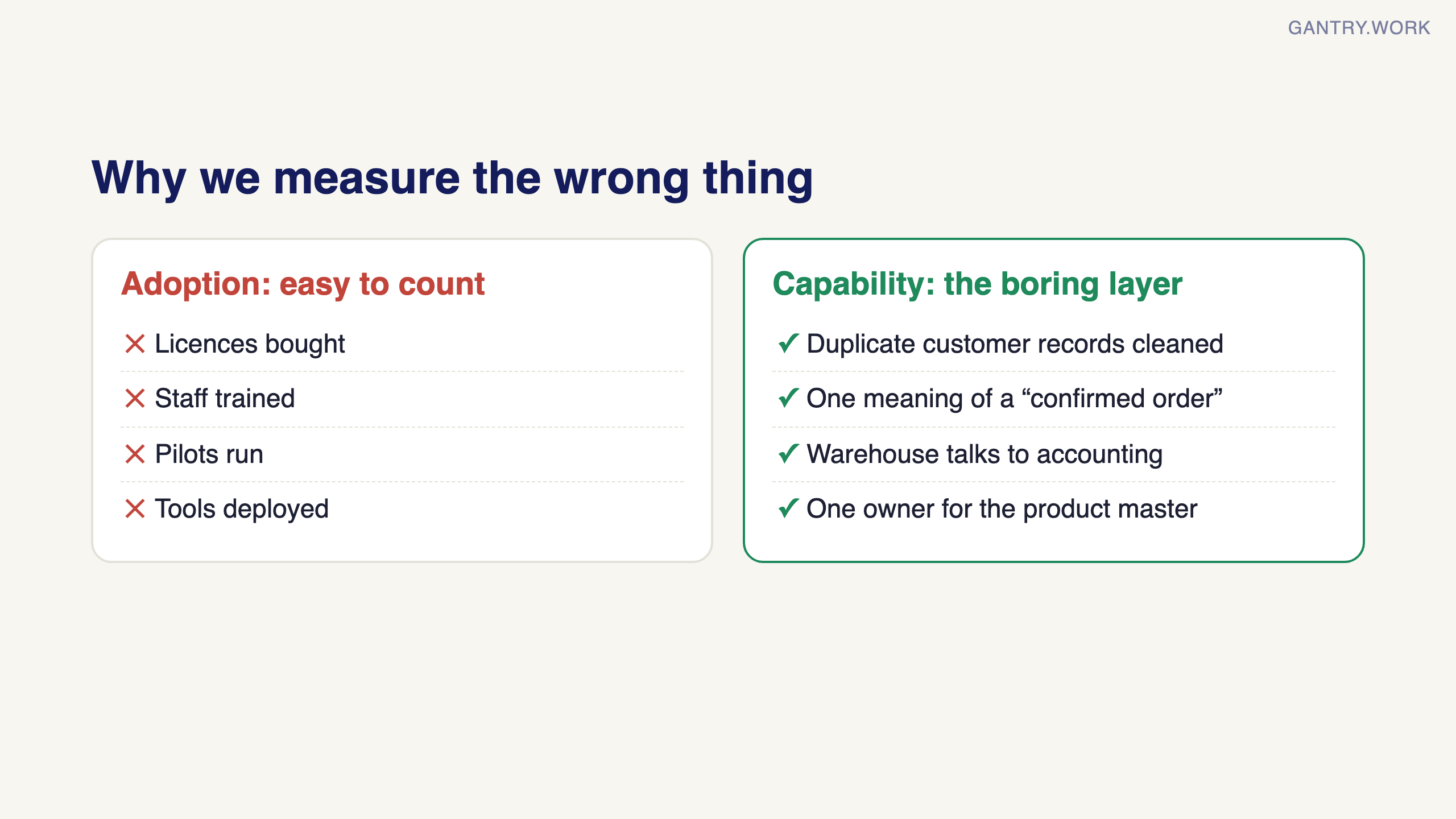
Adoption is countable. Licences bought, staff trained, pilots run, tools deployed. It fits in a board update. It looks like progress and it can be reported the same quarter you spend the money.
Capability is slow, unglamorous and hard to put in a slide. Cleaning up duplicate customer records. Agreeing what a "confirmed order" actually means so two departments stop counting it differently. Getting the warehouse system to talk to the accounting system. Deciding who owns the product master and giving them the authority to say no.
None of that photographs well. All of it is what separates the 15% from the 65%.
I have sat with companies that bought good software and got nothing, next to companies that bought nothing new and transformed, because they spent six months fixing what the data meant. The second group looks lazy in a quarterly report and wins over three years.
From our projects: the boring layer first
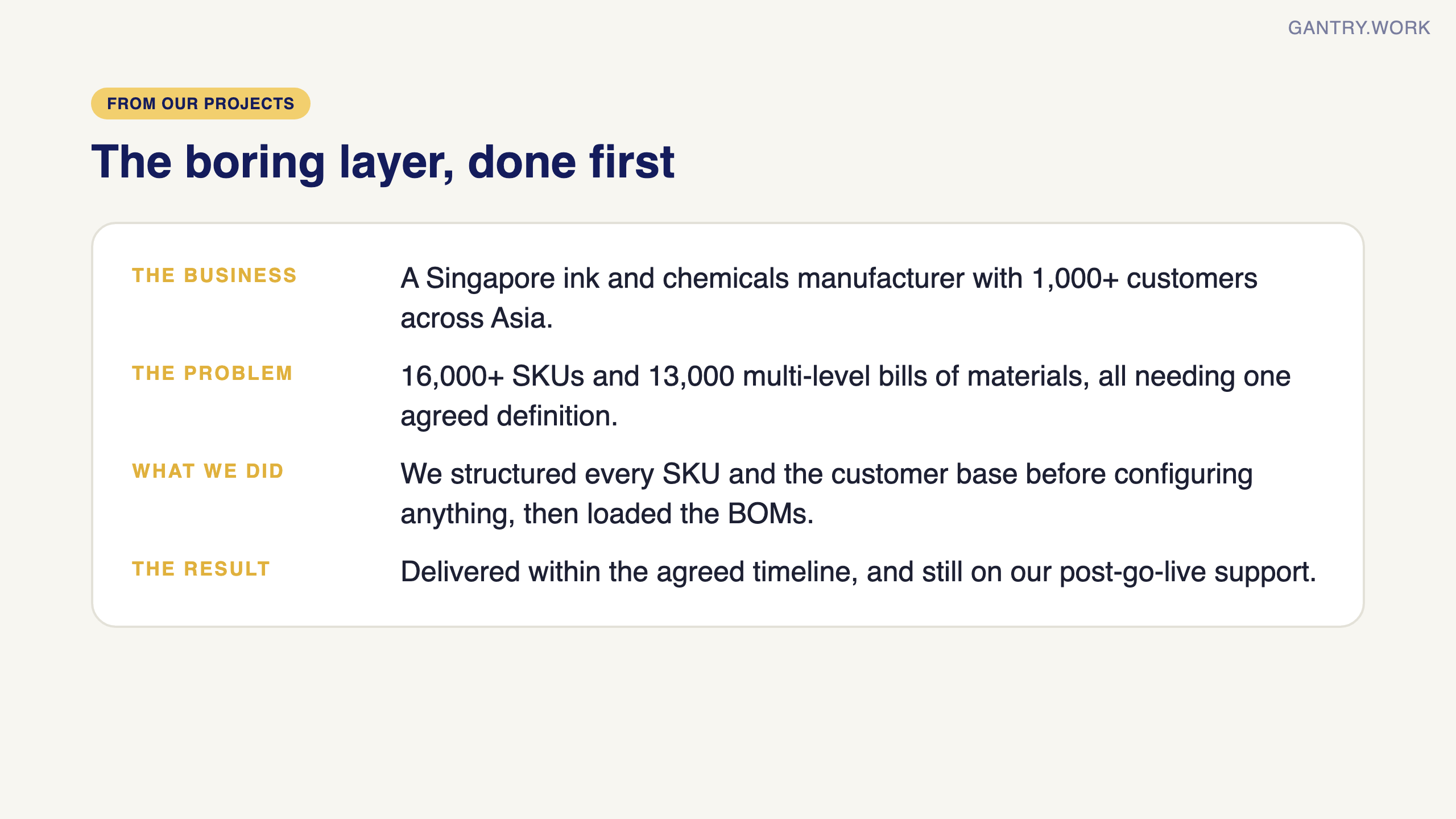
For a Singapore ink and chemicals manufacturer we implemented, the boring layer was the project. More than 16,000 SKUs, 13,000 multi-level bills of materials and over 1,000 customers across Asia each needed one agreed definition. We structured the products and customers before configuring a single workflow, then loaded the BOMs for manufacturing. It was delivered within the agreed timeline, and every report and tool since has had something reliable to read.
Our take: build the boring layer, then buy the exciting one
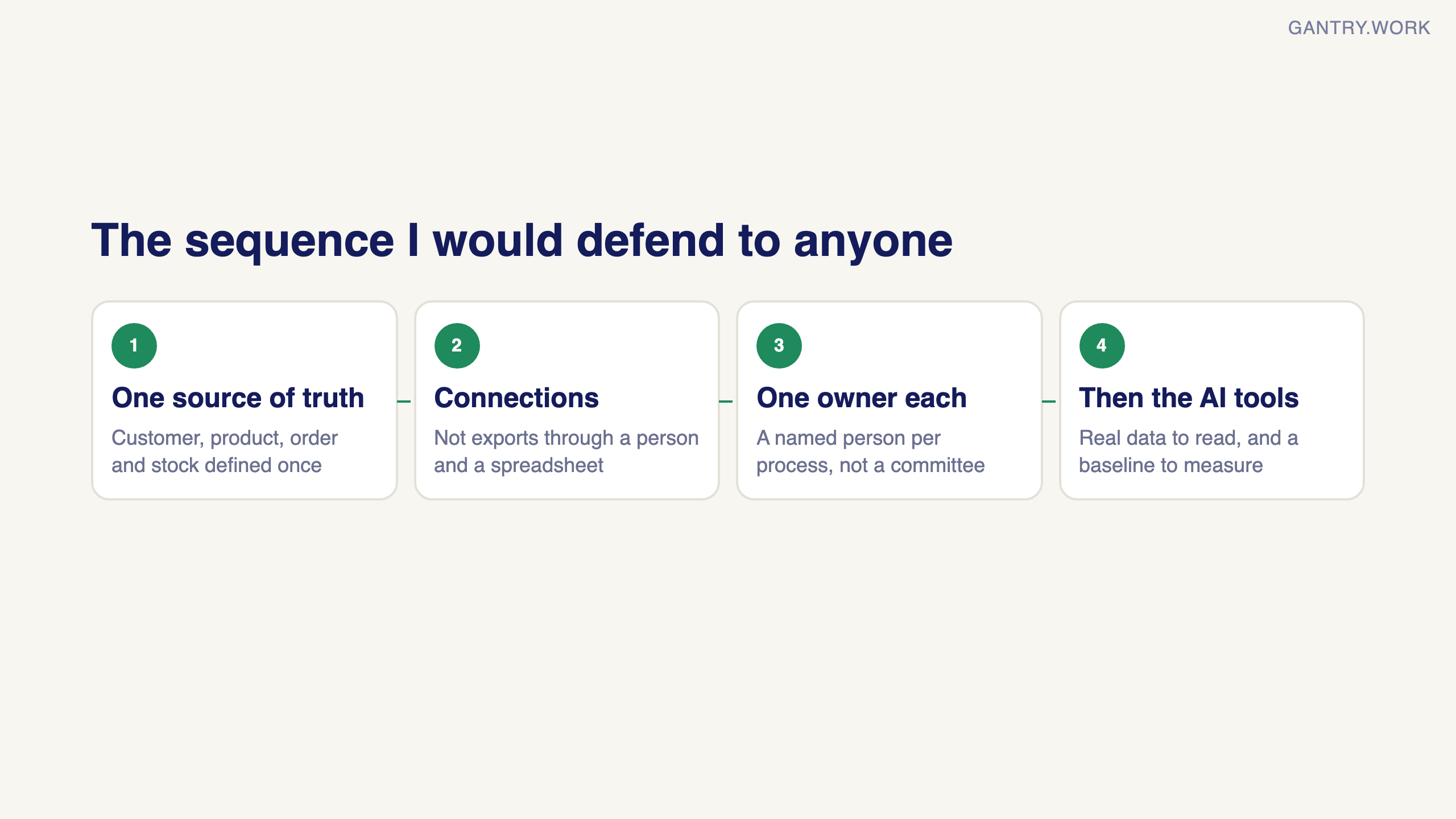
If you are deciding where the next chunk of technology budget goes, here is the sequencing I would defend in front of anyone.
First, one source of truth. One place where a customer, a product, an order and a stock level are defined once. This is what an ERP is actually for. Not features — agreement.
Second, connections instead of exports. If moving data between two systems involves a person and a spreadsheet, you do not have two systems. You have two systems and a job.
Third, one named owner per process. Not a committee. A person who decides what the rules are and is allowed to enforce them. Kearney’s "human capital" point at national scale is one person’s job description at company scale.
Fourth, and only fourth, the clever tools. By this point they have something real to read, and you can measure whether they worked, because you have a baseline.
Kearney’s warning to Indonesia is that a country can import all the technology in the world and still not convert it into growth, because conversion depends on everything around the technology.
The same is true of your business, and you will find out which side of it you are on the first time someone asks a simple question — what did we make on that customer last year — and the answer takes three days.
Of your last three technology purchases, which one can you point to a number and say it moved?
Read the original commentary on Indonesia’s AI ecosystem.
What building the boring layer looks like: getting data to land in one place, the same way, every time. Two free Make templates do this for the most common source of scattered data, the inbox: save each email to Google Sheets and file attachments into Google Drive with a log. Once that runs reliably, AI has something to work with.
Affiliate links: if you sign up to Make through them, The Gantry may earn a commission at no extra cost to you. How I test tools and how this site makes money.
Find out which layer you are missing
The ERP Readiness Scorecard is eight questions on exactly this: data, process, ownership and time. It tells you where you actually are before you spend anything.
Working on something similar? Connect with me on LinkedIn and tell me what you are working on. I read and reply to every message, and the questions people send become the next guides.
Related reading: 51% of Singapore Firms Use AI. 10% Have Changed How Work Happens
Want a second pair of eyes on your setup? Bring the process that keeps going wrong to a free 20-minute systems review. I'll tell you honestly what to fix first, or whether you need anything new yet.
How I test everything and how this site makes money: How The Gantry works.