

A costed bill of materials lists every component and operation needed to make one unit of a product, with a cost on each line: component quantities including scrap, unit costs (ideally landed), routing operations with setup and run times at work-centre rates, subcontracted steps and overhead. Rolled up level by level, it gives the unit cost.
The bill of materials and routing guide explains what BOMs and routings are and how MRP uses them. This guide is about the cost side: exactly what a costed BOM contains, how the roll-up works through several levels, how standard cost compares with what production actually spent, and the mistakes that make small manufacturers quote the wrong price.
What information is included in a costed bill of materials
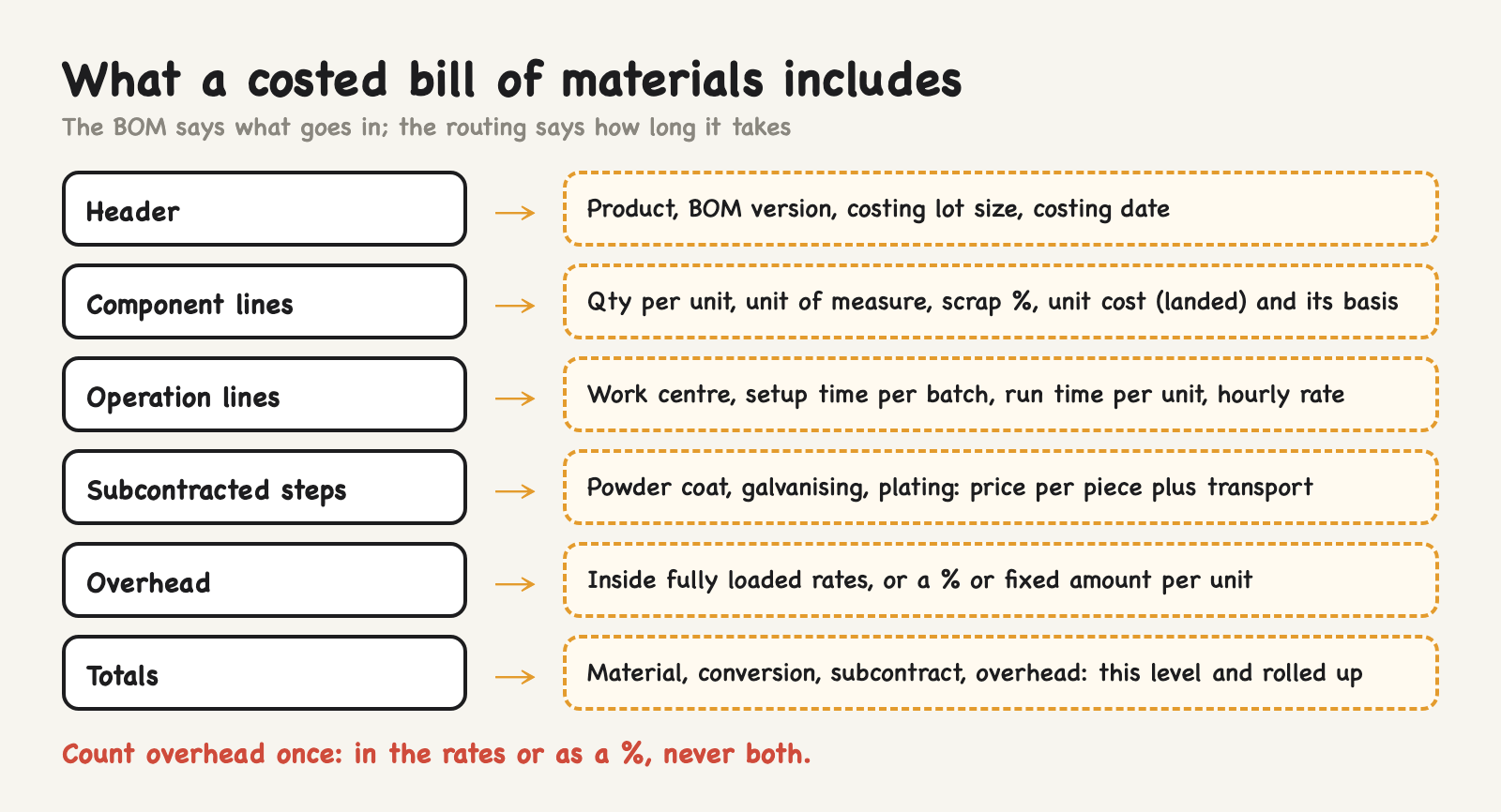
A plain BOM answers "what goes in?". A costed BOM adds "and what does each piece cost?". In most ERPs it contains:
Header: the product, the BOM version or effective date, the costing lot size (the batch quantity costs are calculated for), and the costing date.
Component lines: item code, quantity per unit, unit of measure, scrap or yield percentage, the unit cost and where it came from (standard, average, last purchase price), and the extended cost.
Operation lines from the routing: sequence, work centre, setup time per batch, run time per unit, the hourly rate, and the extended cost.
Subcontracted operations: an outside process such as powder coating or galvanising, priced per piece, plus transport and handling.
Overhead: either built into the work-centre rates or added as a percentage or fixed amount per unit.
Totals: material, conversion (labour and machine), subcontracting, overhead and unit cost, shown for this level only or rolled up through every level.
Two inputs need care. Bought-in parts should carry their landed cost, meaning supplier price plus freight, insurance, handling and any duty. And work-centre rates should be fully loaded: operator wages and CPF, machine running costs and a share of factory overhead, divided by productive hours.
What does a routing provide that a BOM does not?
The BOM gives materials and quantities. The routing gives everything to do with time: which operations, in which order, at which work centre, with how much setup and run time. That is where conversion cost comes from, and it is also what tells you how many hours each machine is loaded. In metal fabrication, the routing is usually the bigger half of the cost.
How a multi-level cost roll-up works
A cost roll-up calculates a product's cost from the bottom of its BOM upwards:
Start with purchased items. Each carries a unit cost, ideally landed.
Cost the lowest-level made items: their components plus their own routing operations.
Use that result as the component cost one level up, and add that level's operations.
Repeat until you reach the finished product.
Microsoft's Business Central documentation describes the same order: an all-levels calculation starts from the lowest-level purchased or produced items and rolls costs up through every intermediate sub-assembly to the top. A single-level calculation only re-adds the direct components of one item, which is fine when the component costs are already current.
Two details matter. A phantom sub-assembly, such as a fastener kit, passes its components straight to the parent and has no cost of its own. And under standard costing, rolling up a new cost does not change the value of stock you already hold. You post a revaluation, which in Business Central is a separate journal created when the new standards are implemented.
Worked example: BOM and routing for a metal product
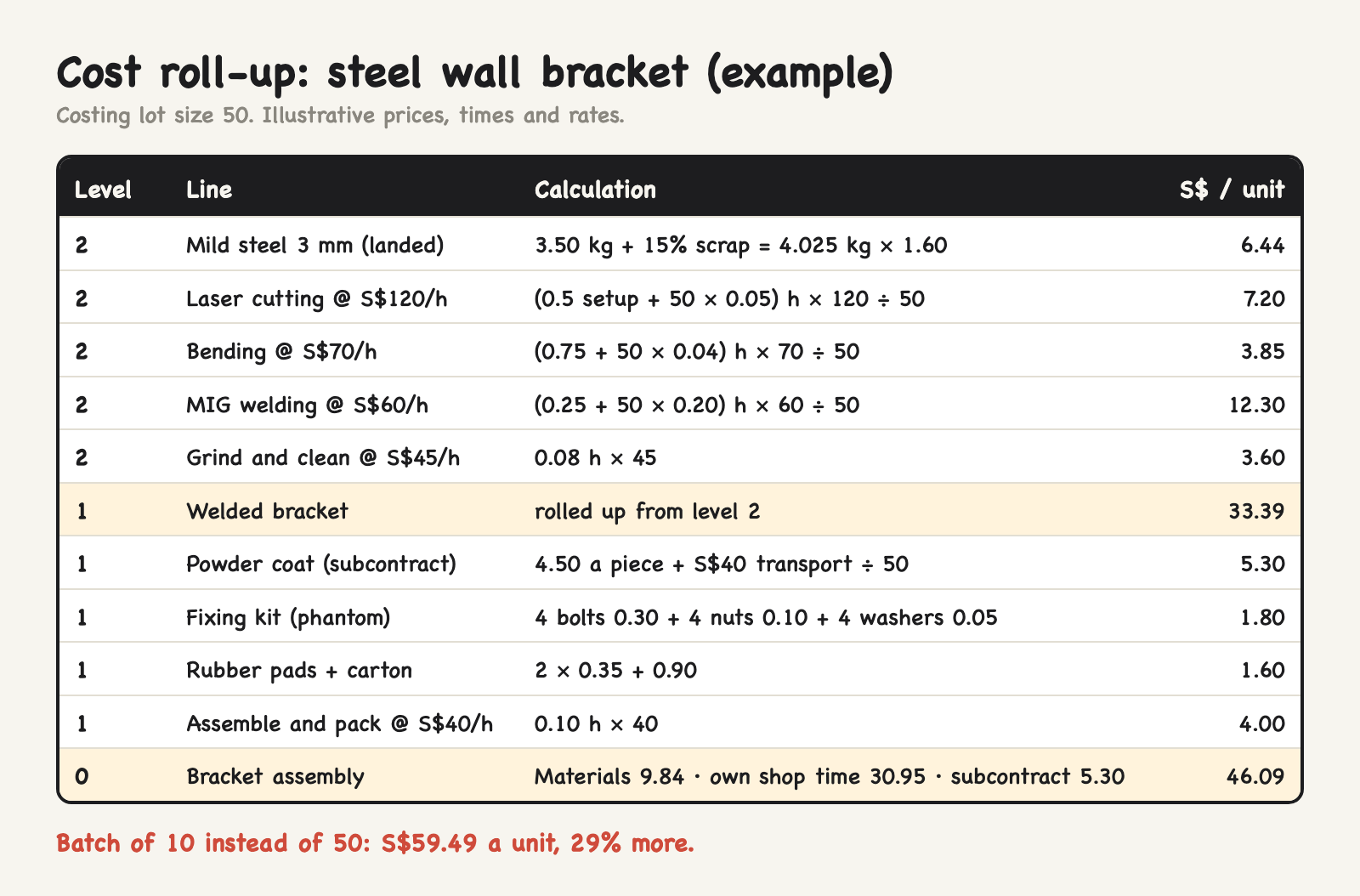
Here is an example costed BOM for a powder-coated wall bracket, as a small Singapore fabrication shop might set it up. All prices, times and rates are illustrative, not quotes. Costing lot size: 50.
Level 1: the welded bracket
Material: three laser-cut parts from 3 mm mild steel sheet (base plate 1.70 kg, upright 1.30 kg, two gussets at 0.25 kg each), 3.50 kg net. Nesting and cutting loss is set at 15%, so the BOM costs 4.025 kg. Steel is S$1.48 per kg from the supplier plus S$0.12 per kg freight and handling, a landed S$1.60 per kg. Material: 4.025 × S$1.60 = S$6.44.
Routing, per batch of 50:
Laser cutting at S$120 an hour: setup 0.5 h, run 0.05 h per unit. 3.0 h × S$120 = S$360, or S$7.20 a unit.
Bending at S$70 an hour: setup 0.75 h, run 0.04 h per unit. 2.75 h × S$70 = S$192.50, or S$3.85 a unit.
MIG welding at S$60 an hour: setup 0.25 h for the jig, run 0.20 h per unit. 10.25 h × S$60 = S$615, or S$12.30 a unit.
Grinding and cleaning at S$45 an hour: run 0.08 h per unit. 4.0 h × S$45 = S$180, or S$3.60 a unit.
Welded bracket: 6.44 + 7.20 + 3.85 + 12.30 + 3.60 = S$33.39.
Level 0: the finished bracket assembly
Welded bracket: S$33.39
Powder coating, subcontracted: S$4.50 a piece plus S$40 transport per batch (S$0.80 a unit) = S$5.30
Fixing kit, a phantom: 4 bolts at a landed S$0.30 (S$0.26 plus S$0.04 freight), 4 nuts at S$0.10, 4 washers at S$0.05 = S$1.80
Rubber pads: 2 × S$0.35 = S$0.70
Carton: S$0.90
Assemble and pack at S$40 an hour, 0.10 h a unit: S$4.00
Unit cost: 33.39 + 5.30 + 1.80 + 0.70 + 0.90 + 4.00 = S$46.09.
What the roll-up tells you
Materials are S$9.84, only 21% of the cost. Own shop time is S$30.95, 67%, and subcontracting S$5.30, 12%. A shop that quotes "materials plus 100%" would price this bracket at about S$19.70 and lose money on every one.
Now cost a rush order of 10 instead of 50. The setups and the coating transport are spread over fewer units: laser S$6.00 a unit instead of S$1.20, bending S$5.25 instead of S$1.05, welding S$1.50 instead of S$0.30, transport S$4.00 instead of S$0.80. The unit cost rises by S$13.40 to S$59.49, 29% more. If your system always costs at 50, small orders look more profitable than they are. Once the true cost is known, the margin vs markup guide helps set the price.
What is different about BOMs for metal products
You buy by sheet or kg and consume by weight or piece, so units of measure and conversions have to be right on the product record.
Nesting loss is scrap. And 15% scrap is not the same as 85% yield: 3.50 kg × 1.15 = 4.025 kg, but 3.50 kg ÷ 0.85 = 4.12 kg. On this bracket that is S$0.15 a unit. Know which one your system uses.
Consumables such as welding wire, gas and grinding discs either go into the work-centre rate or onto the BOM as non-stock lines. Pick one, not both.
Outside finishing (powder coat, galvanising, plating) belongs in the routing as a subcontracted operation, with its transport.
Imported fasteners and sections need landed cost. In Singapore, most imports pay GST but no customs duty: Singapore Customs lists only liquor, tobacco, motor vehicles and petroleum products as dutiable. Import GST that a GST-registered business can claim back stays out of cost.
Standard cost vs actual cost, and what variances mean
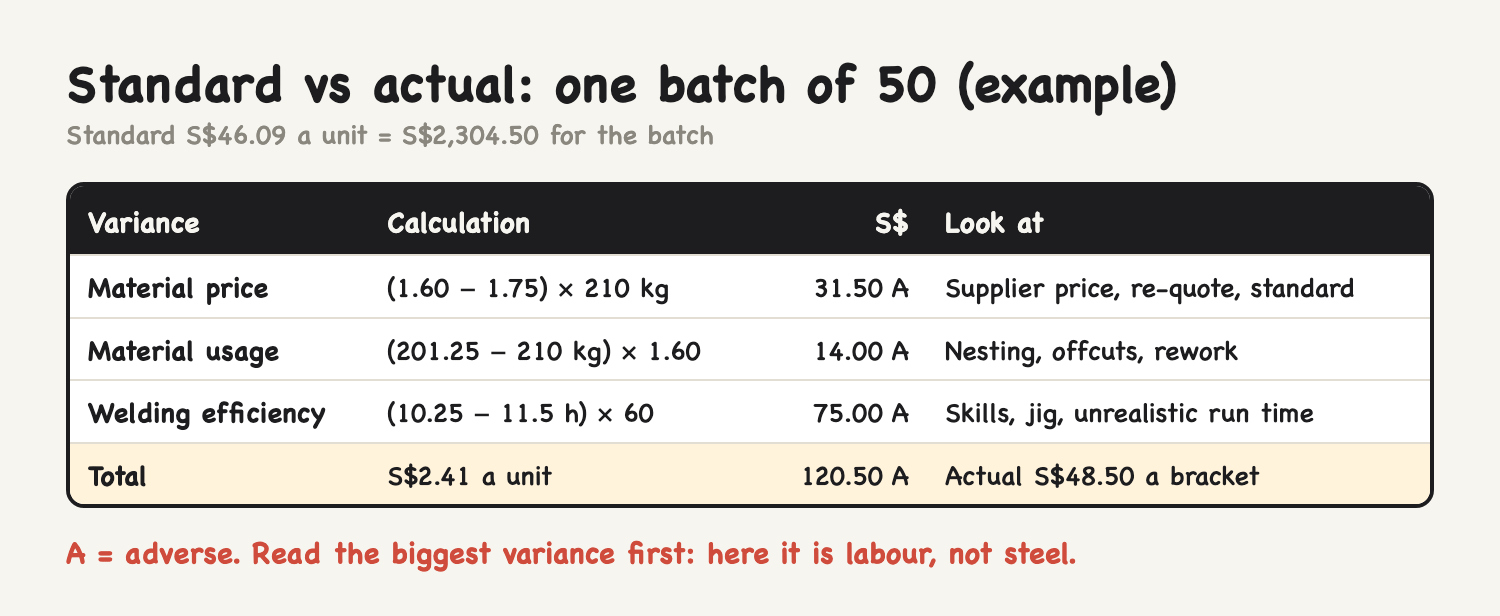
A standard cost is the costed BOM frozen as the yardstick, S$46.09 here. Actual cost is what the batch really consumed. The accounting standard (SFRS(I) 1-2 in Singapore, which is based on IAS 2) allows standard cost for valuing inventory if the result approximates actual cost, and says standards should reflect normal levels of materials, labour, efficiency and capacity, and be reviewed regularly. It also excludes abnormal waste from inventory cost, and spreads fixed overhead over normal capacity, so a slow month should not inflate your rates.
Example batch of 50 in November. Steel arrived at S$1.75 per kg instead of S$1.60, the batch used 210 kg instead of the standard 201.25 kg, and welding took 11.5 hours instead of 10.25:
Material price variance: (S$1.60 − S$1.75) × 210 kg = S$31.50 adverse. A purchasing or market question: re-quote, or update the standard.
Material usage variance: (201.25 − 210 kg) × S$1.60 = S$14.00 adverse. Look at nesting, offcuts and rework.
Welding efficiency variance: (10.25 − 11.5 h) × S$60 = S$75.00 adverse. A new welder, a worn jig, or a run time that was never realistic.
Total: S$120.50 adverse, S$2.41 a unit, so the batch actually cost S$48.50 a bracket. Read the biggest variance first; here it is labour, not steel.
If your system values stock at average or FIFO cost instead of standard, no variances are posted, but the same comparison works: costed BOM against the work order's actual consumption. The difference between the methods is in FIFO vs weighted average.
How often to re-roll costs
There is no fixed rule. Business Central's documentation says standard costs stay frozen until a decision is made to change them. What I set up on projects:
A full roll-up once a year, before budgets and price lists are set.
An extra roll-up when a major material moves by more than about 5%, when work-centre rates change (annual wage increases, a new machine), or when a routing or supplier changes.
A monthly look at variances. If the same component or work centre is off by more than 5% two months running, the standard is wrong, not the shop.
Mistakes I see in small manufacturers
No scrap on sheet and bar material, so every batch runs short and every cost is low.
Purchase prices from two years ago sitting on the product record.
Setup time left out, or costed at a lot size you never actually run.
Labour-only rates that miss machine running cost and overhead.
Supplier price instead of landed cost on imported parts.
Rolling up one level after a component changed, so the finished product still shows the old cost.
Overhead counted twice, once in the rates and again as a percentage.
If every order is a one-off, the costed BOM is your estimate and the real numbers live in job costing; job costing software for small business covers that side.
FAQ
What information is included in a costed bill of materials?
Components with quantities, units, scrap and unit costs; routing operations with work centres, setup and run times and rates; subcontracted operations; overhead; and totals per level and rolled up.
What is a cost roll-up?
The calculation that builds a product's cost from the bottom of its BOM upwards, costing each sub-assembly first and using that cost one level up, until it reaches the finished product.
What is a costed BOM inquiry?
A report that shows the BOM tree with a cost on every line and a subtotal per level. Names vary by ERP; Business Central, for example, has a BOM Cost Shares page.
Should a costed BOM use standard, average or last purchase cost?
Use standard cost for quoting and variance control in repetitive production. Average or FIFO cost follows real purchase prices. Last purchase price swings with every order, so be careful quoting from it.
How do you include scrap in a costed BOM?
Add a scrap percentage to the component line, and the system increases the quantity it plans and costs. Use a yield percentage only if your system is built around yield.
The bottom line
A costed BOM is only as good as its scrap rates, landed prices and routing times. Get those three right, re-roll when they move, and you will know what each product costs before you quote it.
Quoting from material cost and hoping the shop time works out? I do a free 20-minute systems review. No pitch, just your questions answered.
The bracket, its prices, times and rates are an illustrative example, not a real product or quote. Accounting points are general information based on IAS 2 / SFRS(I) 1-2 as of October 2026; check your own case with your accountant.
I'm Sayed. I help business owners automate their operations and set up the systems behind them: ERP, accounting, inventory, CRM and workflows. I write The Gantry about what actually works.