

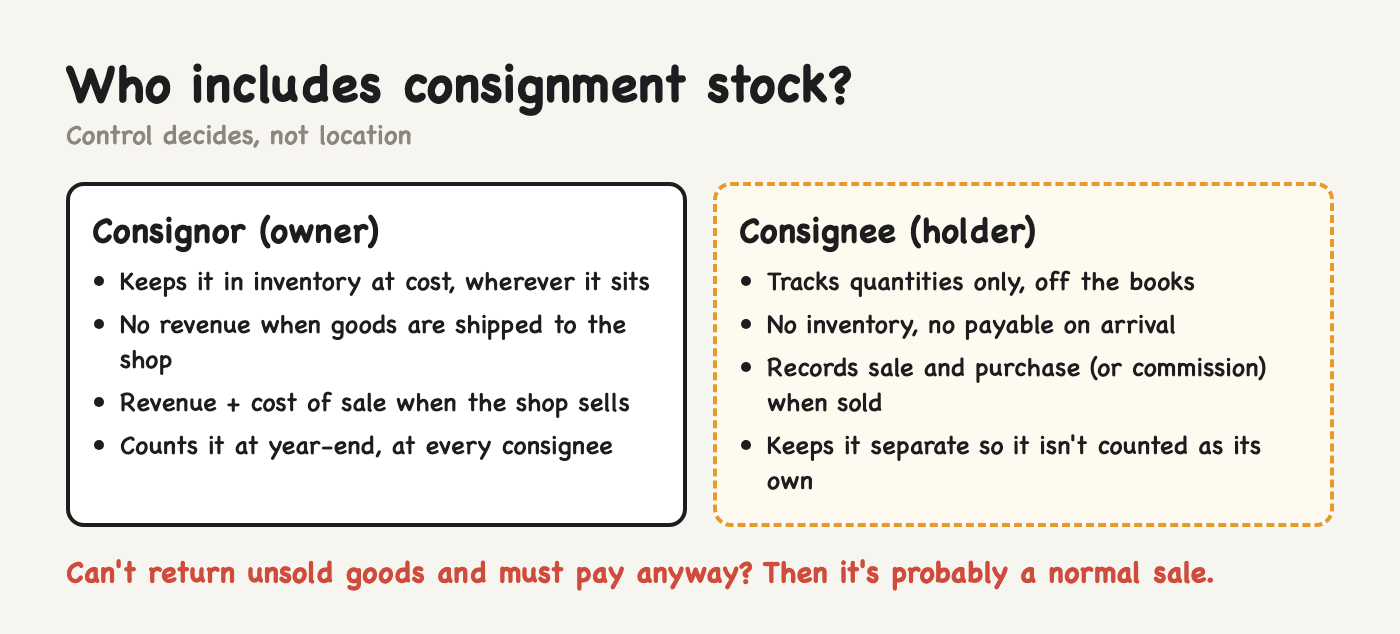
Consignment stock stays in the owner's inventory until it is sold to the end customer. So the consignor (the supplier who sends the goods) includes it in inventory, and the consignee (the shop or distributor holding it) does not. The consignee keeps track of the quantities, because it is responsible for the goods while they are on its premises, but it doesn't put them on its balance sheet or record a purchase until the goods are sold or it otherwise becomes obliged to pay.
That one rule causes a surprising amount of trouble in practice: stock counted twice, stock counted by nobody, sales recognised too early, and "missing" units that were actually sold weeks ago. Here is how to account for it and track it properly.
Who includes consignment stock in inventory?
Consignment shows up in two directions for most SMEs:
You are the consignor. You place your goods in a department store, minimart, pharmacy or another company's warehouse. They sell, report and pay you, less commission. Common for brands, food producers and importers.
You are the consignee. A supplier places stock in your warehouse or shop, and you pay only for what you sell or use. Common for spare parts, medical supplies, and some retail.
The accounting follows control, not location. Under SFRS(I) 15 (the Singapore equivalent of IFRS 15), the signs that an arrangement is a consignment are that the supplier controls the goods until a specified event (usually the sale to the end customer), the supplier can require the goods back or move them to someone else, and the consignee has no unconditional obligation to pay for them (even if it has paid a deposit).
So:
Consignor: keep the goods in inventory at cost, wherever they physically are. Don't recognise revenue when you ship them to the consignee.
Consignee: don't record inventory or a payable when the goods arrive. Track the quantities off the books. Record the purchase (or the commission income, depending on the arrangement) when the goods are sold.
If the paperwork says "consignment" but the shop can't return unsold goods and must pay within 60 days regardless, it is probably a normal sale, whatever the contract is called. Look at the substance.
How goods and money move
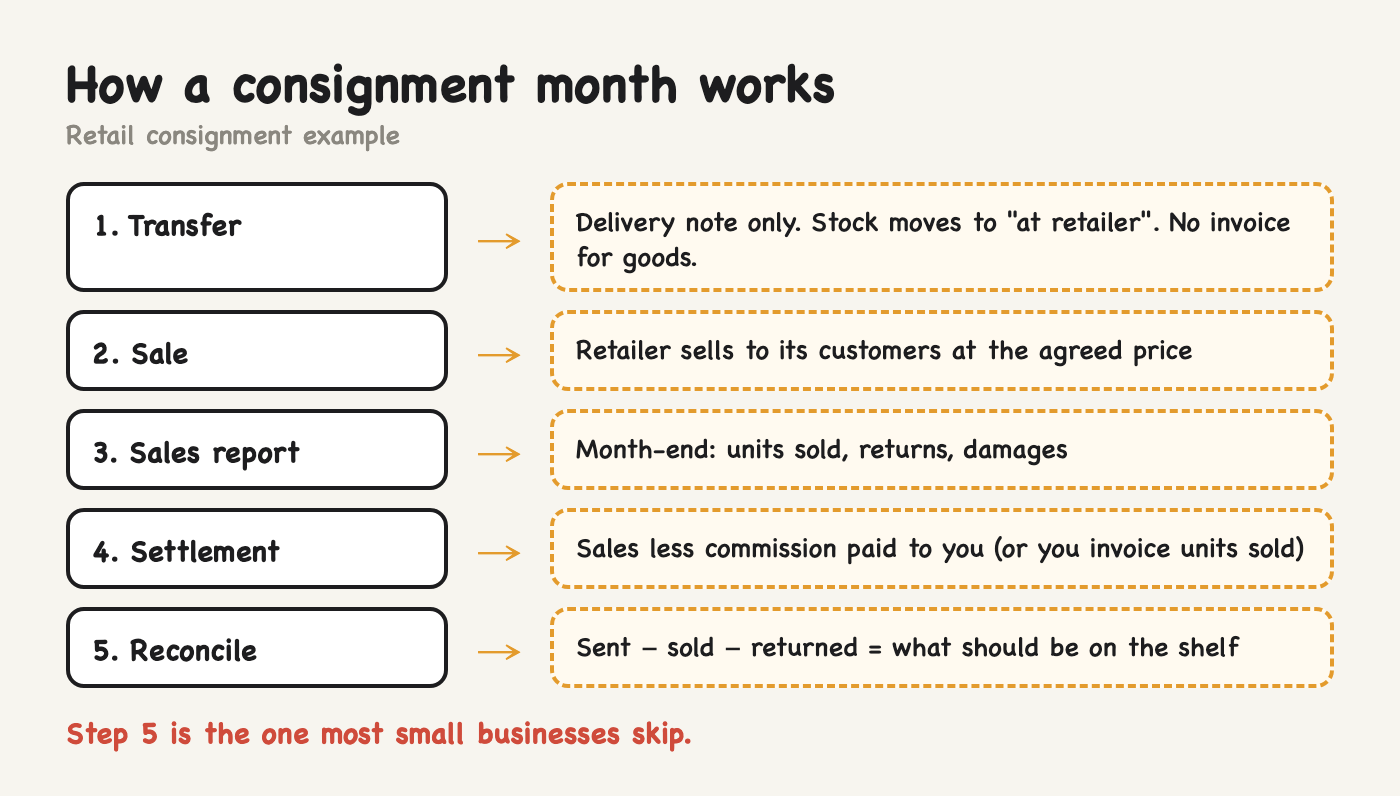
A typical retail consignment month:
Transfer. You deliver 100 units to the store. A delivery note goes with them, but no invoice for the goods.
Sale. The store sells units to its customers at the agreed retail price.
Sales report. At month-end, the store sends a report of units sold (and any returns or damages).
Settlement. The store pays you the sales value less its commission, or you invoice the store for the units sold, depending on how the contract is written.
Reconciliation. You compare what you sent, what they say they sold, and what should still be on their shelf.
Step 5 is the one most small businesses skip, and it is where consignment stock disappears.
Consignment stock accounting: a worked example
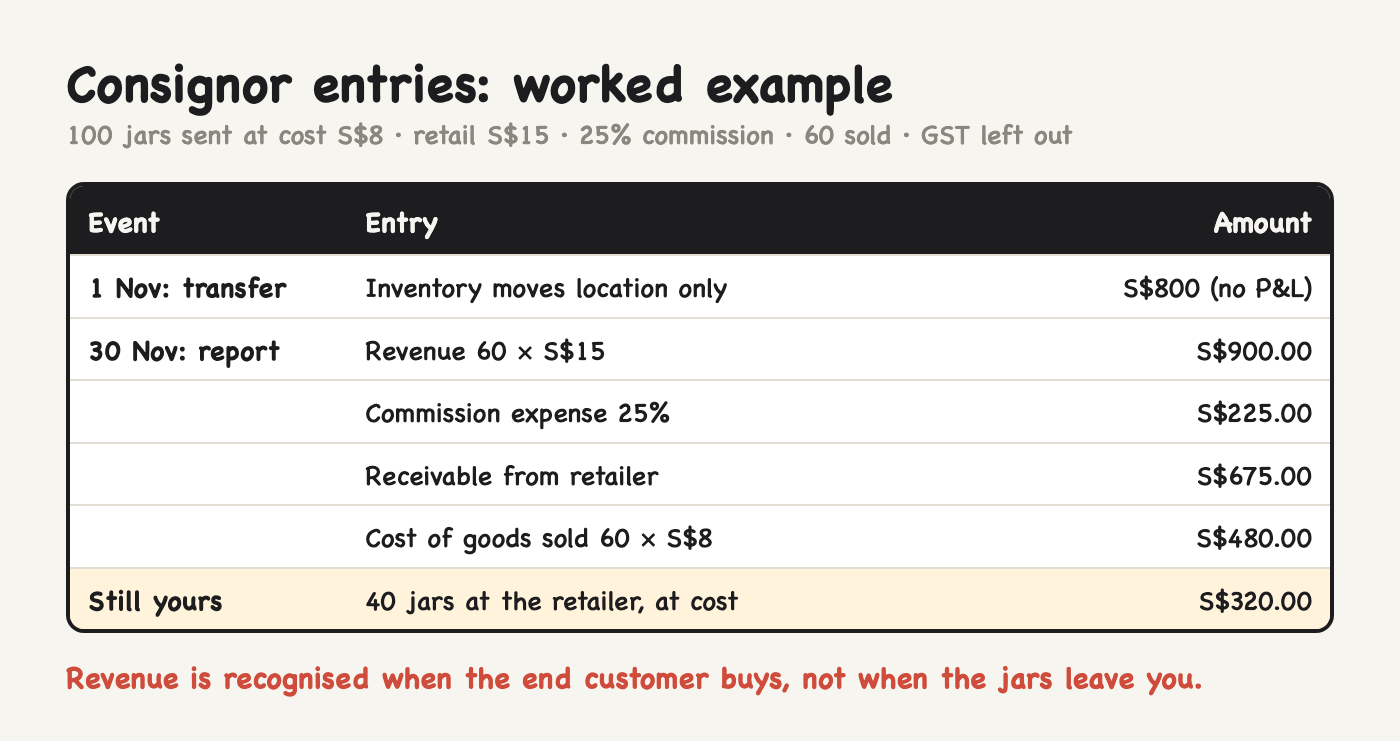
You are a food brand. On 1 November you send 100 jars of sambal, cost S$8.00 each, to a retailer on consignment. Retail price is S$15.00. The retailer keeps 25% commission. By 30 November it reports 60 jars sold. (GST is left out to keep the example readable; your tax adviser should confirm the GST treatment for your arrangement.)
1 November: transfer to the retailer. No sale. Move S$800 of inventory from "Warehouse" to "Stock at retailer" (or simply track the location in your inventory system). The balance sheet is unchanged.
30 November: sales report received.
Revenue: 60 × S$15.00 = S$900.00
Commission expense: 25% × S$900 = S$225.00
Receivable from retailer: S$900 − S$225 = S$675.00
Cost of goods sold: 60 × S$8.00 = S$480.00, out of inventory
Still in your inventory, at the retailer: 40 × S$8.00 = S$320.00
Some arrangements are written differently: the retailer "buys" each unit at S$11.25 when it sells it, and there is no commission line. The cash is the same; the revenue shown is S$675 instead of S$900. Use whichever matches your contract and apply it consistently.
On the retailer's side: nothing on 1 November except a stock record. On 30 November it records sales of S$900, and either a purchase of S$675 (if it buys on sale) or commission income of S$225 (if it acts as agent).
Consignment inventory tracking spreadsheet
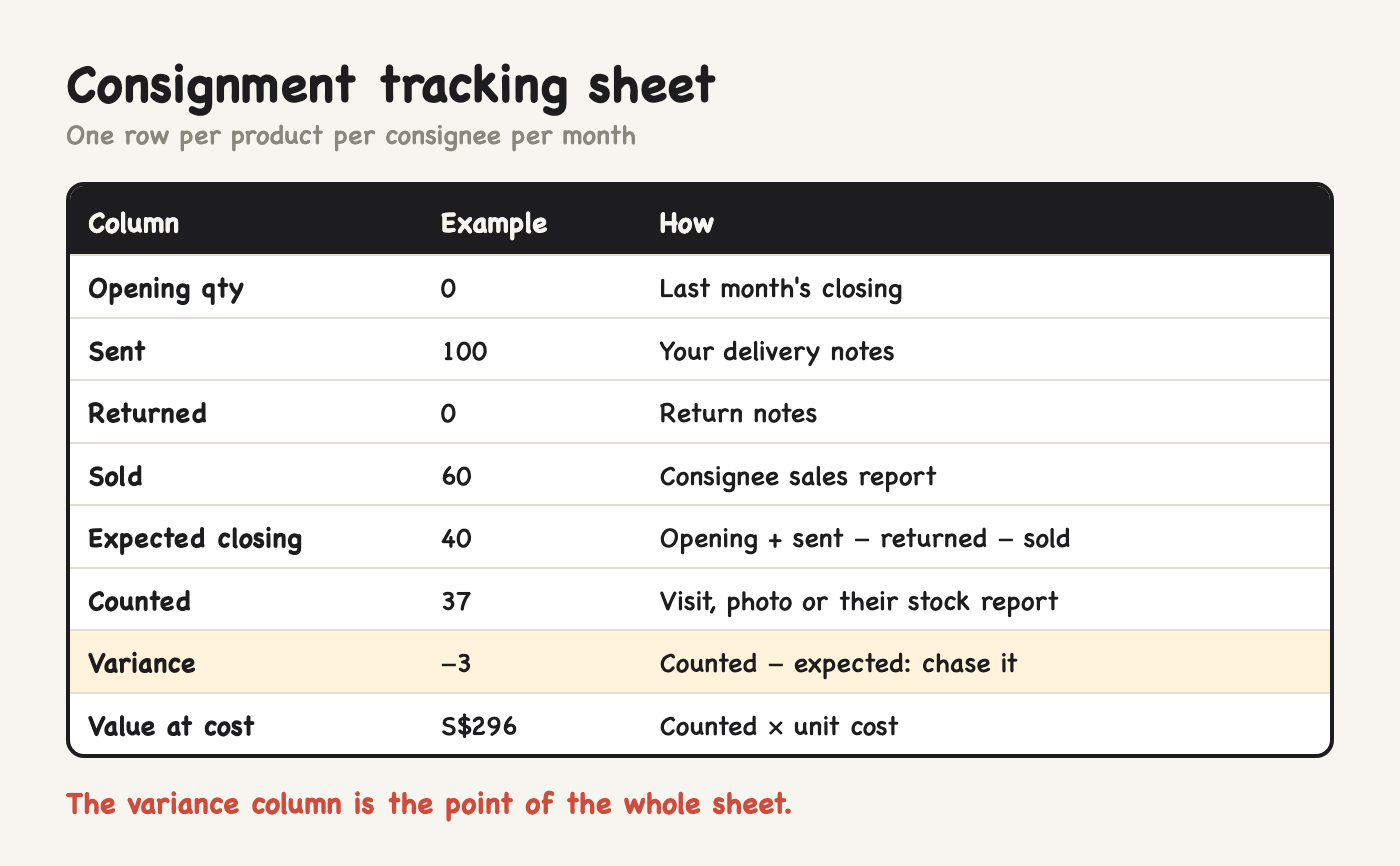
If you have a handful of consignees, a spreadsheet works, as long as it reconciles. One row per product per consignee per month, with these columns:
Opening quantity (last month's closing)
Sent this month (from your delivery notes)
Returned to you this month
Sold per the consignee's sales report
Expected closing = opening + sent − returned − sold
Counted at the consignee (from a visit, a photo or their stock report)
Variance = counted − expected
Value at cost of the closing quantity
Sales value, commission, amount due
The variance column is the point of the whole sheet. A steady negative variance at one store usually means shrinkage, unreported sales or damaged goods thrown away. Agree in the contract who bears shrinkage and damage, and how often you can count.
Two warnings. Expiry and seasonal stock at a consignee is still your problem, so watch the dates. And at your year-end, make sure the consignment stock at every store is in your stock figure, valued at cost, because your auditor will ask. If you value stock at weighted average cost, the same cost applies wherever the stock sits; FIFO vs weighted average explains the difference.
When you are the consignee
Supplier consignment in your warehouse can be great for cash flow: you hold spare parts or fast-moving items without paying for them until they are used. The risks run the other way:
Mark consignment stock clearly and keep it in its own locations, so your team doesn't count it as yours at a stock take.
Record usage the day it happens. Most suppliers invoice you from your usage report, so a late report means a disputed invoice.
Agree what happens to damaged, expired or obsolete consignment items.
Spreadsheet or system?
A spreadsheet holds up to around five consignees and a few dozen SKUs. Past that, consignment works much better inside your inventory system: each consignee becomes a stock location you own, transfers move stock between your locations without a sale, and the sales report is entered as a delivery from that location, which creates the cost of sale and the invoice in one step. For consignee-side stock, most ERPs let you record the owner of the stock, so it is counted but not valued as yours.
If you sell through distributors and retailers, consignment is one of the five flows that decide which system a trading company needs. And if your stock is still periodic rather than perpetual, start with perpetual vs periodic inventory, because you can't reconcile consignment stock against a number you only know once a year.
How many places is your stock sitting today that aren't your own warehouse?
General information, not accounting or tax advice. Check how SFRS(I) 15 and GST apply to your contracts with your accountant. The example uses a fictional company.
I'm Sayed. I help business owners automate their operations and set up the systems behind them: ERP, accounting, inventory, CRM and workflows. I write The Gantry about what actually works.