

This case study is anonymised. The engagement is real and the mechanics and figures are accurate in substance, but the company, sector detail and identifying specifics have been changed. Nothing here identifies a particular business.
A Singapore engineering manufacturer was moving its accounting off one cloud system and onto another. The fixed-asset register was supposed to be the easy part of the job — export the list, import the list, reconcile, done.
It was not the easy part. It was the part that found a hole.
The case in 50 seconds
The short version: reconciling the fixed-asset register to the ledger, class by class, found 25 assets with no cost in the accounts. Here is how they went missing, what we changed, and the check worth running this month.
The situation, in numbers
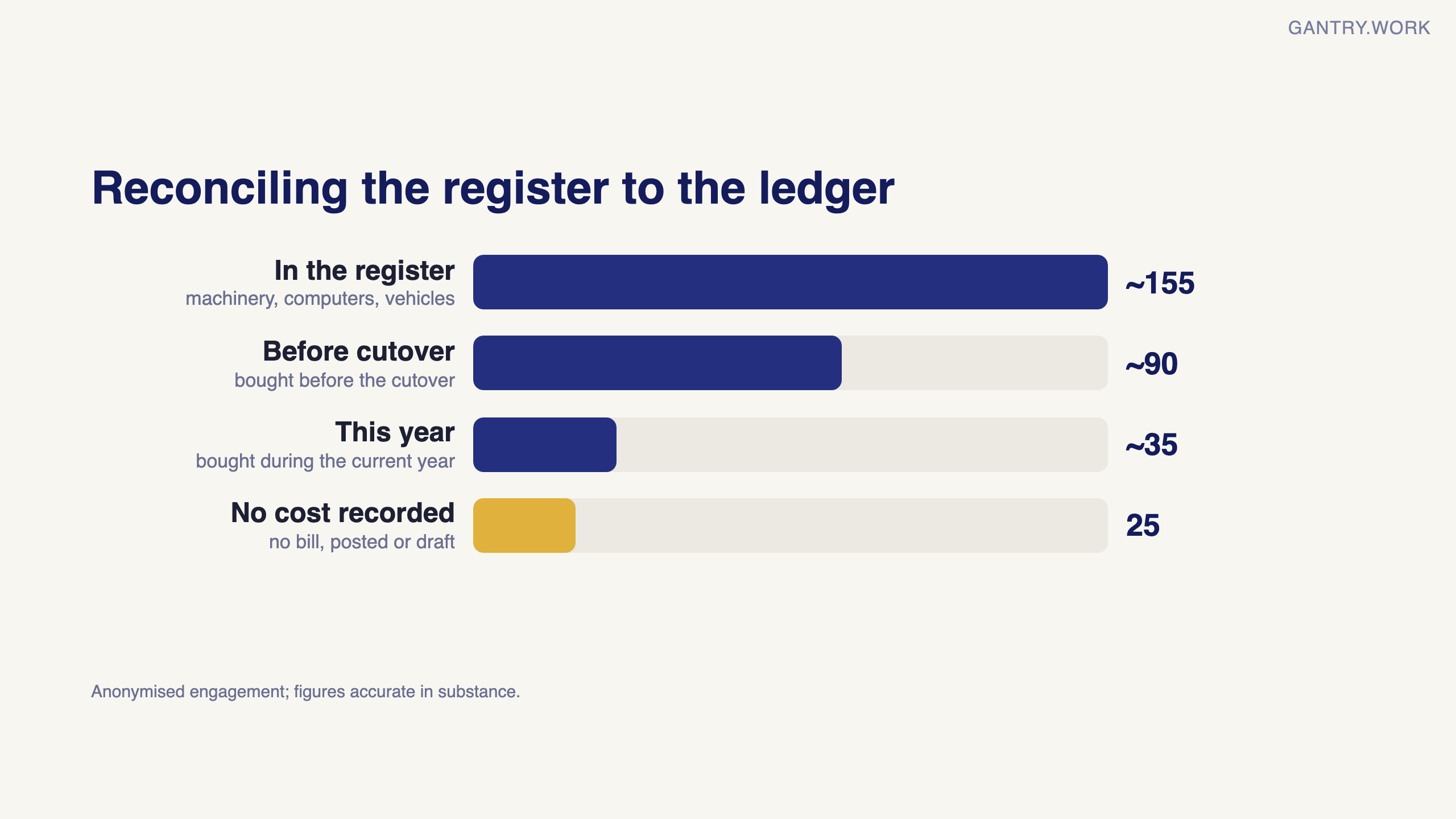
The register held around 155 assets — machinery, computers, vehicles, specialised equipment. Of those, about 90 were bought before the cutover and 35 during the current year.
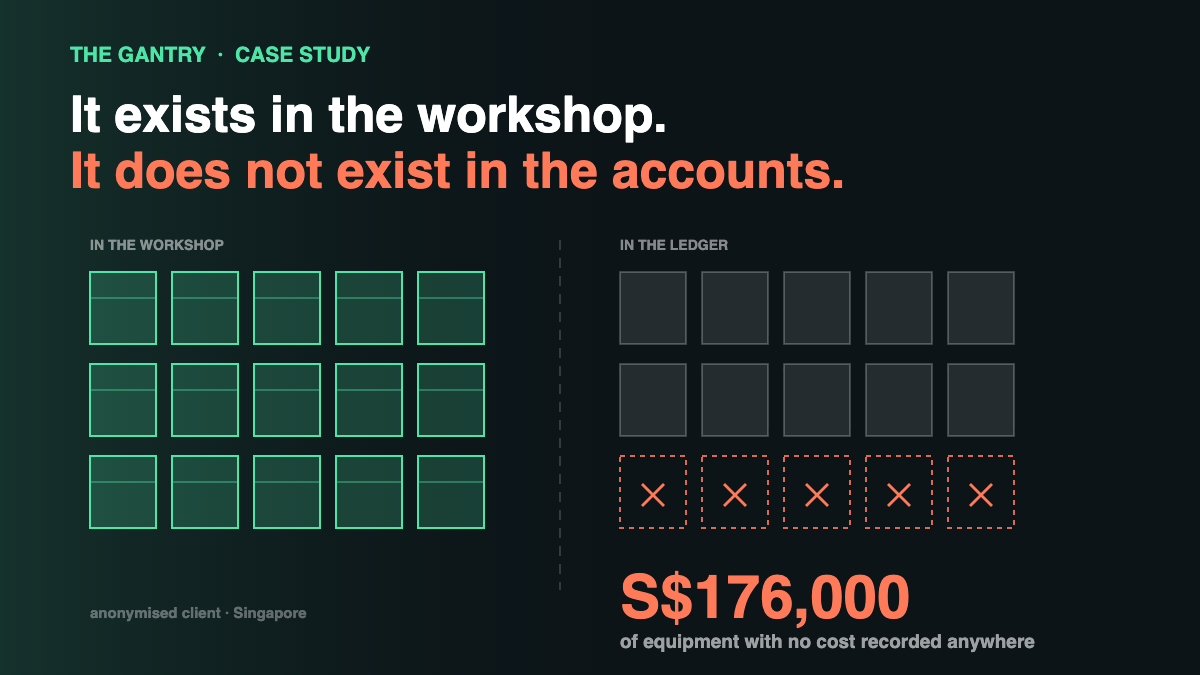
When we reconciled the register against the general ledger, 25 assets worth roughly S$176,000 had no cost recorded anywhere in the accounting system. No vendor bill, posted or draft. Nothing.
The equipment was real. You could walk into the workshop and touch it. It simply did not exist financially.
What everyone assumed the problem was
The assumption was that the export was incomplete — that the old system had dropped some rows, or that the file needed re-running.
It had not. The export was fine. The register was fine. What was missing was on the accounting side, and it had been missing for months.
The causes turned out to be three ordinary things, none of them dramatic:
Bills that were never entered. Equipment arrived, went into service, and the supplier invoice sat in someone’s inbox.
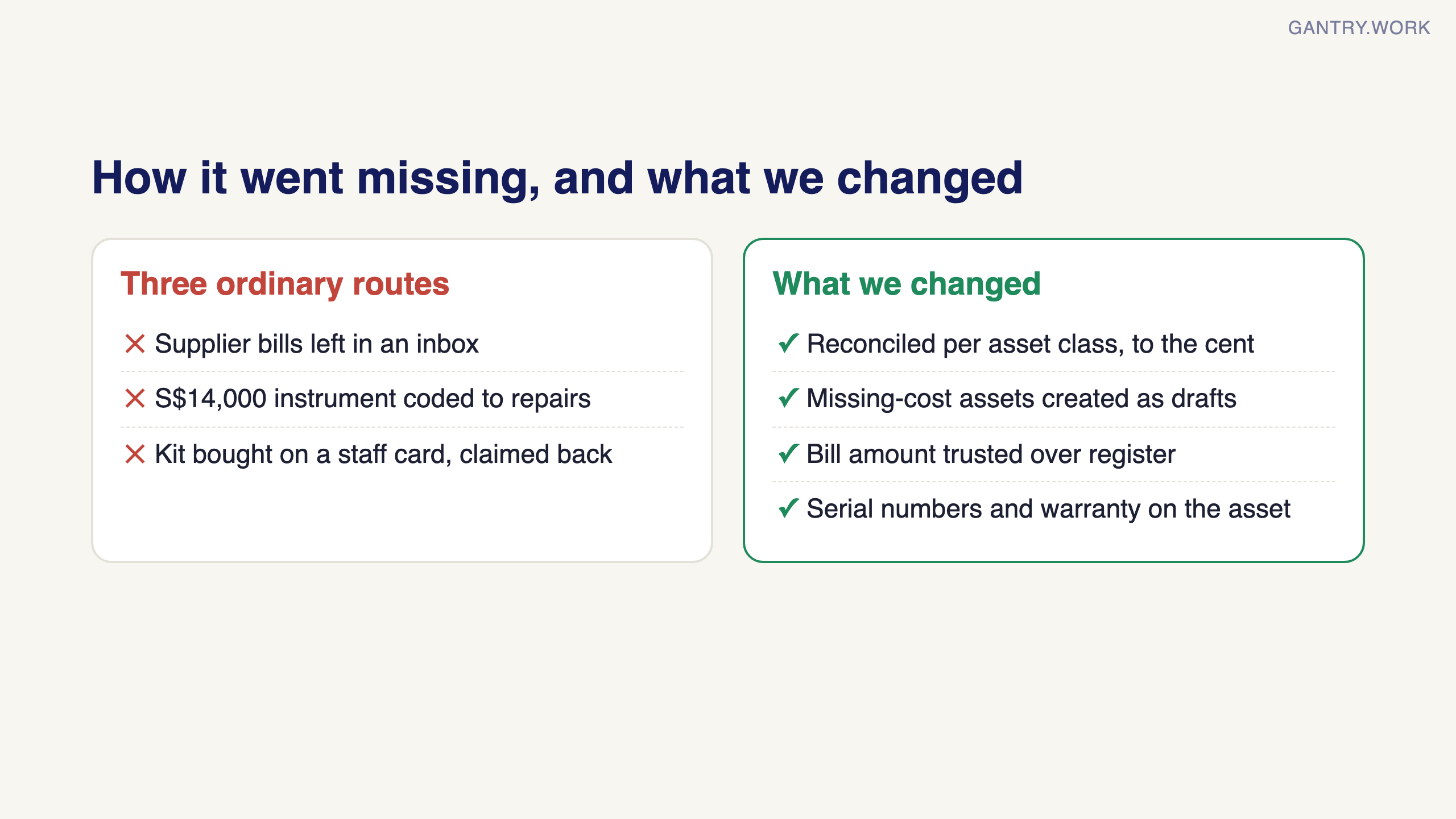
Capital items expensed by mistake. A S$14,000 instrument coded to repairs and maintenance because that is where similar-sounding things usually go.
Purchases made through employee claims. Someone bought a piece of kit on their own card, claimed it back, and it was booked as a staff reimbursement. No asset, no depreciation, no register entry.
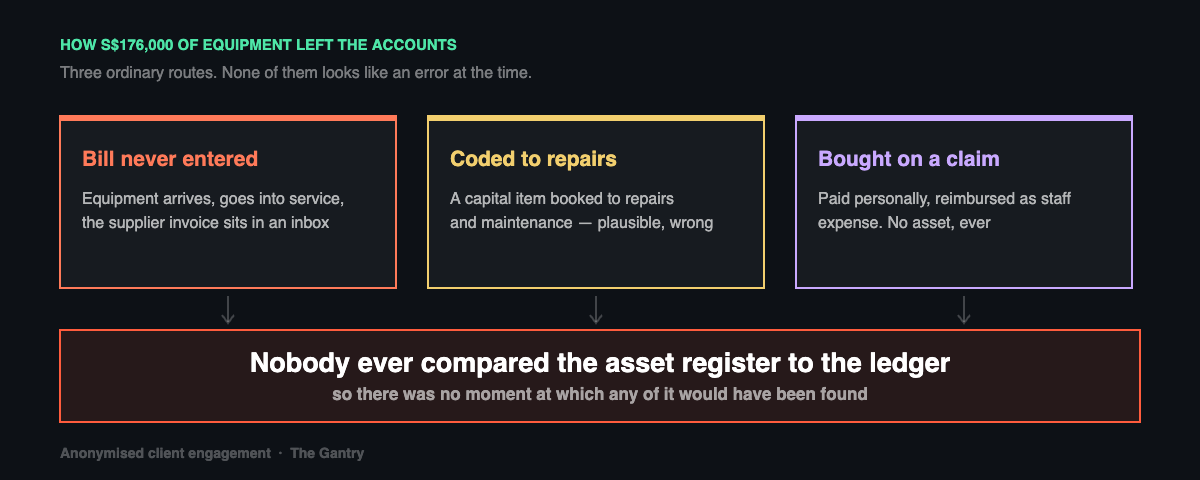
None of that is incompetence. It is what happens when the person who buys equipment and the person who maintains the asset register are different people who never speak. The register and the ledger had never been reconciled against each other, so there was no moment at which anyone would have found out.
Why it actually matters
Three consequences, in ascending order of seriousness.
Your profit is wrong. Capital items expensed to repairs understate this year’s profit and overstate next year’s. Small individually, material at S$176,000.
Your balance sheet understates the business. If you are raising finance, being acquired, or renewing insurance, you are presenting yourself as owning less than you do.
And the depreciation was never charged. Roughly S$11,000 of it, missing across seven months, on assets that had been in service the whole time.
What we actually changed
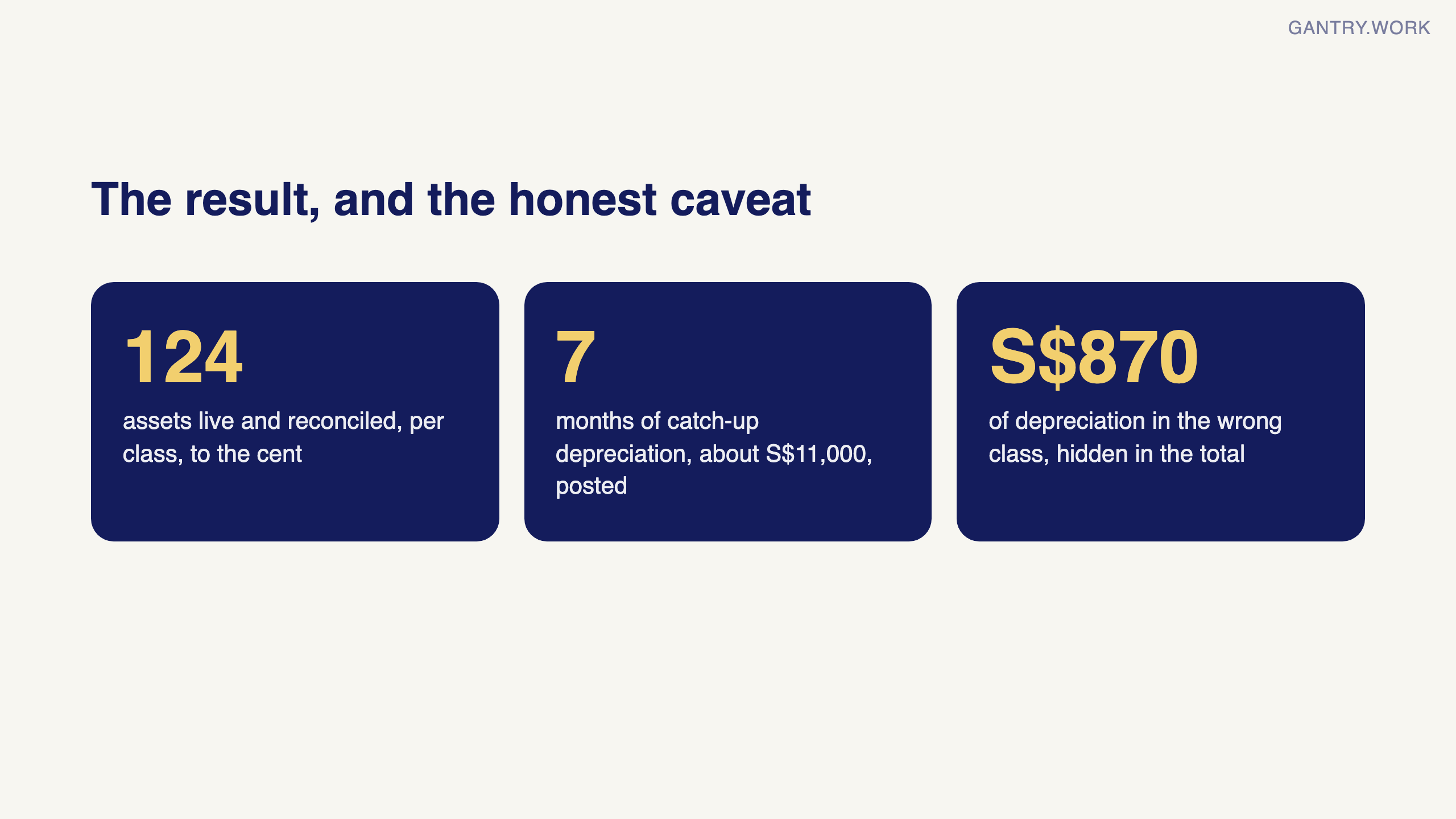
We reconciled register to ledger, per asset class, to the cent. Not in aggregate — per class. Aggregate reconciliation hides offsetting errors, and this engagement had one: about S$870 of accumulated depreciation classified against the wrong asset class. Two errors that cancelled out in total and were both wrong.
We created the 25 unfunded assets as drafts, not live records. A draft has no accounting impact. That let the client see exactly what was claimed to exist, with values and serial numbers, and decide item by item — without anything hitting the books before the cost side was fixed.
We used the bill amount, not the register amount, wherever both existed. Where an asset did have a matching supplier bill, the two figures sometimes differed by a few hundred dollars because of exchange rates and GST timing. The accounting system has to agree with the accounting system. The register is a record of things, not the authority on their value.
We added serial numbers and warranty expiry to the asset record. Not an accounting requirement. But the operations team had been keeping that in a separate spreadsheet, and moving it in meant one less parallel list to maintain.
The result, and the honest caveat
124 assets went live and reconciled, per class, to the cent. Seven months of catch-up depreciation posted correctly. The register and the ledger now agree, and there is a monthly check that keeps them agreeing.
The caveat is significant and worth stating plainly: the 25 missing-cost assets were not resolved by me, and could not be. Each one needs a decision — find the bill, enter it, or reclassify what was wrongly expensed — and those are the client’s and their accountant’s calls, not a consultant’s. They went live as drafts and stayed there.
So the honest scorecard is: I found the hole, sized it, and made it actionable. Closing it was work that had to happen inside the business. Anyone promising to fix this end-to-end without your finance team doing the reclassification is either overselling or about to post entries they should not.
What I would do differently
A genuine error, caught before it did damage but only just.
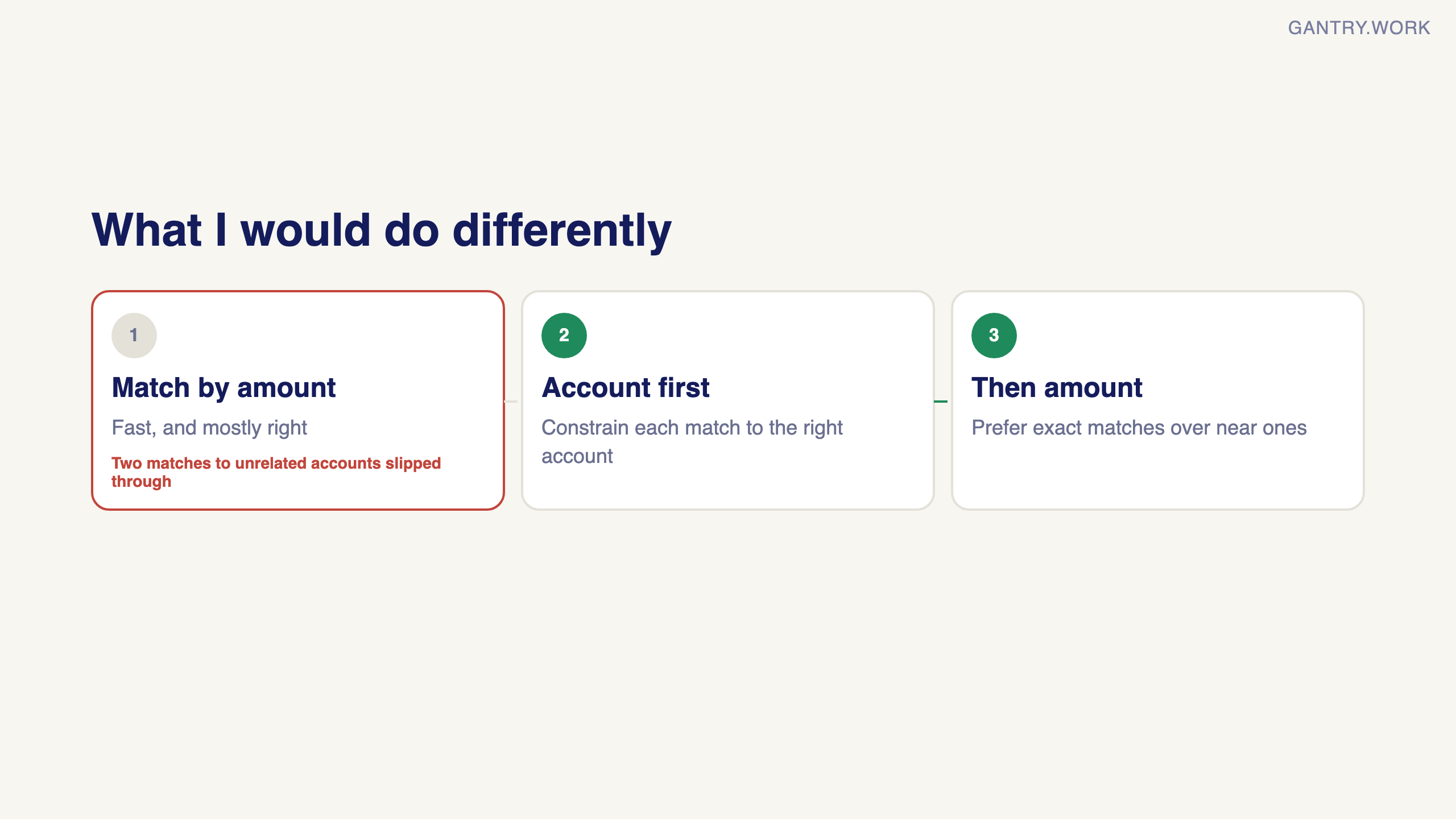
To link assets to their original purchase bills, I first matched them by amount alone. Find a bill line for S$8,450.64, match it to the asset for S$8,450.64. Fast, and mostly right.
Mostly. It also confidently matched assets to bill lines in completely unrelated accounts — a piece of equipment linked to a line that happened to share its value but belonged to a different category entirely. Two of those slipped through before I caught them on review.
The fix: constrain the match by account first, then by amount, and prefer exact matches over near ones. Obvious in hindsight. The reason it bit me is that amount-matching works on the first fifty and fails silently on the fifty-first, and by then you have stopped checking.
The broader lesson I took from it: on any data migration, the dangerous errors are not the ones that fail loudly. They are the ones that produce a plausible-looking result. Build the reconciliation that would catch them before you start, not after.
The check worth running this month
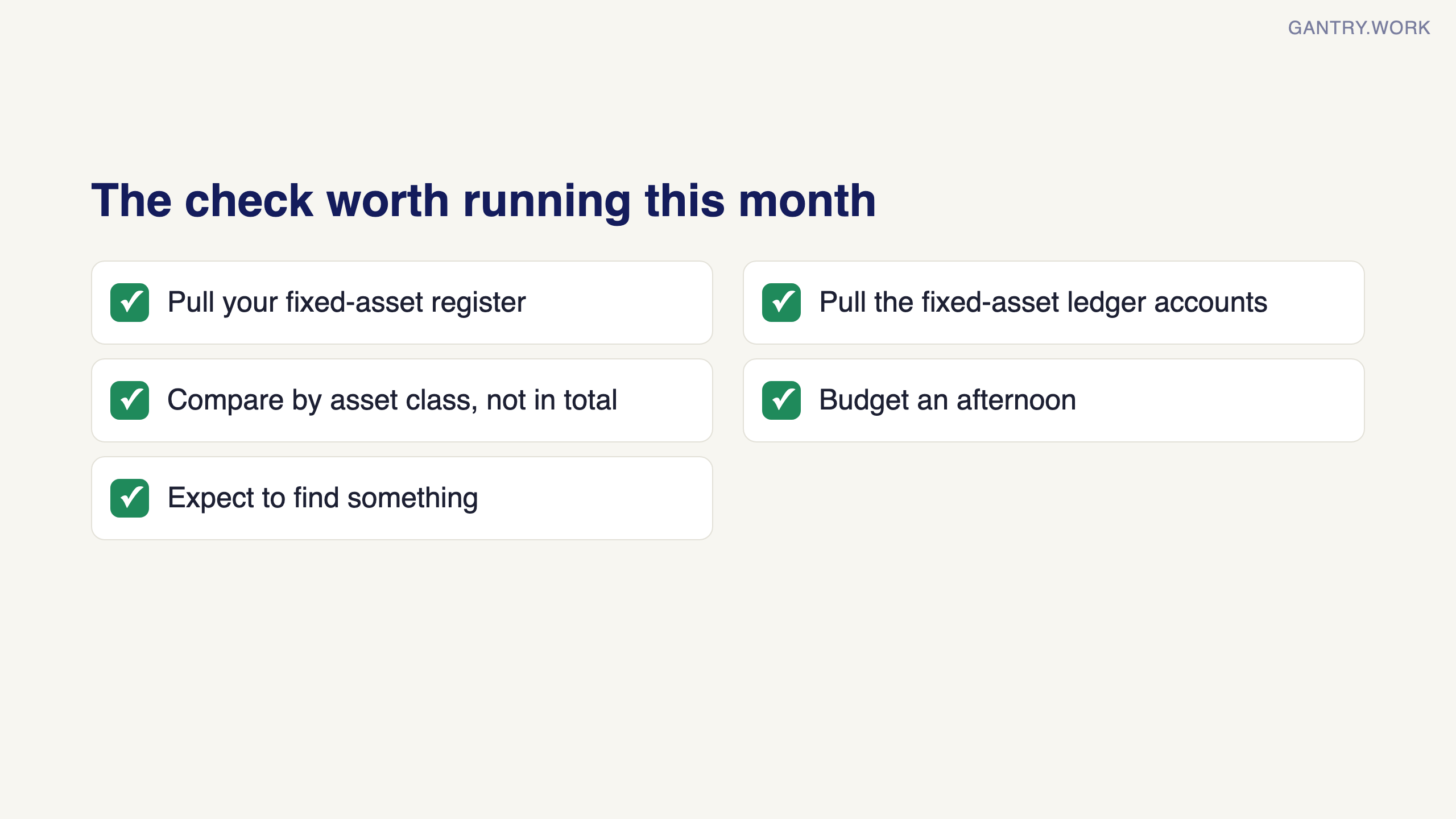
Pull your fixed-asset register. Pull your fixed-asset general ledger accounts. Compare them by asset class, not in total.
If you have never done this, budget an afternoon and expect to find something. Nearly every business I have run this on has a gap somewhere — usually smaller than this one, occasionally larger.
The Systems Health Check has a section on exactly this kind of blind spot: places where two records that should agree have never been compared. Ten questions, sixty seconds, no signup.
Working on something similar? Connect with me on LinkedIn and tell me what you are working on. I read and reply to every message, and the questions people send become the next guides.
Want a second pair of eyes on your setup? Bring the process that keeps going wrong to a free 20-minute systems review. I'll tell you honestly what to fix first, or whether you need anything new yet.
How I test everything and how this site makes money: How The Gantry works.