

A progress claim in Singapore is a contractor's claim for the value of work done to date, less retention and less what has already been claimed. Under the Building and Construction Industry Security of Payment Act (the SOP Act), it is called a payment claim. A usable progress claim template shows the contract and claim reference, the cut-off date, each work item with its contract value and percentage complete, approved variations, retention, previous claims, the amount claimed this period, and GST if you are registered.
Below is the field-by-field format, a worked claim with real numbers, the SOP Act deadlines that apply when your contract is silent, and how retention release usually works. This is practical guidance, not legal advice: your contract and the Act always come first.
Progress claim, payment claim, progress billing: same thing?
Mostly, yes.
Progress claim is what the industry calls it on site and in the QS office.
Payment claim is the statutory term in the SOP Act. When a progress claim is served under the Act, it is a payment claim, and the Act's timelines apply.
Progress billing is the accounting and US term for the same idea: billing in stages as the work progresses, rather than once at the end.
Milestone billing is a variant where you bill fixed amounts when defined stages are reached ("first fix complete"), rather than by measured percentage.
The SOP Act covers written contracts for construction work, and for the supply of goods or services for construction projects in Singapore. It does not cover residential works that need no plan approval under the Building Control Act, so an HDB renovation with no structural works is outside it.
What a progress claim template should include
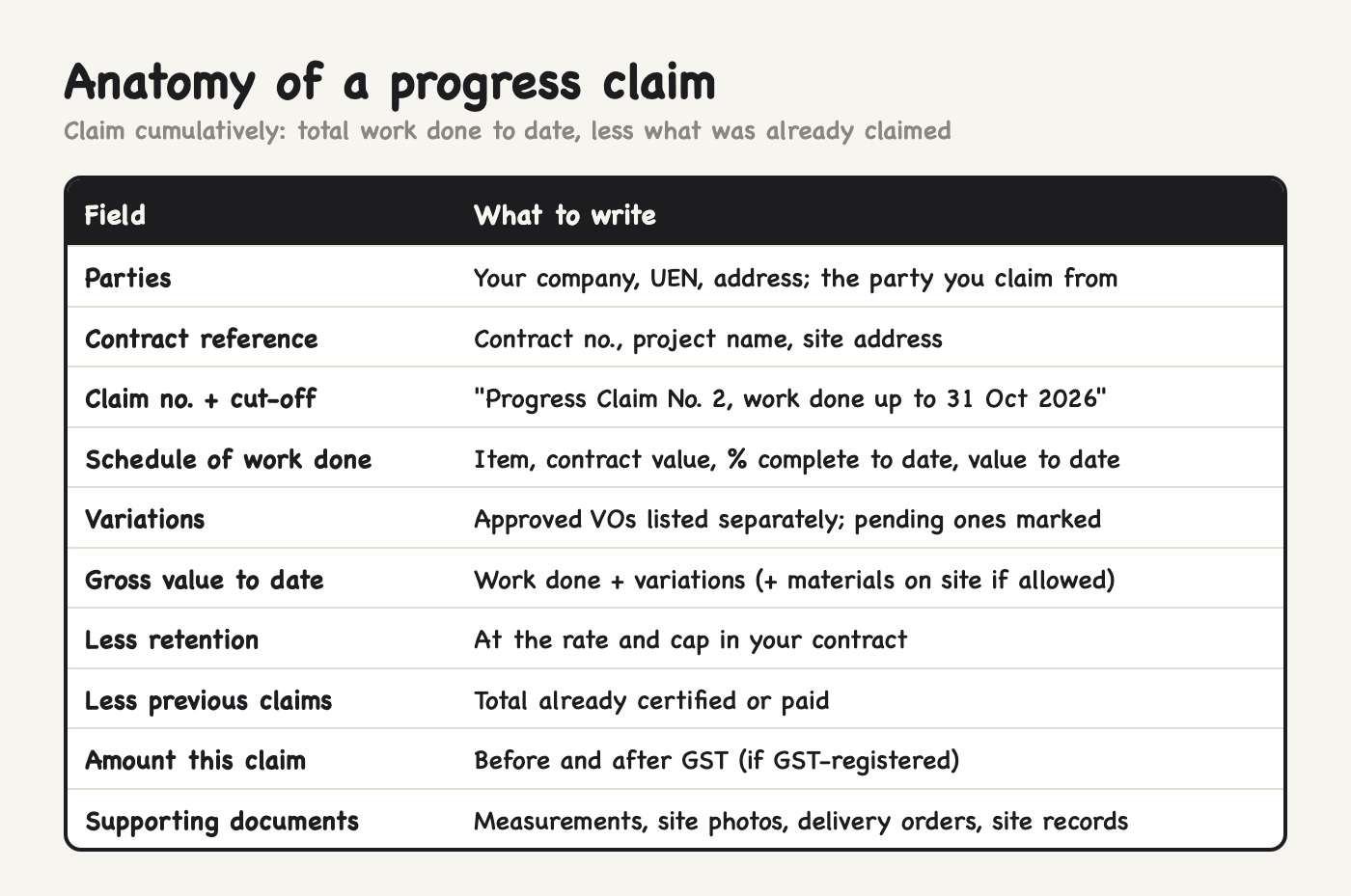
Use one claim document per contract per period, and always claim cumulatively: show the total value of work done to date, then deduct what has already been claimed. Cumulative claims are easier to check and harder to dispute than "this month's work" lists.
The fields:
Claimant and respondent. Your company name, UEN and address; the party you are claiming from.
Contract and project reference. Contract number, project name and site address.
Claim number and cut-off date. "Progress Claim No. 2, work done up to 31 October 2026."
Schedule of work done. Each item or stage from the contract breakdown, with contract value, percentage complete to date, and value of work done to date.
Variations. Approved variation orders listed separately, with their own values to date. Keep unapproved variations off the claim, or list them clearly as pending, so they don't hold up the rest.
Materials on site (if your contract allows it).
Gross value to date. Work done plus variations plus materials.
Less retention. At the rate and cap your contract sets.
Less previous claims certified or paid.
Amount claimed this period, before and after GST if you are GST-registered.
Supporting documents. Measurement sheets, site photos, delivery orders, signed site records.
BCA publishes sample payment claim and payment response forms on its Security of Payment pages. They are a good base for a template; add your own work breakdown and retention lines.
A worked progress claim
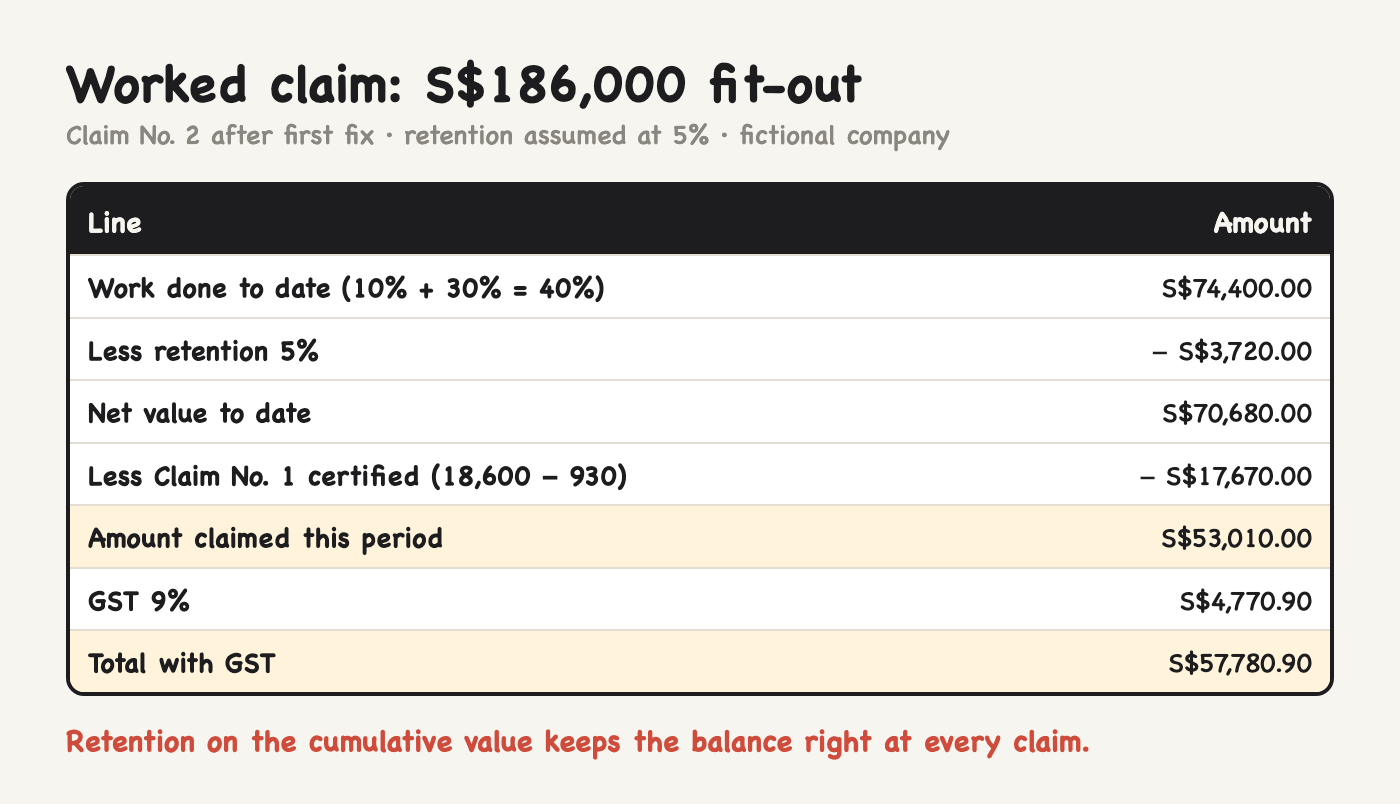
Take a fictional M&E contractor with a S$186,000 ACMV and electrical fit-out for a clinic. The contract is billed in four stages: mobilisation 10%, first fix 30%, second fix 30%, testing and handover 30%. Assume the contract sets retention at 5% of the value of work done.
Claim No. 1 (mobilisation) was S$18,600, less 5% retention of S$930, so S$17,670 was certified and paid.
Claim No. 2, after first fix:
Work done to date: mobilisation 10% + first fix 30% = 40% of S$186,000 = S$74,400
Less retention at 5%: S$3,720
Net value to date: S$70,680
Less previous claims certified: S$17,670
Amount claimed this period: S$53,010
GST at 9%: S$4,770.90
Total with GST: S$57,780.90
Notice that retention is calculated on the cumulative value, and the previous claim is deducted net of its own retention. That keeps the retention balance correct at every claim: here S$3,720 is now held.
The gap a progress claim is meant to close
Here is the same contract in the contractor's system. The order line shows the contract quantity as one unit at S$186,000. "Delivered" is 0.40 because the first two stages are marked reached on site. "Invoiced" is 0.10 because only mobilisation has been billed.
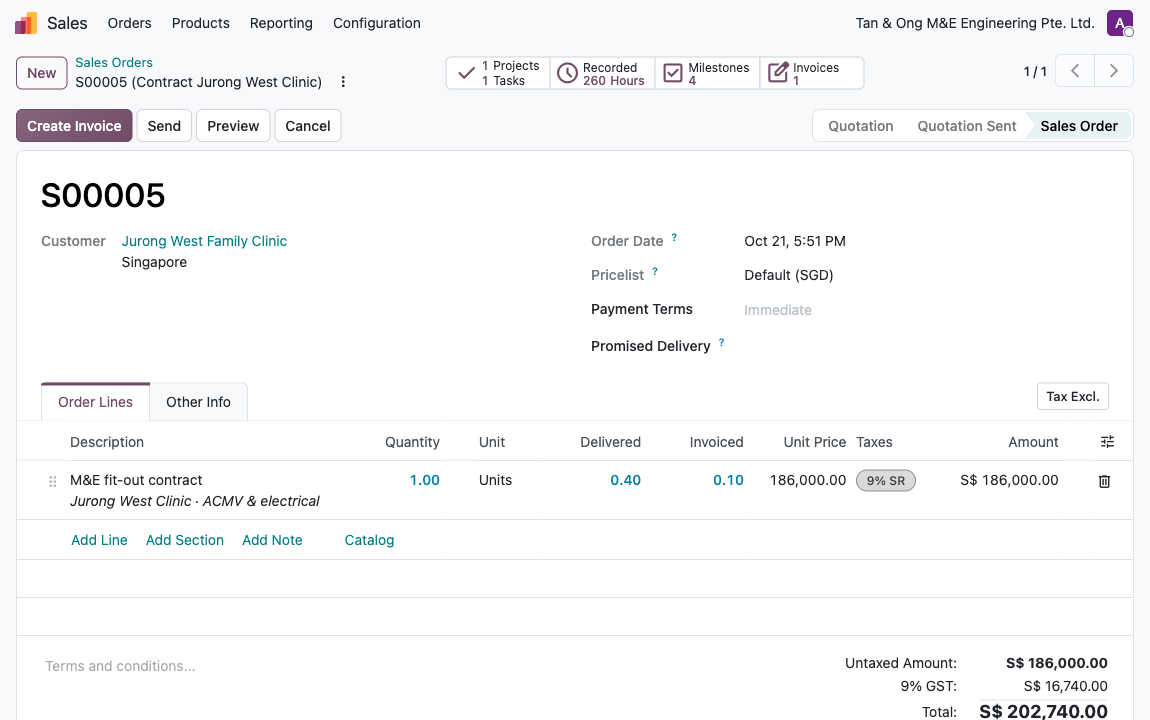
That 30-point gap is S$55,800 of finished work that has not been claimed, while materials and wages for it have already been paid. In a lot of small firms the gap is not a dispute. It is admin: the site team knows first fix is done, but nobody tells the person who prepares claims until the end of the month, or the month after.
The fix is to make "stage reached" and "claim ready" the same event. When the project manager marks the milestone reached, the claim amount is calculated and waiting to be sent. I covered how construction firms set this up in ERP for construction firms: progress claims, retention and margin.
SOP Act deadlines when your contract is silent
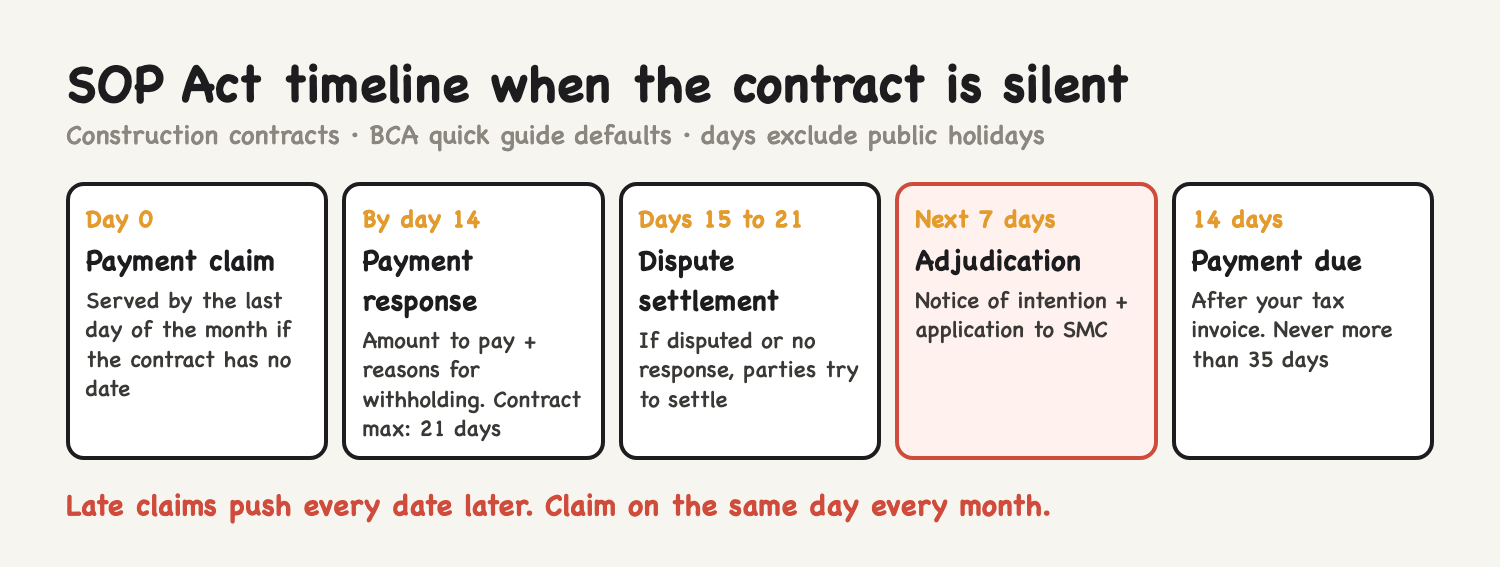
If your contract sets dates, follow the contract, within the limits of the Act. If it doesn't, BCA's quick guide sets out the statutory defaults for construction contracts:
Serving the payment claim: by the last day of the month, if the contract doesn't specify a date or period.
Payment response: the respondent must issue it within 14 days of the claim being served. A contract can allow up to 21 days, not more. The response states the amount they propose to pay and the reasons for withholding anything.
Dispute settlement period: if the response disputes the amount, or no response is issued, there is a dispute settlement period (days 15 to 21 under the default timeline) for the parties to resolve it.
Adjudication: if it is not resolved, the claimant can serve a notice of intention and apply for adjudication within the next 7 days. Applications go to the Singapore Mediation Centre.
Payment: once you accept the response by issuing your tax invoice, payment is due within 14 days of the tax invoice if the contract is silent, and never more than 35 days under any contract.
Statutory "days" here exclude public holidays. Adjudication is designed to be fast and cheap: BCA lists an application fee of S$600, and the adjudicator's fee is capped at S$2,400 for claims below S$24,000 and at 10% of the claimed amount above that (both before GST).
A practical note on GST: under the SOP Act flow, the tax invoice usually follows the payment response, for the agreed amount. IRAS generally expects a tax invoice within 30 days of the time of supply, and payment received also triggers the time of supply, so keep the claim, the response and the tax invoice linked in your records. The free GST calculator is handy for checking claim totals.
When should retention money be released?
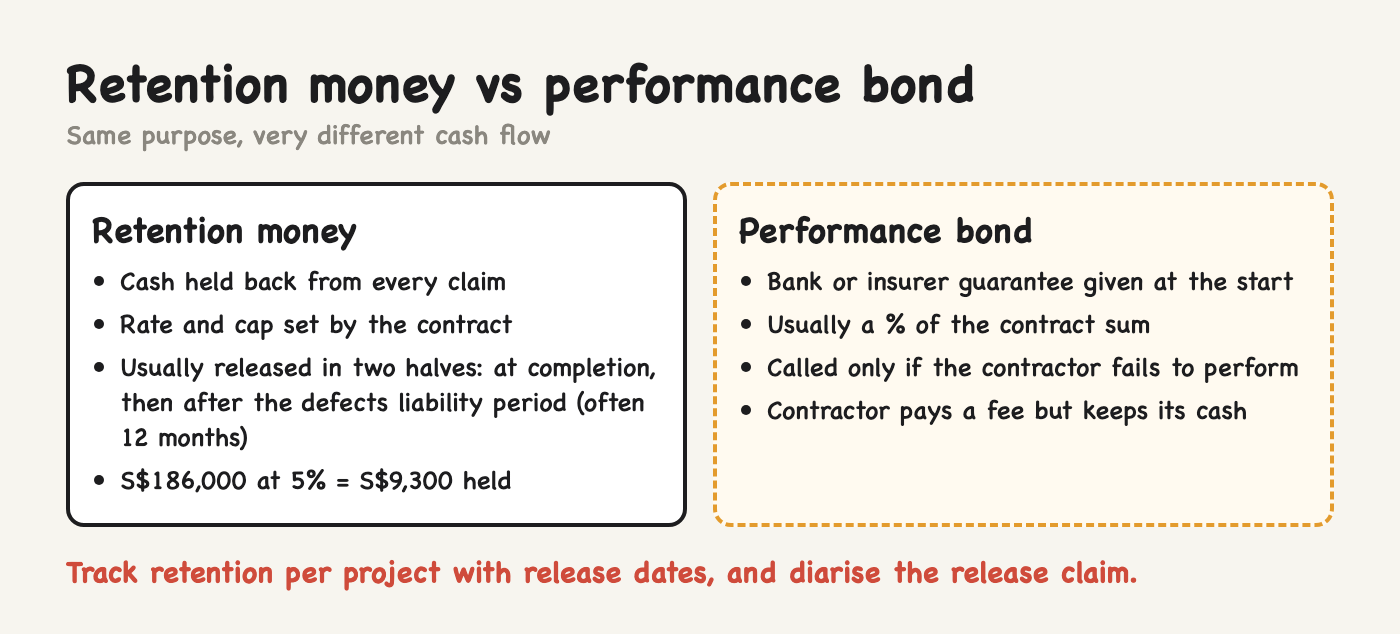
Retention is part of each claim that the employer or main contractor holds back as security against defects. The rate, cap and release terms come from your contract, so read those clauses before you price the job. The common pattern in Singapore contracts is a two-stage release:
The first half is released when the works are certified complete (the completion or practical completion certificate).
The second half is released at the end of the defects liability period, often 12 months after completion, once defects are rectified and the maintenance or final certificate is issued.
Retention is easy to forget because it sits outside the normal claim cycle for a year or more. Track it per project, with the release dates, and diarise the release claim. On a S$186,000 job at 5%, that is S$9,300 that otherwise stays in someone else's bank account.
Retention money vs performance bond
They protect the same party in different ways.
Retention money is cash held back from each claim. It hits the contractor's cash flow every month until it is released.
A performance bond is a guarantee from a bank or insurer, usually a percentage of the contract sum, given at the start of the job. The employer can call on it if the contractor fails to perform. The contractor pays a fee for the bond but keeps its cash.
Some contracts require both. Others allow a bond in place of retention, which is worth asking for if your cash flow is tight.
Getting progress claims out on time
Three habits make the biggest difference:
Claim on the same date every month, even when the amount is small. Late claims push every SOP Act date later.
Keep variations moving. Get site instructions confirmed in writing and priced quickly, so approved variations can go on the next claim.
Link site progress to billing. Whether you use a spreadsheet or a system, the person who prepares claims should see stage completion the day it happens, not at month-end.
If chasing slow payers is part of your month too, the payment reminder templates cover the polite, firm and final versions.
How long does it take your team today to raise a claim after a stage is done on site?
This article is general information, not legal advice. Check your contract and the current SOP Act and Regulations, and get advice on any dispute. The worked example uses a fictional company and assumed retention terms.
I'm Sayed. I help business owners automate their operations and set up the systems behind them: ERP, accounting, inventory, CRM and workflows. I write The Gantry about what actually works.